
This post contains affiliate links. If you buy something through my links, I may earn a small commission at no extra cost to you. I only recommend things I genuinely use or believe in.
A slanted ceiling is the one feature that makes people feel like they lost the bedroom lottery. You move in, you see the angle cutting across what should be your wall space, and the whole room suddenly feels like a puzzle you did not agree to solve. I know this feeling. I spent three months sleeping in a loft bedroom with a slope so aggressive that I could only stand upright in a 4-foot-wide strip down the center. I hated it for exactly three months. Then I figured out how it actually worked, and I have genuinely never wanted a regular flat-ceilinged bedroom since.
The slanted ceiling is not a design flaw. It is an architectural feature that almost every flat-ceilinged room lacks: built-in character. The angle creates a natural focal point, a sense of enclosure that reads as cozy rather than cramped when you work with it, and opportunities for storage and built-in styling that a standard square room simply cannot offer. The difference between a slanted ceiling that feels awkward and one that feels intentional is almost always just approach, not renovation budget.
These 11 small bedroom ideas with a slanted ceiling are the ones that actually work in a real compact space. Each one addresses a specific challenge the slope creates and turns it into something you can use.
Before we continue, if you’re tired of buying decor that doesn’t look right together, I created something specifically for this…
The Core Rule for Every Slanted Ceiling Bedroom
Before getting into specific ideas, there is one principle that makes every decision easier: stop treating the slope as a wall and start treating it as a ceiling. Most people mentally fight the angle by trying to hang things on it, furnish against it, or visually ignore it. The rooms that look intentional do the opposite. They acknowledge the slope architecturally, work with its lowest point as a built-in boundary, and use the tallest area of the room as the visual anchor for the space. Everything else follows from that reframe.
The low side of the slope is not wasted space. It is a zone with a specific set of uses. The high side of the room is where you stand, circulate, and anchor your main furniture. Once you know which is which, every decision about layout, storage, lighting, and decor becomes considerably more obvious.
11 Small Bedroom Ideas With a Slanted Ceiling
1. Tuck the Bed Under the Lowest Slope
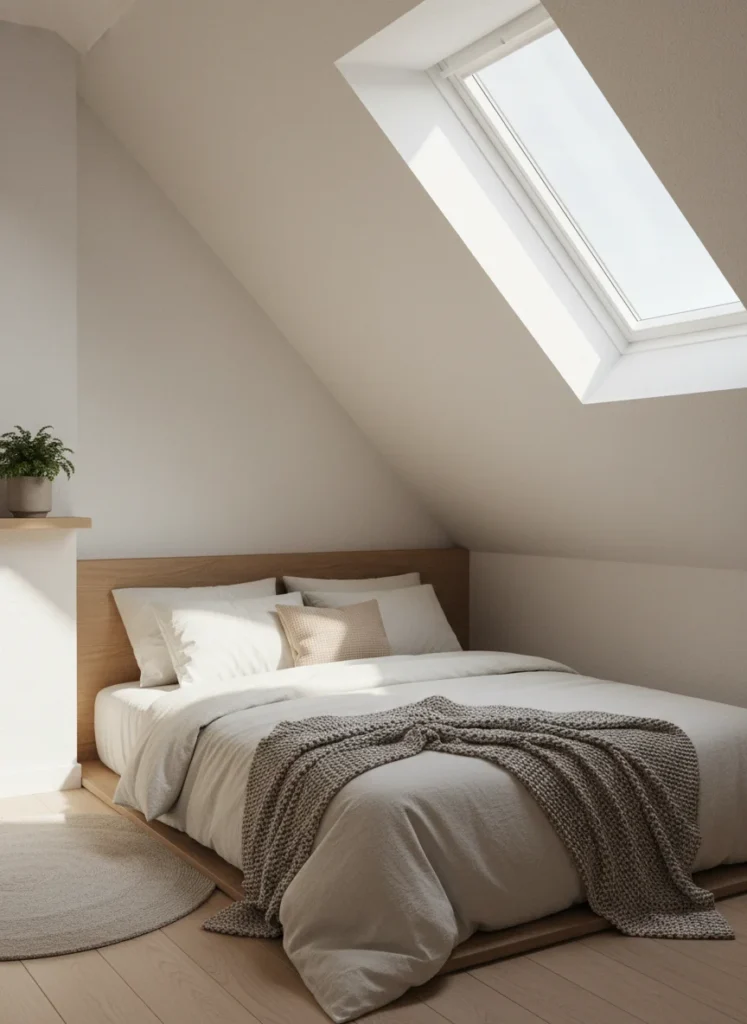
This is the move that transforms the slanted ceiling from obstacle to asset faster than anything else. Tucking the bed under the lowest portion of the slope creates a natural canopy effect, the kind of enclosed, cocoon-like sleeping space that people spend real money trying to recreate with actual canopy frames. The slope does it for free, and it does it permanently. The sleeping area feels like its own protected zone within the room, separate and deliberate.
The practical requirement is a low bed frame. You need a platform bed or a bed with a very low profile, ideally no more than 14 inches from floor to top of mattress, so that sitting up in bed is comfortable even under the angle. A low platform bed frame without a tall headboard is the right choice here, typically in the $80 to $180 range. Place the head of the bed against the perpendicular wall where the ceiling is at its highest, so you can sit up fully when you first wake up. The slope angles over the lower portion of the body where headroom is not needed during sleep.
This placement also naturally creates floor space along the taller wall for a wardrobe or dresser, which is where you want those items anyway since that is where you can stand upright to use them.
2. Build In or Style the Eaves for Storage
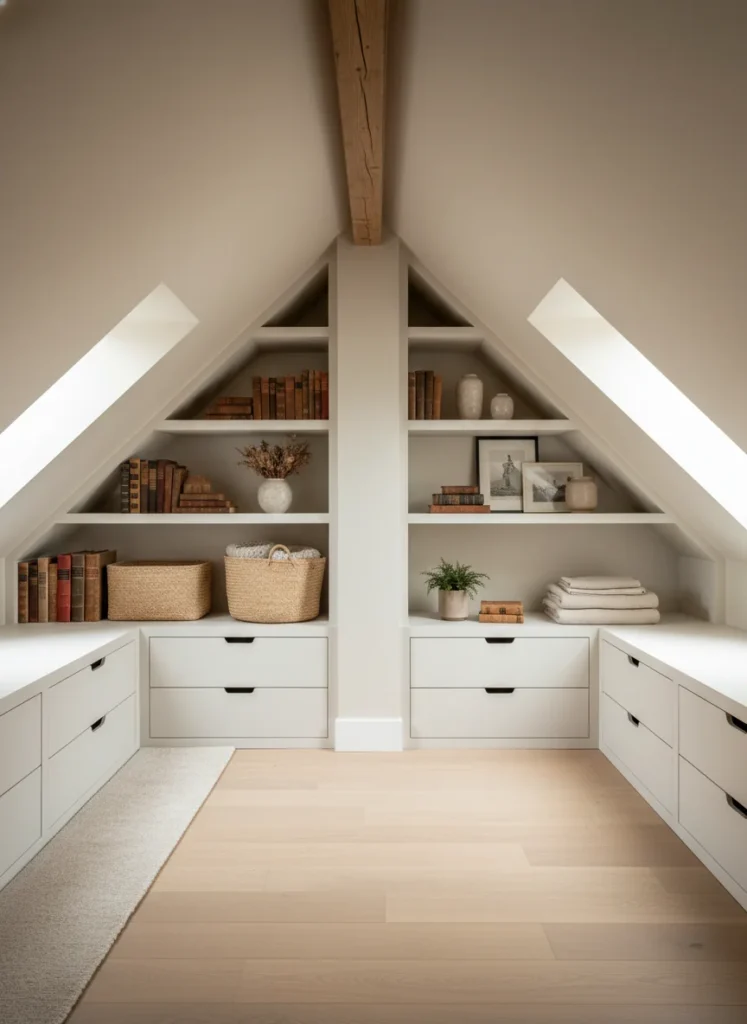
The dead zone under the eaves, the area where the ceiling drops so low that you cannot stand or really use it as open floor space, is actually the most valuable storage real estate in a slanted ceiling bedroom. It is fully enclosed space that would otherwise collect dust and function as a frustrating reminder of wasted square footage. With the right storage solution, it becomes the reason the rest of the room can stay clear and uncluttered.
Built-in fitted drawers following the exact pitch of the eave line are the most efficient solution, but they require a carpenter or significant DIY skill. The more accessible approach is to use low-profile storage that fits the height constraint: rolling storage bins on casters that slide under the lowest point, flat fabric bins stacked in the eave zone, or low open shelving units no taller than the eave clearance at their back. IKEA’s KALLAX unit in the shorter 2×2 configuration at 30 inches tall fits under many standard eave lines while providing four substantial storage cubbies. I covered the best ways to use IKEA for small bedroom storage in this post on IKEA small bedroom hacks that make a $200 room look like a $2000 room, and several of those solutions work directly in the eave zone.
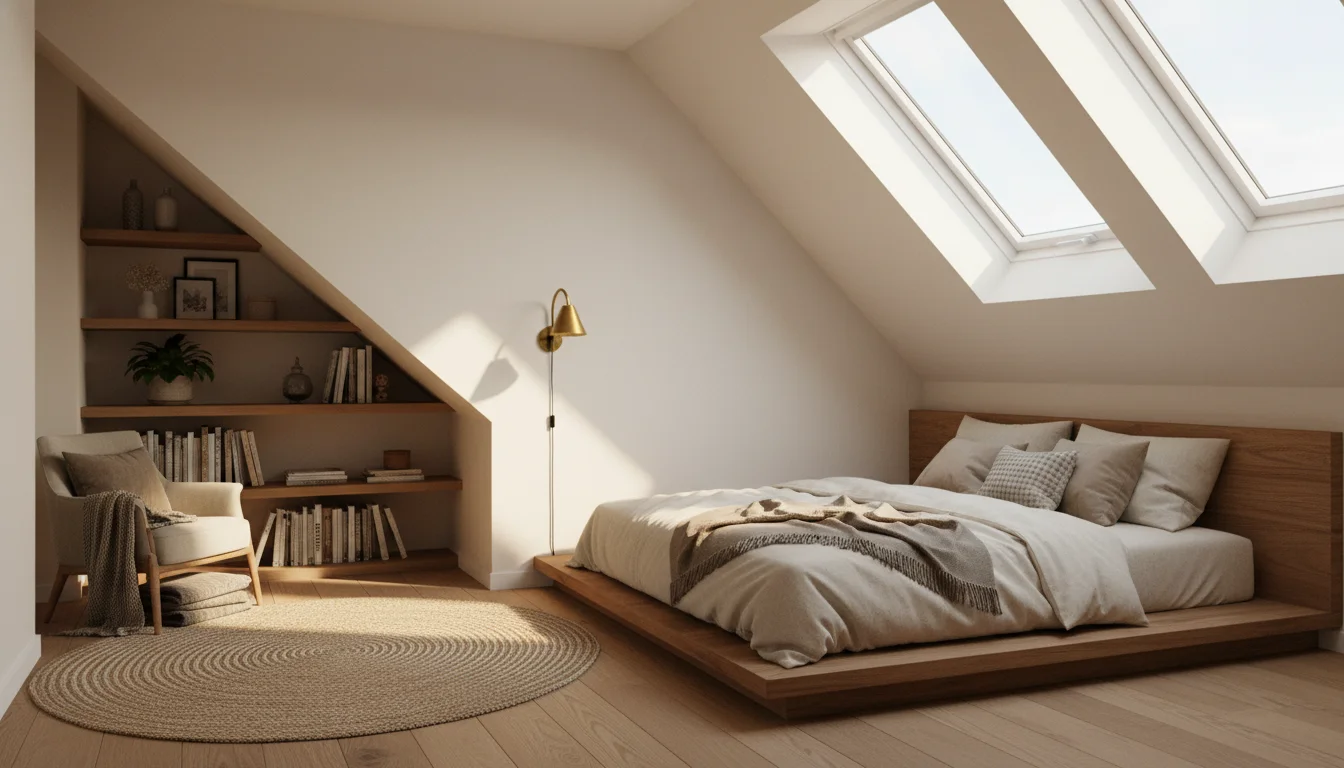
The styling approach, for people who want form as well as function, is to use the eave shelf zone for books, baskets, and small decor items arranged at varying heights within the constraint. The low ceiling above the shelf creates a natural display niche that reads as an architectural built-in rather than a workaround.
3. Use Wall-Mounted Sconces Instead of Floor Lamps
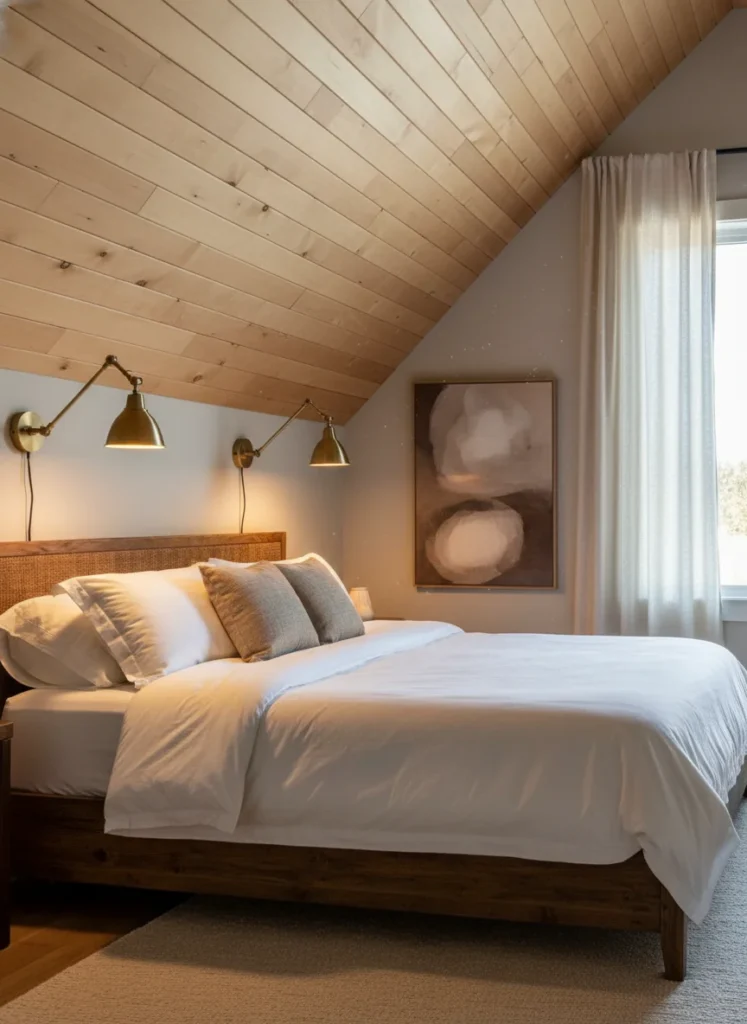
Floor lamps are the first piece of furniture that fails in a slanted ceiling bedroom. The shade of a standard floor lamp typically sits at the same height as the low point of a moderate slope, which means either the lamp does not fit under the slope or the shade is awkwardly visible at an angle that looks unintentional. Table lamps on nightstands have the same issue in a more compact form: the lamp competes for the limited surface space beside a low bed under a slope.
Wall-mounted plug-in sconces are the solution that most slanted ceiling bedrooms need and most people do not think of first. Mounted directly on the angled slope wall at bed level, they take up zero floor space, zero nightstand surface space, and they solve the headroom constraint entirely because the sconce sits flat against the wall rather than projecting upward into limited clearance. A pair of plug-in swing-arm wall sconces mounts with two screws or even Command strips for lighter models, and runs about $35 to $60 for a pair. I covered sconce lighting in more detail in this post on quiet luxury bedroom ideas on a budget, where the sconce argument applies equally to any bedroom with a lighting constraint.
4. Paint the Ceiling and Walls the Same Color
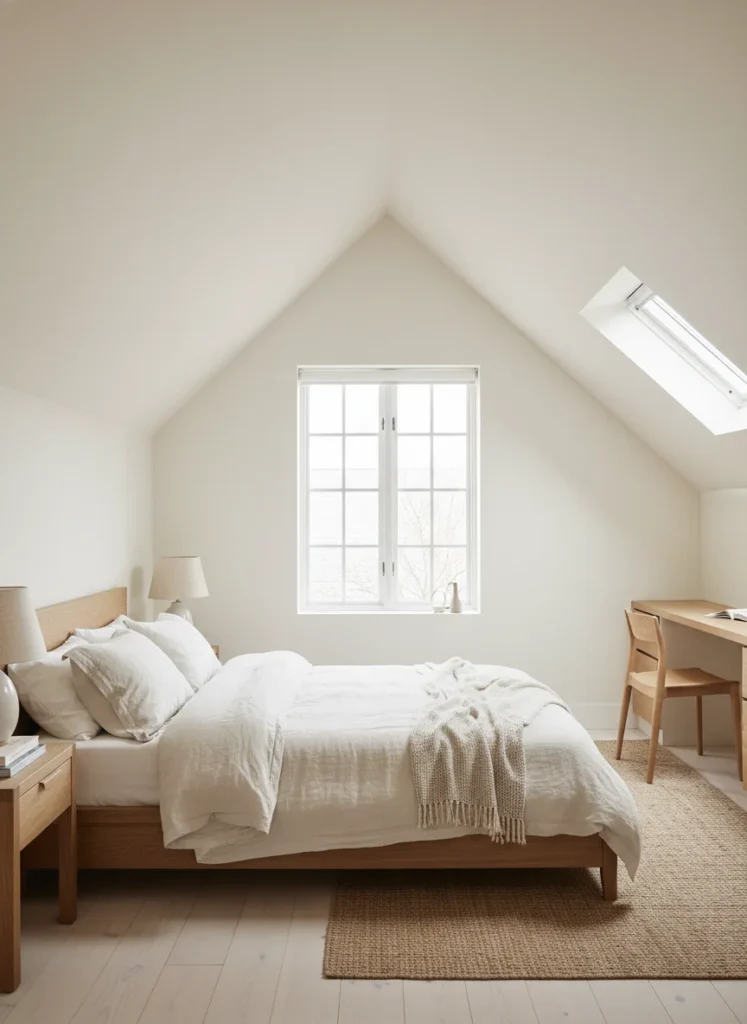
The visual problem with a slanted ceiling is the line where the wall transitions into the slope. That line draws attention to the angle, emphasizes the height change, and makes the room feel geometrically complicated rather than architecturally interesting. The fastest way to neutralize this visual complexity is to eliminate the line entirely by painting both the wall and the ceiling the same color. Color drenching, as interior designers call it, makes the room read as one continuous shell rather than a surface interrupted by an awkward angle.
The color you choose matters. In my testing of the best paint colors for small bedrooms, warm white and soft greige proved to be the most effective shades for dissolving harsh slope transition lines. A deeper tone, like charcoal or forest green, creates a dramatic cocoon effect that can actually feel more spacious than a small room painted in mismatched light tones, because the enclosed consistency reads as intentional rather than constrained. If you want subtle depth across these angled planes without flat paint glare, exploring textured limewash bedroom ideas can give sloped drywall an organic mineral finish that diffuses sunlight beautifully. Whatever you choose, the ceiling and wall need to be the same shade from the same tin.
For renters who cannot paint, the same principle applies through soft furnishings: matching the curtain color to the wall color, using bedding in the same tone as the walls, and minimizing any color that contrasts with the ceiling. The less your eye has to distinguish between surfaces, the less the angle becomes a feature to process.
5. Create a Reading Nook in the Deepest Corner
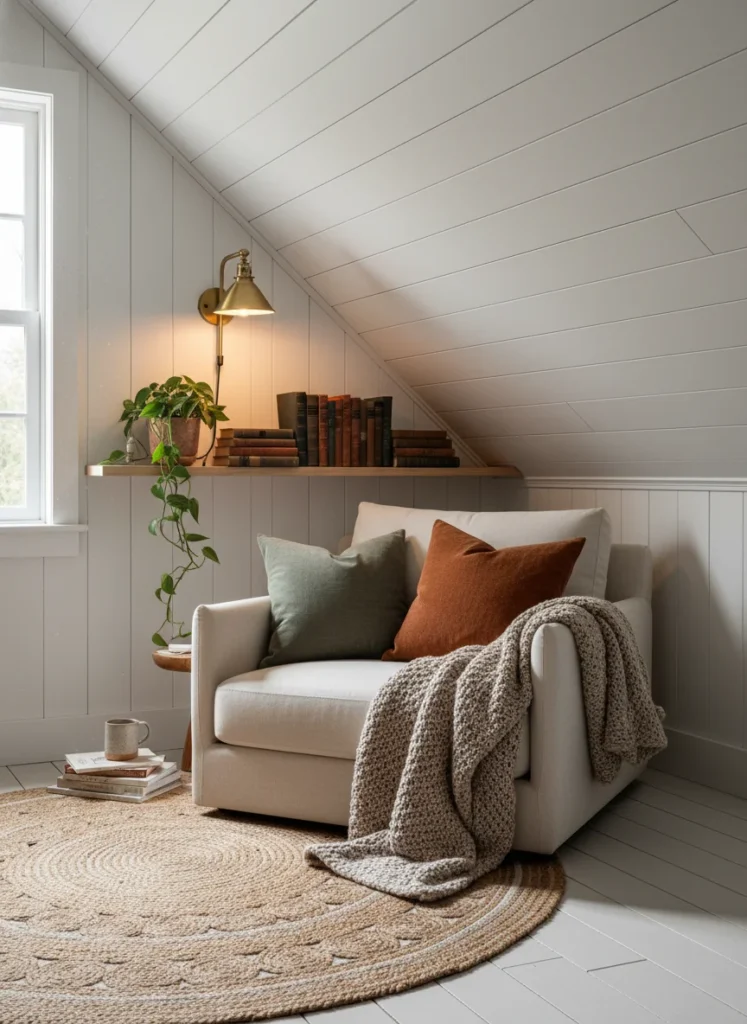
The corner where the ceiling is at its lowest is the space that most people treat as a dead zone and then feel guilty about ignoring. It is actually the perfect footprint for a reading nook precisely because of the low ceiling overhead. A reading nook is meant to feel enclosed and separate from the rest of the room. The slope provides that quality without any construction. All you need is a low-profile chair or a floor cushion that fits within the height constraint, a small side surface or wall-mounted shelf for a book and a drink, and a sconce or clip-on reading light mounted on the angled wall above.
The furniture requirement is specific: the seat height plus the head height of a sitting person needs to clear the ceiling at that point. Most adults sitting in a low saucer chair or floor cushion need about 48 to 52 inches of clearance. A papasan-style low chair at 10 inches seat height with a 36-inch average sitting head height needs 46 inches total, which clears even moderate slopes at the corner point. A small area rug in a contrasting texture defines the nook as its own zone within the bedroom, which is useful in a small room because it makes the space feel like it has multiple distinct areas rather than one undifferentiated room.
6. Install a Skylight or Maximize the Window
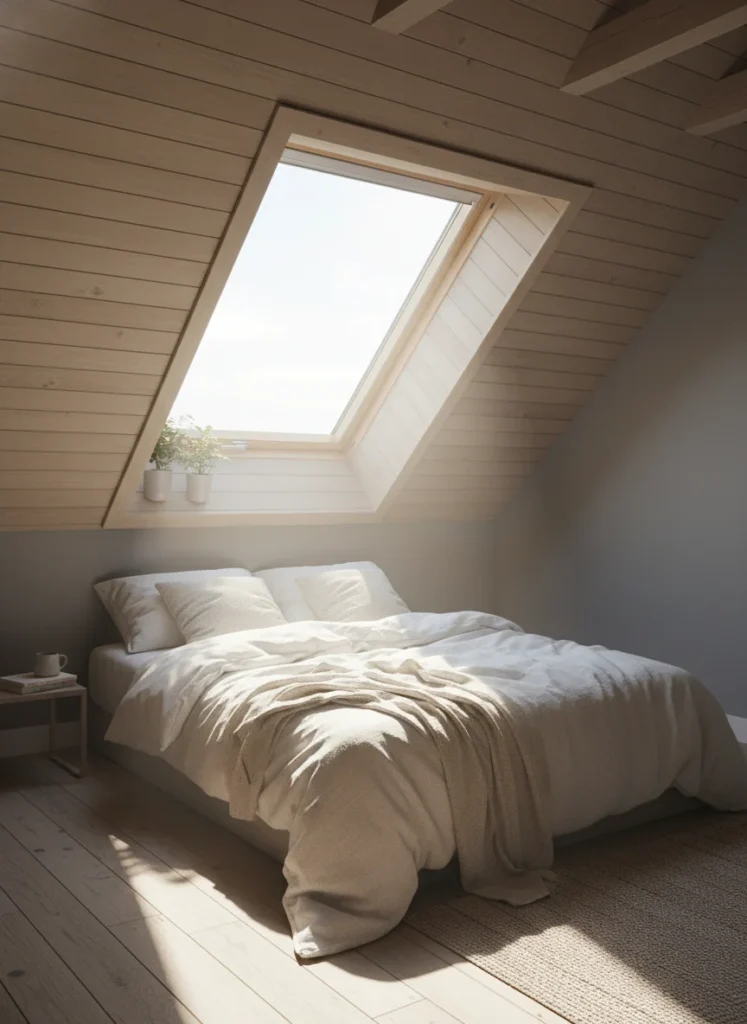
This is the one idea on this list that requires a real investment and potentially professional installation, but it belongs here because it is the change that has the single highest impact on a slanted ceiling bedroom. A rooflight or skylight built into the slope does something that no amount of furniture arrangement or paint color can accomplish: it turns the ceiling itself into a source of natural light. The slope stops being a constraint and starts being the reason the room is filled with a quality of light that flat-ceiling rooms simply cannot get.
For those who cannot install a skylight, the equivalent principle applies to the existing windows. Slanted ceiling attic rooms typically have dormer windows or gable-end windows that are the only source of natural light. Keeping these completely uncovered during the day, using sheer window treatments rather than blackout curtains during non-sleeping hours, and placing a mirror on the opposite wall to reflect the window light throughout the room doubles the effective natural light in the space without any structural work. The mirror approach is discussed in depth in this post on how to make a small bedroom feel bigger, where natural light amplification through reflection is one of the highest-impact free changes available.
7. Use the Slanted Wall as an Accent Wall
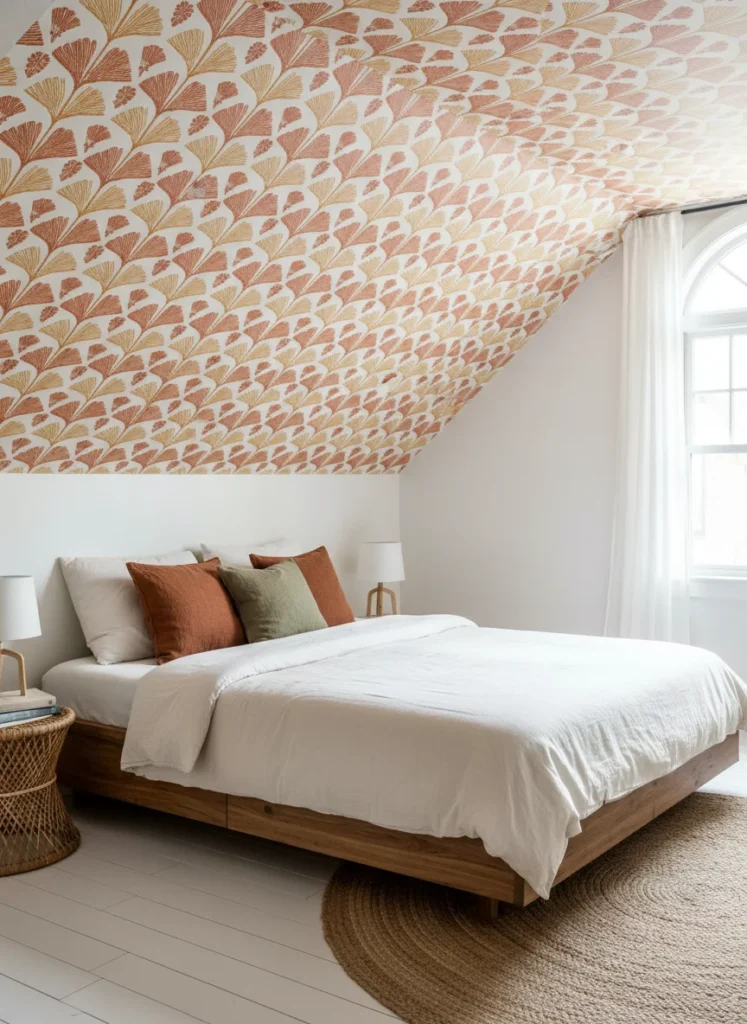
If the slope is going to dominate the visual field of the room regardless of what you do, the effective strategy is to make it worth looking at. Treating the slanted ceiling surface as an accent wall, using wallpaper, a contrasting paint color, wood paneling, or even a gallery arrangement, turns the architectural constraint into the most interesting surface in the room. The slope goes from being the thing you apologize for when guests see the room to the thing you point out first.
Peel-and-stick wallpaper is the renter-safe way to do this. Applied to the angled ceiling surface, a botanical print, a subtle geometric, or a textured grasscloth-look paper transforms the slope completely. The key is to choose a pattern with enough scale to read from below but not so large that it overwhelms the room. A pattern with a 6 to 8-inch repeat works well in most attic bedrooms. Wood shiplap paneling applied to the slope in a light natural tone is another strong option that reads as intentional and architectural without requiring paint. Both approaches are also excellent ways to add visual warmth to what can be a cold-feeling space in winter. For more on accent wall approaches that work without permanent changes, the post on renter-friendly bedroom ideas that require zero landlord permission covers peel-and-stick and panel-based options in detail.
8. Choose a Headboard That Follows the Angle
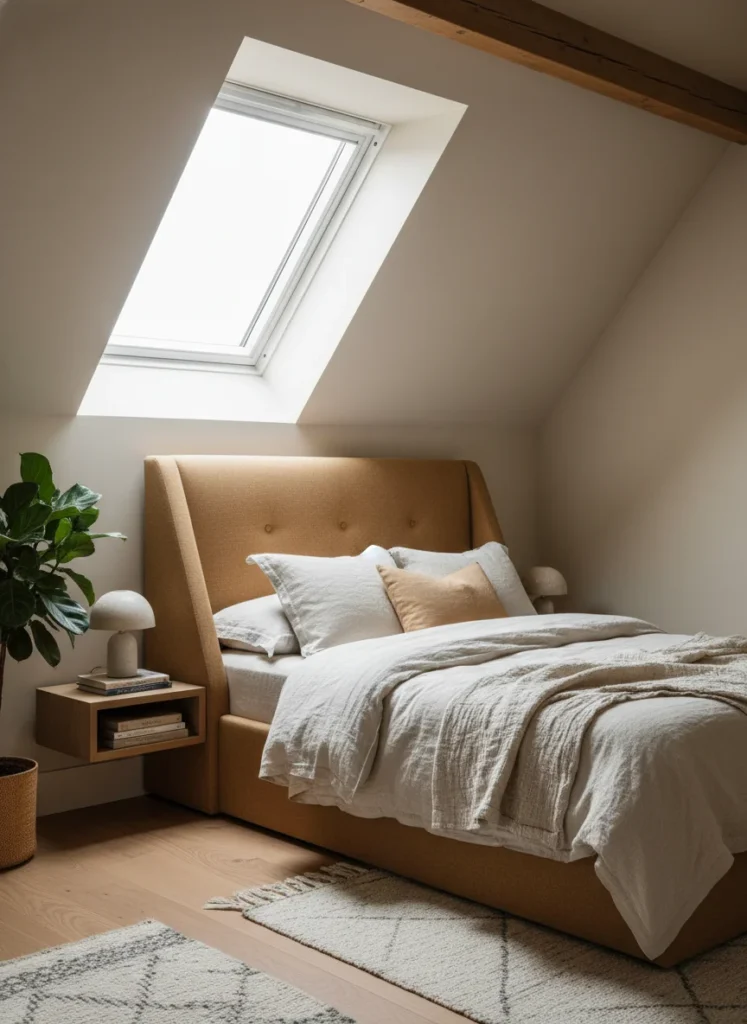
One of the most common frustrations in a slanted ceiling bedroom is placing a rectangular headboard against the angled wall and getting a gap between the top of the headboard and the slope above it. The gap reads as an oversight. It makes the placement look temporary and unconsidered. The solution is either to skip the traditional headboard entirely, using a wall-mounted upholstered panel cut to a wedge shape that follows the angle, or to use a very low headboard that stays well below the slope regardless of where the bed is placed.
A DIY wedge headboard is more achievable than it sounds. A piece of plywood cut at the angle of the slope, wrapped in batting and upholstered in linen or velvet fabric, and mounted to the wall with a French cleat, creates a headboard that fits the space with a precision that looks custom and expensive. The material cost for this is typically $40 to $80 depending on the fabric choice. Alternatively, a low-profile upholstered headboard under 24 inches in height positions the top of the headboard below the slope at most standard pitches, eliminating the gap problem entirely.
9. Mount Shelves Along the Highest Wall
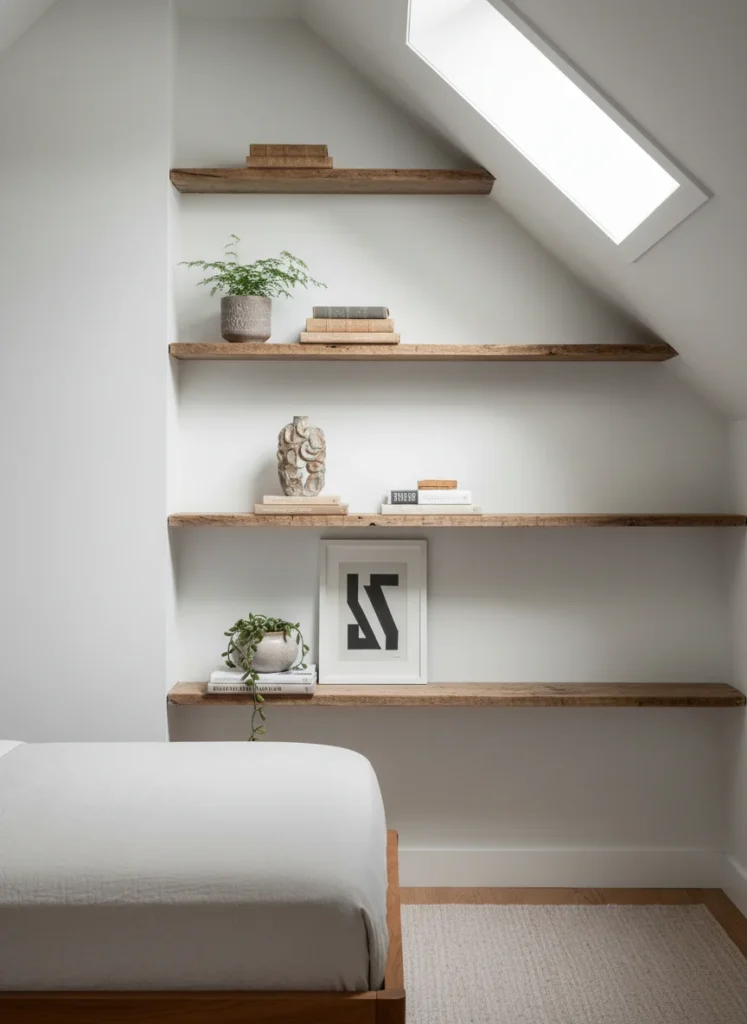
The wall at the highest end of a slanted ceiling room, the perpendicular wall where the ceiling meets its maximum height, is the one surface in the room where you can use vertical storage without constraint. This is where floor-to-near-ceiling shelving works, where a tall wardrobe fits, and where floating shelves stacked at multiple heights give you storage capacity that the rest of the room cannot offer. Using this wall deliberately and generously for storage means the rest of the room stays clear, which is what makes a slanted ceiling bedroom feel spacious rather than cramped.
Two or three floating shelves in solid wood or in a finish that matches the room’s tone, mounted at 36, 52, and 68 inches from the floor, give three distinct storage zones without any furniture footprint on the floor. The lowest shelf is accessible from a seated or short-standing position, the middle at standing height, the top for display objects or infrequently used items. Solid wood floating shelves in the 24-inch length run about $20 to $40 each. Mount them with standard shelf brackets and wall anchors, or use the bracket-free floating shelf hardware that gives a cleaner line against the wall.
10. Add LED Strip Lights Along the Slope Line
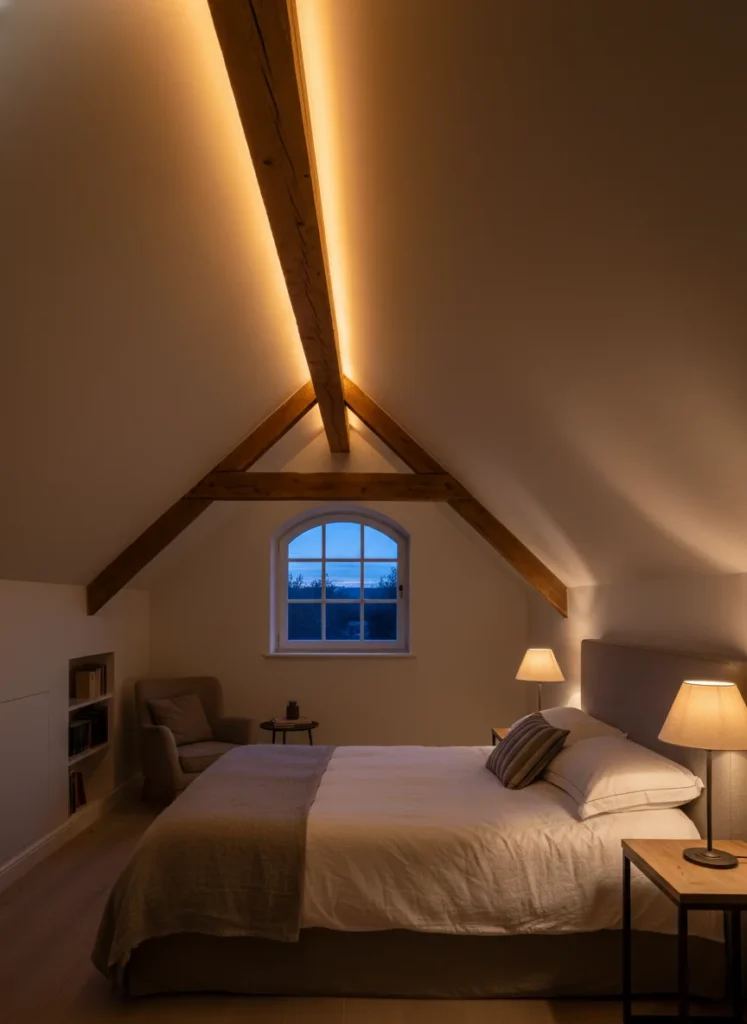
LED strip lights placed at the junction where the slanted ceiling meets the wall, tucked into a small channel or simply pressed along the edge, transform the slope from a geometric problem into a dramatic architectural element at night. The warm indirect light washes up the angled surface and emphasizes the slope rather than apologizing for it. The effect looks like something from a boutique hotel room and costs about $15 to $30 in LED strip lights and an afternoon of installation.
The critical detail is color temperature. Use 2700K warm white strips, never cool white or daylight temperature, because warm light on a slanted ceiling reads as atmospheric and moody. Cool light on a slanted ceiling reads as hospital. Dimmable strips are worth the slight extra cost because having full control over the intensity lets you use the ceiling lighting as ambient mood light in the evening and brighter task light when needed. Dimmable warm white LED strip lights with an adhesive backing and a compatible dimmer switch run about $20 to $35 for a 16-foot kit, which covers most standard room perimeters with some left over.
11. Use Low Furniture Consistently Throughout
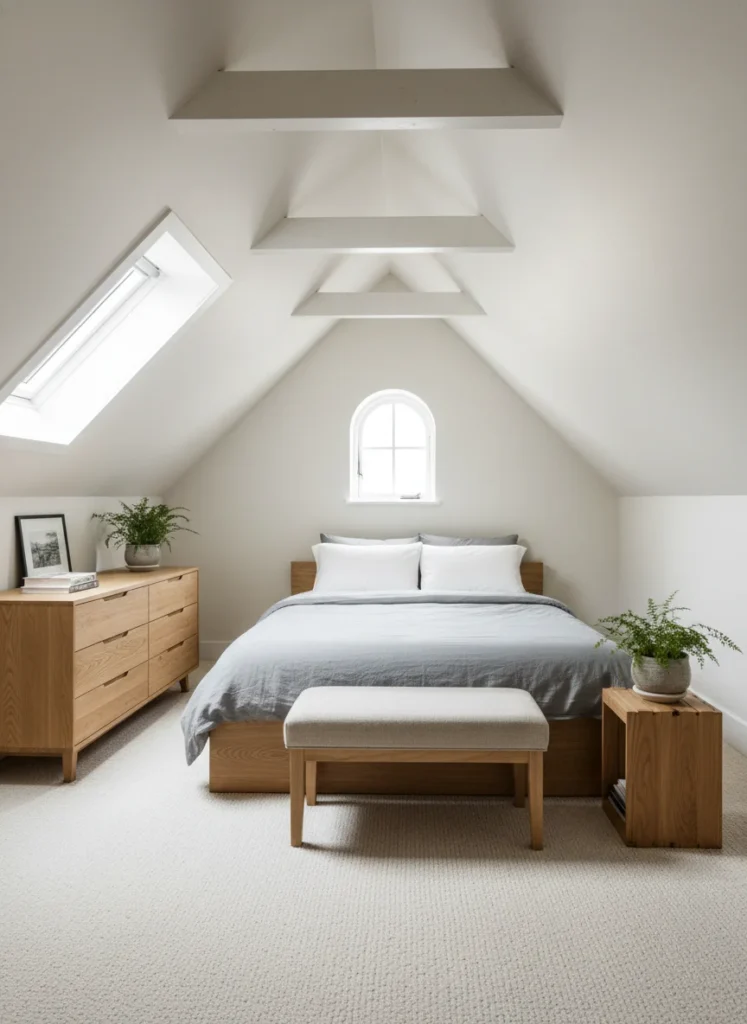
The single most cohesive thing you can do in a slanted ceiling small bedroom is apply the low furniture principle consistently across every piece in the room, not just the bed. A low bed combined with a standard-height dresser creates a visual inconsistency where one piece fits the room and one fights it. A low bed, a low dresser at 32 to 36 inches, a low bench or storage ottoman at the foot of the bed, and low bedside surfaces all reading at a similar height create a strong horizontal line through the room that makes the ceiling space above feel deliberately generous rather than accidentally constrained.
This approach also has a practical benefit: in a slanted ceiling bedroom, every inch of usable headroom is valuable when you are getting dressed or moving around the room. Keeping furniture low means you never have to navigate around a tall piece that occupies the only zone where the ceiling is high enough to stand. The full height of the room remains accessible for circulation. For more on furniture proportions that make small rooms feel bigger, the post on how to make a small bedroom feel bigger covers scale and furniture proportion in detail. And if you are working from a very tight budget, the ideas in this post on free ways to make your bedroom look expensive this weekend include several rearrangement-based moves that apply directly to slanted ceiling spaces.
The Slanted Ceiling Bedroom That Wins
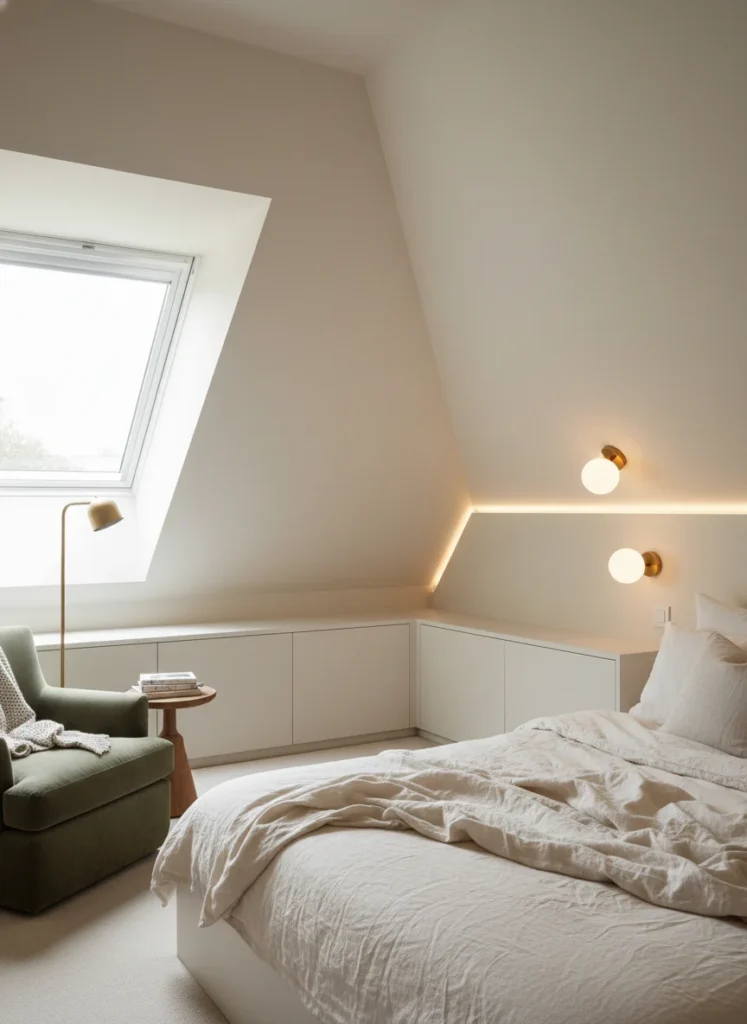
The slanted ceiling bedrooms that look genuinely beautiful in photographs, and more importantly feel genuinely comfortable to live in, all share one characteristic: the person who decorated them stopped apologizing for the angle and started working with it. The slope is not a problem to hide. It is the reason the room has character that a standard rectangular box bedroom never will.
Start with the bed placement, low and tucked under the slope. Add the wall sconces. Paint the ceiling and walls the same color if you can. Everything else on this list builds on those three decisions, and the room will look more intentional with each addition. A slanted ceiling small bedroom done well is not a compromise. It is genuinely one of the most interesting sleeping spaces you can create, and people will walk in and ask who designed it.