
This post contains affiliate links. If you buy something through my links, I may earn a small commission at no extra cost to you. I only recommend things I genuinely use or believe in.
Here is the counterintuitive truth about small bedrooms and scent: they actually have an advantage. Less air volume means fragrance molecules concentrate faster and linger longer. A single reed diffuser that would be invisible in a large open-plan room fills a 100-square-foot bedroom completely within an hour. You need less product, not more. The mistake most people make is treating a small room like a large one, piling on air fresheners and candles until the whole space smells like a department store fragrance counter at noon.
The other truth competitors almost never say: the smell in your bedroom is not coming from the air. It is coming from your textiles. Bedding, curtains, rugs, and upholstered headboards are porous. They absorb body oils, sweat, and dead skin cells at a rate that the air in your room simply cannot. Address the textiles first and everything else becomes much easier. Spray all the linen spray you want over a pillowcase that has not been washed in ten days and you will still walk into that room and notice something is off.
These nine methods work in a small bedroom specifically. The quantities, placements, and product choices are calibrated for smaller spaces. Some of them cost nothing. None of them require a plug-in or a synthetic air freshener. If you are also working on making the room itself feel better to be in, the post on how to make a small bedroom feel bigger runs alongside this one perfectly.
💡 Before you start decorating, see how your room could look with AI.
🏡 See Your Room Before You Spend a Dollar
Still wondering if that new furniture, paint color, or decor style will actually look good in your space?
- Upload a photo of your room and let AI instantly generate beautiful design ideas.
- Explore different interior styles, furniture layouts, and color combinations before you spend a single dollar.
9 Ways to Make a Small Bedroom Smell Amazing All Day
1. Reed Diffusers, Used Correctly for a Small Room
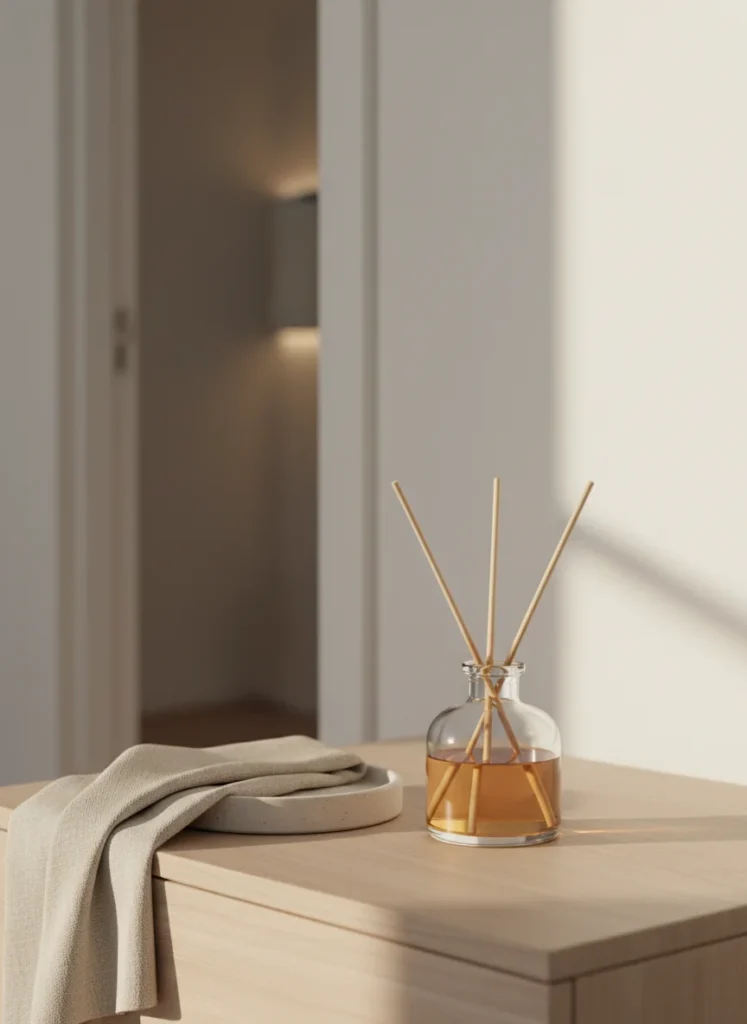
Reed diffusers are the single best all-day fragrance option for a small bedroom, and almost everyone uses them wrong in a small space. The packaging usually comes with eight to twelve reeds. In a room under 150 square feet, you want three to five, not the full bundle. More reeds means more evaporation surface, which in a small room creates a scent that overwhelms rather than welcomes. Start with four and adjust from there.
Placement matters more than most people realize. Do not tuck the diffuser into a corner shelf or a closet nook. Place it near the bedroom doorway or at the edge of a nightstand close to the entry point of the room. Air movement from opening and closing the door carries the scent inward each time. A diffuser sitting in a dead corner in a small room just sits there.
Flip the reeds every two weeks, not every few days. In a small room, daily flipping creates a sudden scent blast that reads as overwhelming rather than ambient. Every two weeks maintains a steady, low-level release. For scent profiles that work without suffocating a small space: eucalyptus, soft lavender, clean linen, cedarwood, or sandalwood. Avoid heavy musks, strong florals like tuberose or gardenia, and anything marketed as “warm and spicy.” Those scent families are designed for large rooms and become cloying fast in a small one. A good eucalyptus or clean linen reed diffuser in the 100ml range runs $15 to $25 and lasts about six to eight weeks in a small bedroom with four to five reeds.
2. Linen Spray on Bedding Every Morning
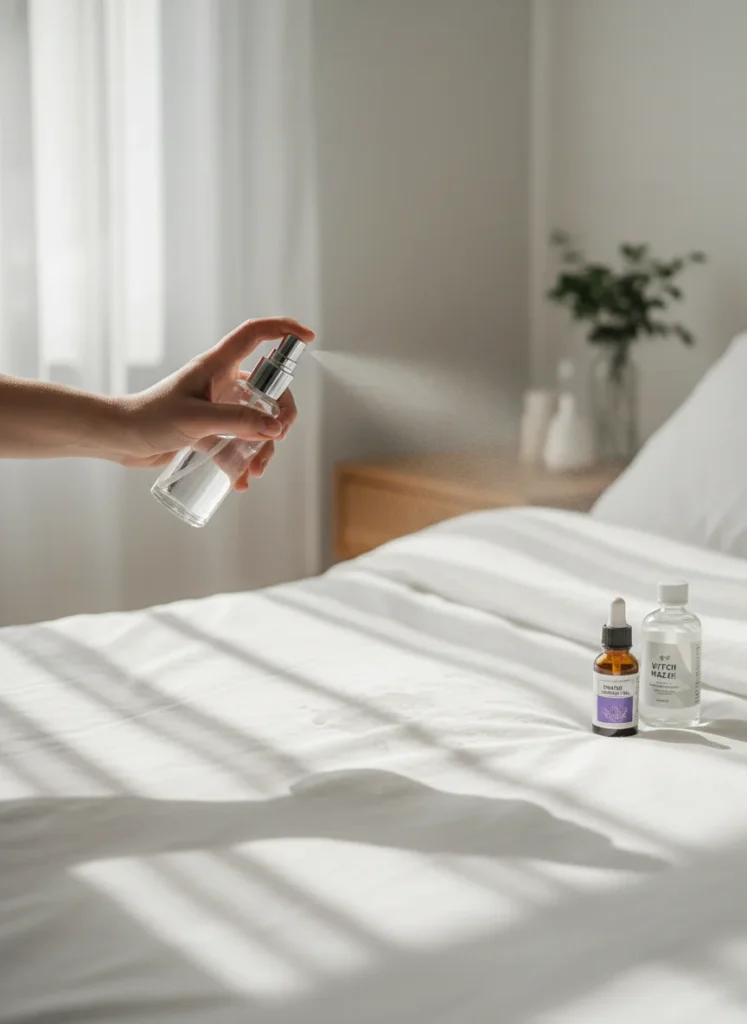
Linen spray and fabric freshener are not the same product, and the difference matters on bedding. A true linen spray is water-based, formulated to be gentle against skin-contact fabrics, and designed to leave a subtle fragrance as it clings to textile fibers. Fabric fresheners like Febreze use odor-neutralizing chemistry that works well on couches and drapes but is too harsh for daily use on pillowcases you sleep against every night.
Application technique: hold the bottle twelve inches away from the surface and apply a light mist, not a soak. Mist once across the pillowcases and once across the top of the duvet cover, then let it dry completely before getting into bed or putting anything else on top of it. Saturating bedding with any spray creates a damp environment that encourages bacterial growth, which creates exactly the smell you are trying to solve.
The DIY version costs under $8 total and works as well as anything sold commercially. Combine two ounces of witch hazel with four ounces of distilled water and ten to fifteen drops of lavender essential oil in a small two-ounce spray bottle. Shake before each use. The witch hazel acts as an emulsifier to keep the oil dispersed in the water and also contributes a very mild antiseptic quality. A commercial lavender linen spray in the $10 to $18 range is a good option if you want something already formulated. Scent families that work especially well on bedding: lavender, clean cotton, light eucalyptus, and chamomile.
3. Wax Melts in an Electric Warmer
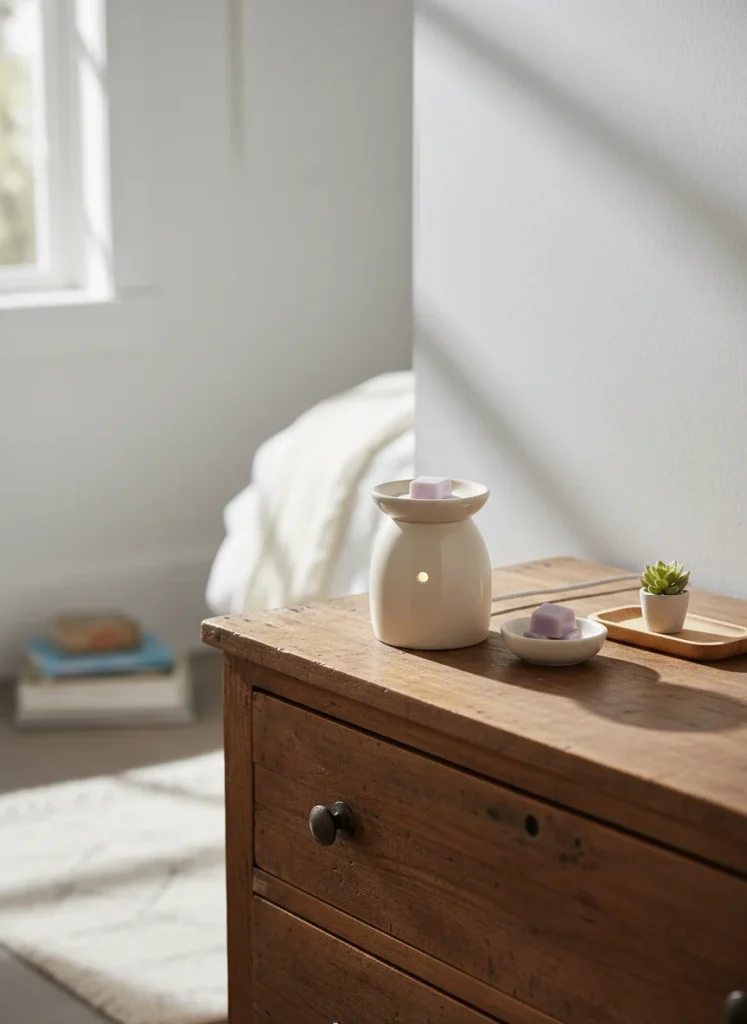
Wax melts in an electric warmer are better than candles for a small bedroom in two specific ways. There is no combustion, which means no smoke, no soot particles being released into the air, and no waxy residue smell that candles leave when they do not burn cleanly. That residue odor is subtle but real, especially in a small room where air does not move much. An electric warmer just heats the wax gently until the fragrance releases, and nothing burns.
The rule for small rooms: avoid triple-scented wax melts. “Triple-scented” means the manufacturer increased the fragrance load significantly, which is designed for large open spaces. In a 100-square-foot bedroom, a triple-scented vanilla or cinnamon melt becomes physically unpleasant within thirty minutes. Use standard-strength melts and use half a cube at a time rather than a full one. You can always add more. You cannot un-melt what is already in the dish.
Scent layering works beautifully with wax melts in small rooms. A half cube of lavender and a half cube of vanilla create a soft lavender-vanilla blend that neither one achieves alone. Eucalyptus and mint is another clean pairing that reads as fresh rather than medicinal. A starter kit with an electric ceramic wax warmer runs about $15 to $22, and a multipack of wax melts in a compatible fragrance family runs $8 to $15 and lasts weeks.
4. The 10-Minute Morning Ventilation Ritual

This is the single most effective thing on this entire list and it costs exactly nothing. Every morning, open the bedroom window and the bedroom door for ten minutes. This creates cross-ventilation, where fresh air enters from outside and stale, moisture-laden air exits through the door into the rest of the home. In a small room where air circulation is inherently limited by the square footage, stale air accumulates overnight faster than in a large room, because the same amount of human respiration and body heat fills a smaller air volume.
In winter, you do not need to open the window fully. A two-to-three-inch crack is enough to create airflow while keeping the room from dropping in temperature too significantly. Ten minutes is the threshold where the air exchange becomes meaningful. Less than that and you are mostly just letting in a draft. This one habit, done consistently every morning before making the bed, does more for long-term bedroom freshness than any product you can buy.
The reason this works so well in a small bedroom specifically: because the room is small, even minimal airflow cycles the entire air volume more quickly. A large room requires sustained ventilation to meaningfully move the air. Your small bedroom replaces its full air volume in those ten minutes if the cross-ventilation path is unobstructed.
5. Wash Bedding More Frequently Than You Think You Need To

Between 70 and 80 percent of bedroom odor comes from the bed textiles, not from the air. This is the fact that most advice articles bury or skip entirely. Bedding absorbs sweat, body oils, and dead skin cells every single night. In a small room, those textiles represent a large proportion of the total surface area, which means their odor contribution is proportionally higher than in a larger room with more furniture and floor space diluting the effect.
The practical schedule that actually works: wash pillowcases every three to four days. Not once a week. Pillowcases are in direct contact with your face and hair for seven to eight hours every night, and they become the primary odor source faster than any other textile in the room. Wash the duvet cover every two weeks. Wash the flat sheet weekly. This schedule sounds like a lot until you realize how much it changes the baseline smell of the room without buying a single product.
One more detail that most people overlook: the detergent matters. Use an unscented or lightly scented base detergent so the fragrance you choose from a fabric softener is the one you actually smell on the finished bedding, not a clash between your detergent and your softener. Choose a fabric softener in a scent you genuinely love and that scent becomes the persistent, slow-releasing fragrance in your bedding for the next three to four days. This is passive, consistent scent that no diffuser or spray can fully replicate.
6. Activated Charcoal Bags in Strategic Spots
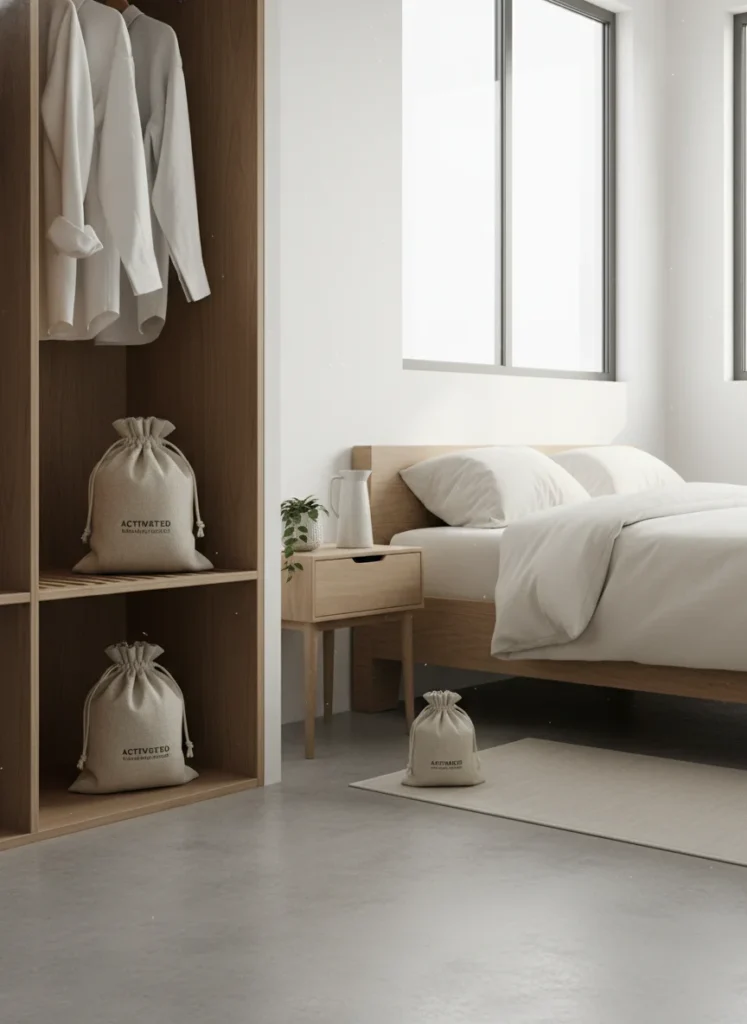
Activated charcoal bags are the most underrated item on this list, and most people have never heard of them outside of skincare. They work by passively adsorbing odor molecules and moisture from the surrounding air through millions of microscopic pores in the charcoal surface. They do not mask odor with a scent. They remove odor molecules from the air chemically. In a small bedroom where air circulation is limited, a bag sitting in a closed area like under the bed or in the closet is particularly effective because the still air gives it time to work.
Where to place them in a small bedroom: one under the bed or tucked against the bed frame where air barely moves, one inside the closet if you have one, and one on the floor beside the nightstand where overnight moisture and body heat are highest. A set of three bags covers a small bedroom completely. They last one to two years with monthly maintenance: take them outside on a sunny day for one to two hours per month. The UV exposure reactivates the charcoal and restores its adsorption capacity.
A set of activated charcoal odor absorber bags in the 75g to 200g range runs $10 to $15 for a pack of three or four. They are the closest thing to a passive, set-it-and-forget-it odor solution that actually exists. If you are working with a small bedroom that has storage challenges alongside odor challenges, the post on small bedroom ideas with no closet covers how to store things in ways that do not compound the odor problem.
7. A Small Essential Oil Diffuser, Run Strategically
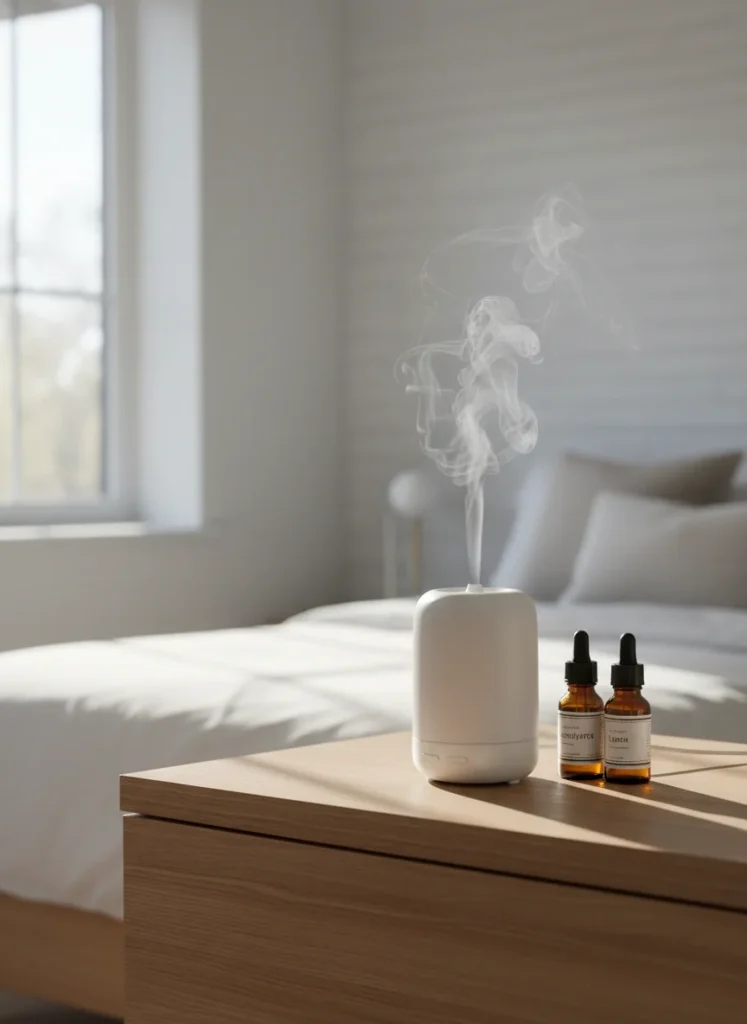
An ultrasonic diffuser works differently from a reed diffuser in a way that matters for how you use it. Instead of passive evaporation through reeds, an ultrasonic diffuser uses high-frequency vibrations to break water and essential oil into a fine mist that is literally suspended in the air. This is more immediate and more concentrated than a reed diffuser, which is both its strength and its risk in a small room.
Run time in a small bedroom: thirty to forty-five minutes, then off. Not all night. Running a diffuser all night in a small room saturates the air with oil particles to the point where it can irritate airways and create a cloying baseline scent that becomes unpleasant. Use it in the morning while you are getting ready, or for thirty minutes before bed. The scent lingers in the air and in the textiles for hours after you turn it off.
Some essential oils actually eliminate odor rather than just covering it. Tea tree oil has antimicrobial properties and breaks down the bacterial compounds that cause stale air smell. Eucalyptus is a natural antibacterial. Lemon has odor-neutralizing compounds that work on organic odor molecules. These are different from lavender or vanilla, which are pure fragrance additions. In a small room with an odor problem, a blend of eucalyptus and lemon is more effective than any pleasant-smelling fragrance blend because it is addressing the source chemistry. A good small ultrasonic diffuser in the 100ml to 150ml range runs $20 to $35 and is quiet enough to not be noticed.
8. Baking Soda Under the Bed or in the Closet
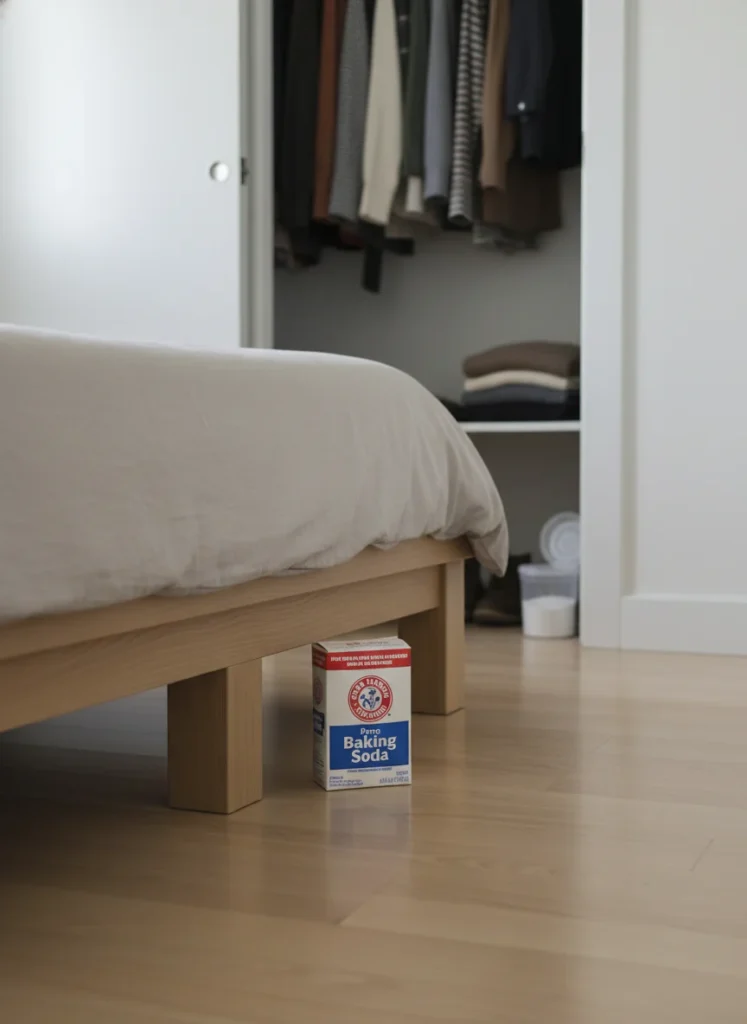
An open box of baking soda placed in a small, still-air zone absorbs moisture and neutralizes odor through a simple acid-base reaction. The stale, sour odors that accumulate in bedrooms from sweat and body chemistry are typically acidic compounds. Baking soda, being alkaline, reacts with those compounds and renders them odorless. This is not a metaphor. It is basic chemistry that costs two dollars.
The best placement in a small bedroom: under the bed, especially under a low platform bed where the floor gap is only a few inches and air barely circulates at all. That still-air zone is exactly where moisture and odor molecules concentrate most. A second box in the back of the closet works the same way. Replace both every thirty days. An expired box of baking soda from the fridge does the job just as well as a fresh one for this purpose, so you are essentially recycling something you were going to throw out anyway.
This is genuinely the cheapest passive odor absorber available anywhere, and it outperforms most commercial odor-eliminating sprays in enclosed, low-circulation zones because it works continuously rather than with a single burst. For renters who want low-intervention, no-installation solutions throughout the bedroom, the post on renter-friendly bedroom ideas has a full approach that pairs naturally with this kind of passive, product-free method.
9. Scented Drawer Liners and Lavender Sachets
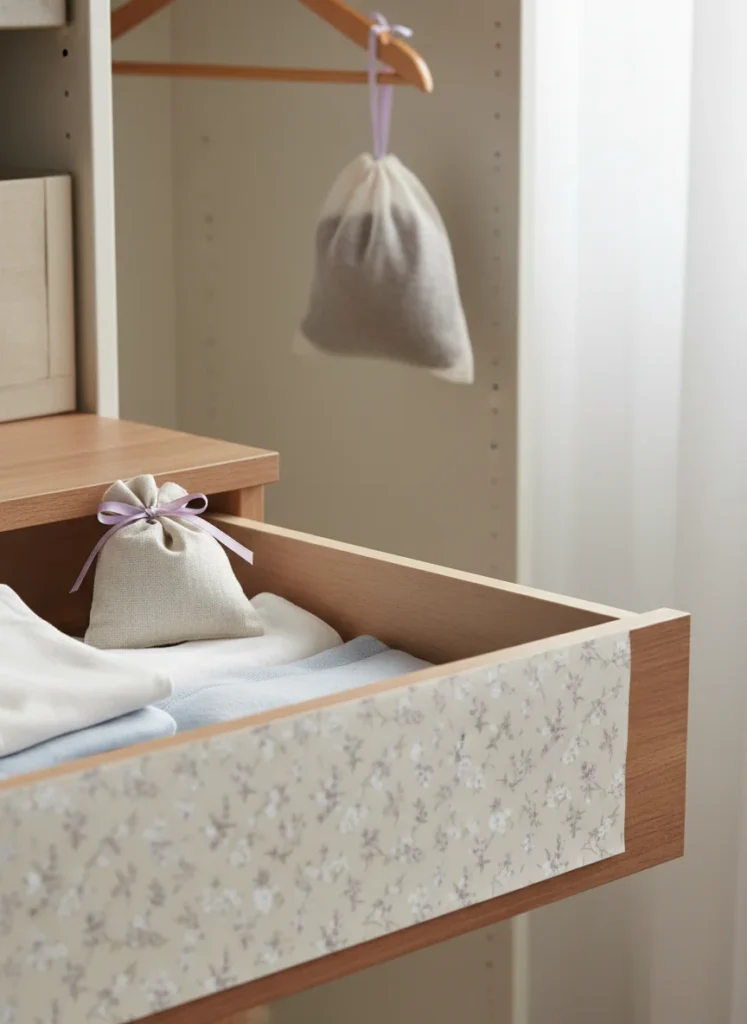
Scented drawer liners and sachets create a layered, graduated fragrance release from inside your storage rather than from the air. Every time you open a drawer or a closet, a small burst of scent is released into the room. Over time, your clothing itself carries a faint, clean fragrance that extends the scent profile of the room into everything you wear. It is the most invisible and persistent fragrance strategy on this list.
Lavender sachets specifically serve a dual purpose that other scents do not: lavender contains linalool and linalyl acetate, compounds that are natural moth deterrents. Moths avoid laying eggs in areas with a strong lavender presence. This means a lavender sachet in your closet or drawers is simultaneously freshening the air, scenting your clothing, and protecting natural fiber garments from damage. That triple function makes lavender the most practical sachet scent for a bedroom with limited storage.
The DIY version: fill a small cloth pouch with two to three tablespoons of dried lavender buds, tie it closed, and place one in each drawer and hang one or two in the closet from a hanger. Dried lavender buds are widely available for about $8 to $12 for enough to make six to eight sachets. The scent persists for three to six months and is refreshed by crushing the pouch gently between your hands, which releases more of the aromatic oil from the dried buds. Commercial lavender sachets for drawers and closets run $8 to $14 for a set of six and are a perfectly good alternative if making your own is not appealing.
What NOT to Use in a Small Bedroom
This section matters as much as the nine above. The wrong fragrance choices in a small bedroom do not just fail to help. They actively make the space worse.
Synthetic plug-in air fresheners. These devices heat synthetic fragrance compounds continuously at a high intensity, releasing a constant stream of artificial scent molecules into a small, enclosed space. In a large room with good airflow, the synthetic quality dilutes into the background. In a small bedroom with limited air circulation, it accumulates. The result is a headache-inducing, chemical smell that coats the air rather than refreshing it. Many synthetic fragrance compounds also contain phthalates and VOCs that are linked to respiratory irritation. This is the worst possible option for a small room that you sleep in.
Incense sticks. Incense produces particulate matter from combustion, including fine soot, carbon, and aromatic compounds that are inhaled directly. In a large room or outdoors, these disperse. In a small bedroom with a closed door, you are essentially filling your breathing air with smoke particles. The scent is also intense, persistent, and very difficult to remove from textiles once the room is saturated. One incense stick in a small bedroom can leave a smoky undertone in the bedding for days.
Candles used as a primary fragrance source. Candles are not inherently bad, but using them as your main all-day scent strategy in a small room has a specific problem: the waxy, slightly acrid smell of warm wax and a small flame in an enclosed space. If you love candles and want to use them occasionally for atmosphere, that is reasonable. But after you extinguish the flame, the lingering warm-wax smell can be unpleasant in a small room. This is why wax melts in an electric warmer beat candles here. Same fragrance, no combustion, no waxy residue odor.
Before we continue, if you’re tired of buying decor that doesn’t look right together, I created something specifically for this…
Choosing the Right Scent Family for Your Bedroom
Not all pleasant scents are pleasant in a bedroom. The context of a bedroom, specifically a small one where you sleep and breathe the air for eight hours, calls for lighter, cleaner, and less assertive scent profiles than you might use in a living space or entryway.
Scents that work in small bedrooms: soft lavender, clean linen, eucalyptus, light cedarwood, chamomile, light sandalwood, and cotton. These all share a quality of being clean-reading rather than loud. They suggest cleanliness and calm rather than announcing themselves. Citrus scents like lemon and bergamot work well in the morning but fade quickly and are better delivered through a diffuser than a reed.
Scents to avoid in small bedrooms: heavy musks, strong florals like gardenia and tuberose, amber-heavy orientals, anything with “warm spice” or “cinnamon” as the dominant note, and overly sweet vanilla-forward blends. These scents are all designed to project across a large space. In a small bedroom, they become overwhelming within an hour and cling to textiles in a way that is difficult to remove. The goal in a small bedroom is a scent that you barely notice consciously but that makes the room feel welcoming every time you walk in. That quiet background freshness is the target, not a statement fragrance. If you are also thinking about the physical feel of the bedroom alongside the sensory experience, the post on decorating a bedroom with no money covers the foundational visual changes that cost nothing and make the whole space feel more intentional.