
This post contains affiliate links. If you buy something through my links, I may earn a small commission at no extra cost to you. I only recommend things I genuinely use or believe in.
Anthropologie charges $180 for a ceramic table lamp. The thrift store near my apartment charges $6 for the same organic silhouette, same warm glaze, same quiet drama on a nightstand. I know because I bought mine for $6 and nobody has ever believed me. That is the whole secret of the Anthropologie bedroom aesthetic: it is not about the brand. It is about a specific visual story, and that story is one thrift stores have been telling for decades for almost nothing.
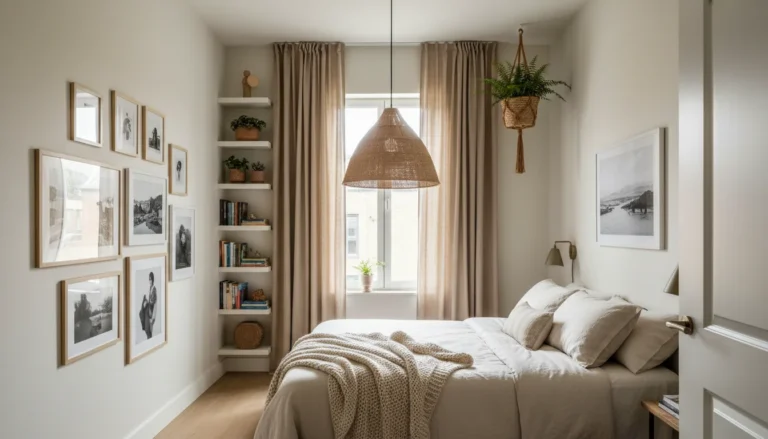
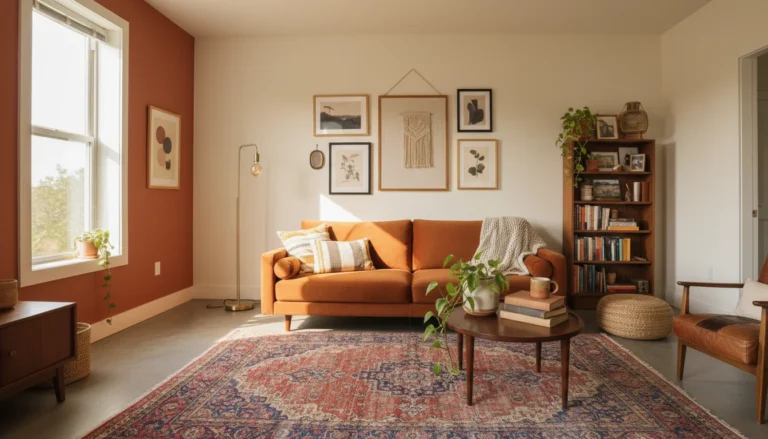
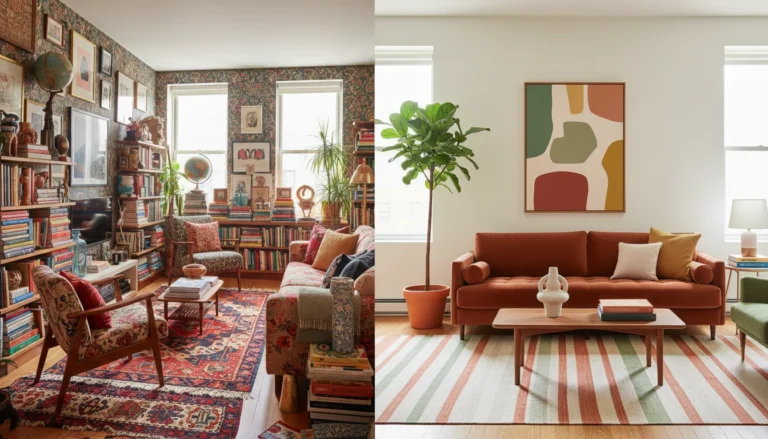
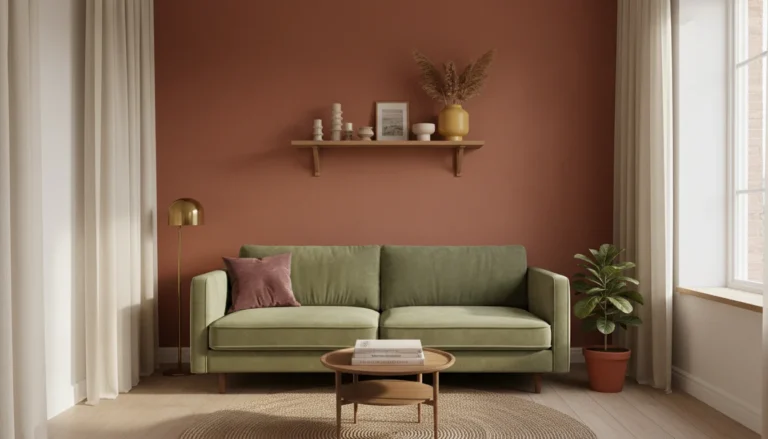
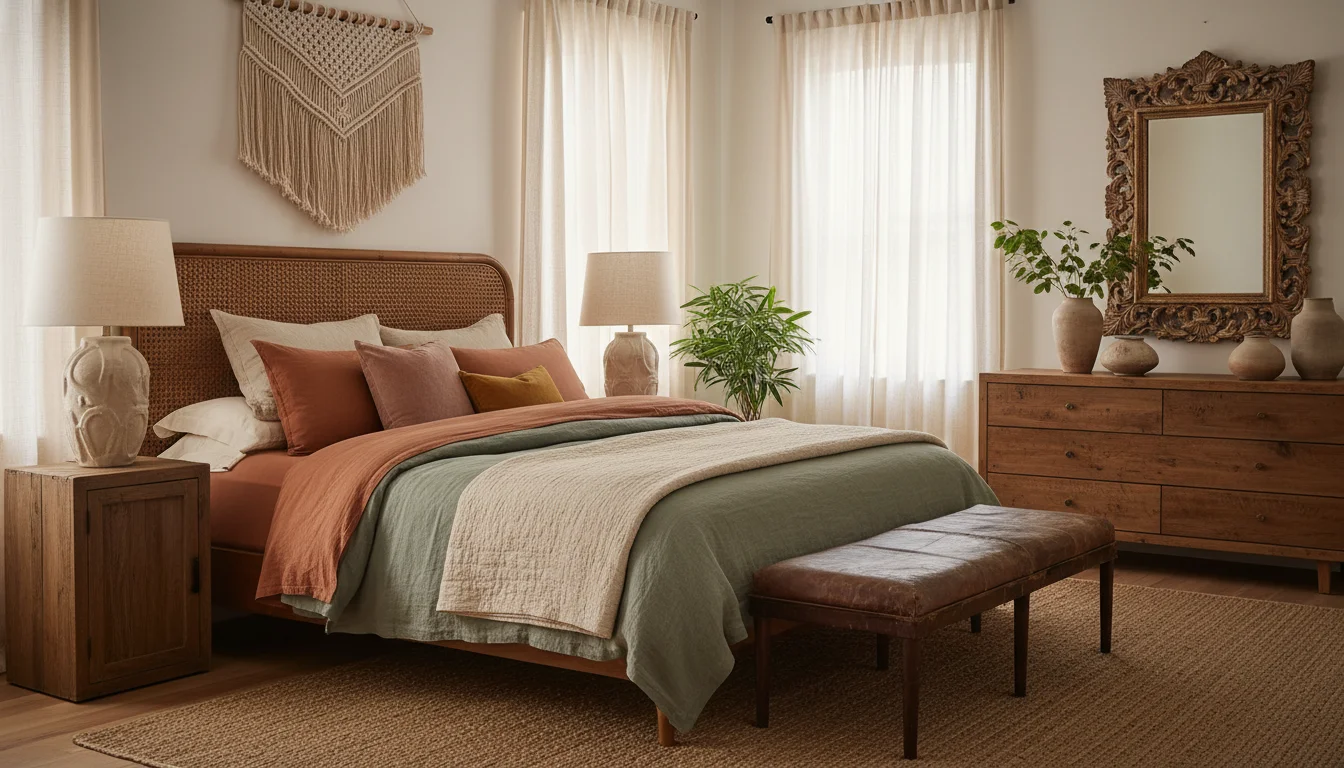
The Anthropologie look is built on pieces that seem like they were collected across different decades, different countries, different flea markets and estate sales. Nothing matches perfectly. Everything belongs. The palette stays warm: terracotta, sage, dusty rose, ochre, cream, deep plum. The textures layer: velvet against linen, rattan next to ceramic, aged brass beside raw wood. A bedroom done in this aesthetic feels like it belongs to someone interesting who has actually lived somewhere. You can recreate that entirely at a thrift store because Anthropologie itself is just a very expensive version of that exact philosophy.
Here are the 11 thrift store bedroom decor ideas that get you there. For each one I will tell you exactly what to look for, what condition is acceptable, what to skip, and which Amazon pieces bridge the gap when the thrift store comes up short.
💡 Before you start decorating, see how your room could look with AI.
🏡 See Your Room Before You Spend a Dollar
Still wondering if that new furniture, paint color, or decor style will actually look good in your space?
- Upload a photo of your room and let AI instantly generate beautiful design ideas.
- Explore different interior styles, furniture layouts, and color combinations before you spend a single dollar.
How to Actually Thrift for the Anthropologie Aesthetic
Before the list, a few honest things nobody tells you. Thrifting for a specific aesthetic requires patience and multiple trips. You will not find all 11 of these in one afternoon. You will go three times and find nothing, then go on a random Tuesday and walk out with four perfect pieces for under $20 total. That is the deal. The payoff is real but the timeline is not instant.
When you walk into a thrift store, train your eye to look past the context. A lamp sitting under fluorescent lights next to a broken office chair looks like nothing. That same lamp on a nightstand with a warm bulb and a linen shade looks like it costs $160. Context is almost everything with thrift finds. Your job is to see past the bad staging and the dust and ask: what would this look like cleaned up, in the right room, with the right bulb?
A few things to always skip for this aesthetic: anything made of shiny plastic, fast-furniture pieces with particle board showing, items with structural damage like broken frames or cracked bases, and anything that reads as novelty rather than timeless. The Anthropologie look is about warmth and weight. Lightweight, hollow, or overly shiny pieces break the spell immediately.
11 Thrift Store Bedroom Finds That Look Like Anthropologie
1. A Chunky Ceramic Table Lamp With an Interesting Silhouette
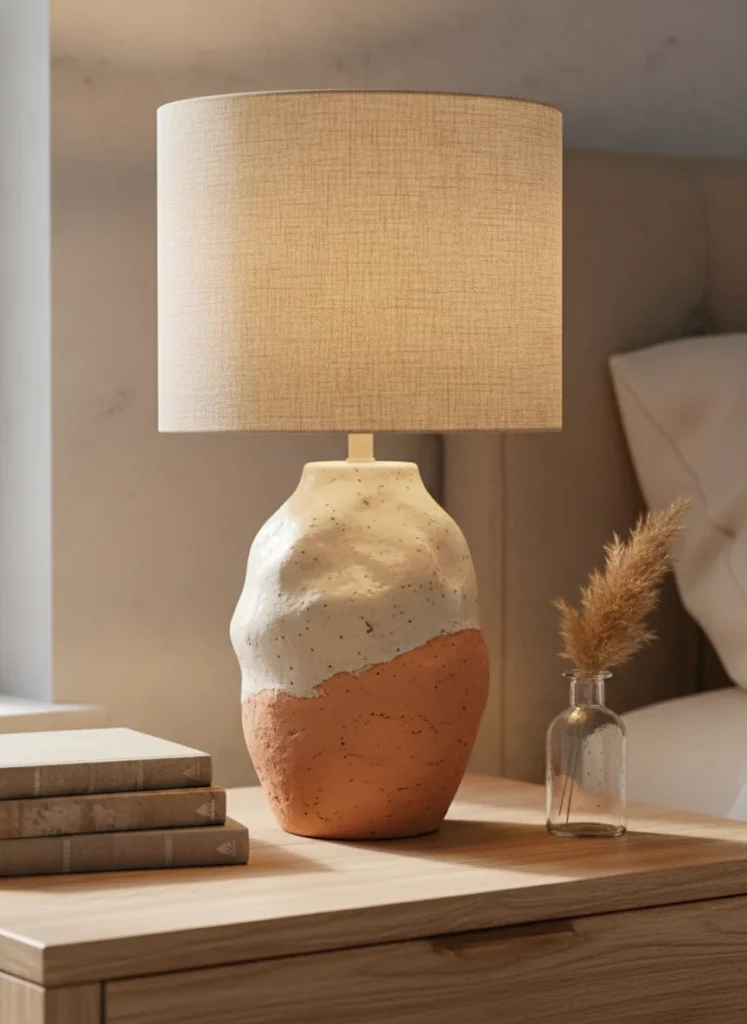
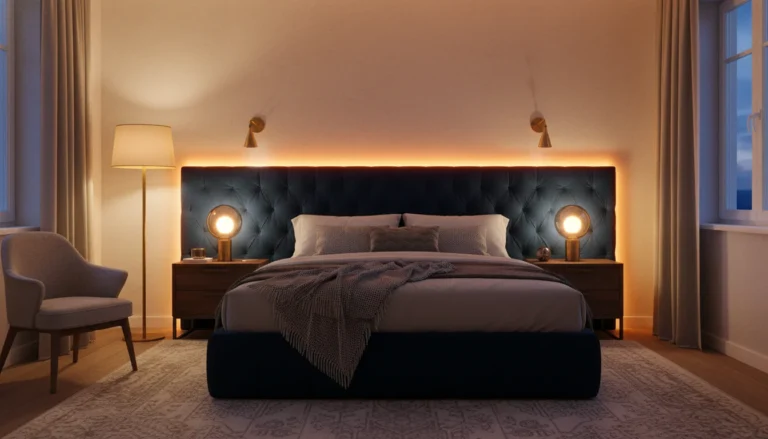
This is where thrift stores outperform every other sourcing option by a wide margin. Ceramic lamps are heavy, awkward to ship, and expensive to store, which means they cycle through thrift stores constantly. Anthropologie charges $140 to $220 for their signature ceramic lamp styles. The thrift store version costs between $4 and $12.
What to look for: organic shapes. Not straight cylinders, not symmetrical geometric forms. You want something that looks like it was thrown on a wheel by a human hand. Slightly uneven curves, a bulbous base, a tapered neck, a flat-sided column with texture. Earthy glazes in cream, terracotta, sage, warm gray, or dusty blue are ideal. Avoid anything with a very shiny glaze, a novelty shape like animals or fruit, or bright primary colors that would fight your palette.
The shade is almost always the problem. Most thrift store lamps come with dated shades in cream with gold trim or pleated fabric that reads as grandmotherly in the wrong way. Replace it. A simple natural linen drum shade from Amazon runs about $18 to $22 and transforms the entire lamp. Suddenly the ceramic base reads exactly the way it should: organic, warm, and expensive-looking. Budget total: $6 for the lamp, $20 for the shade, $26 for something Anthropologie charges $180 for.
2. An Ornate or Unusually Shaped Mirror
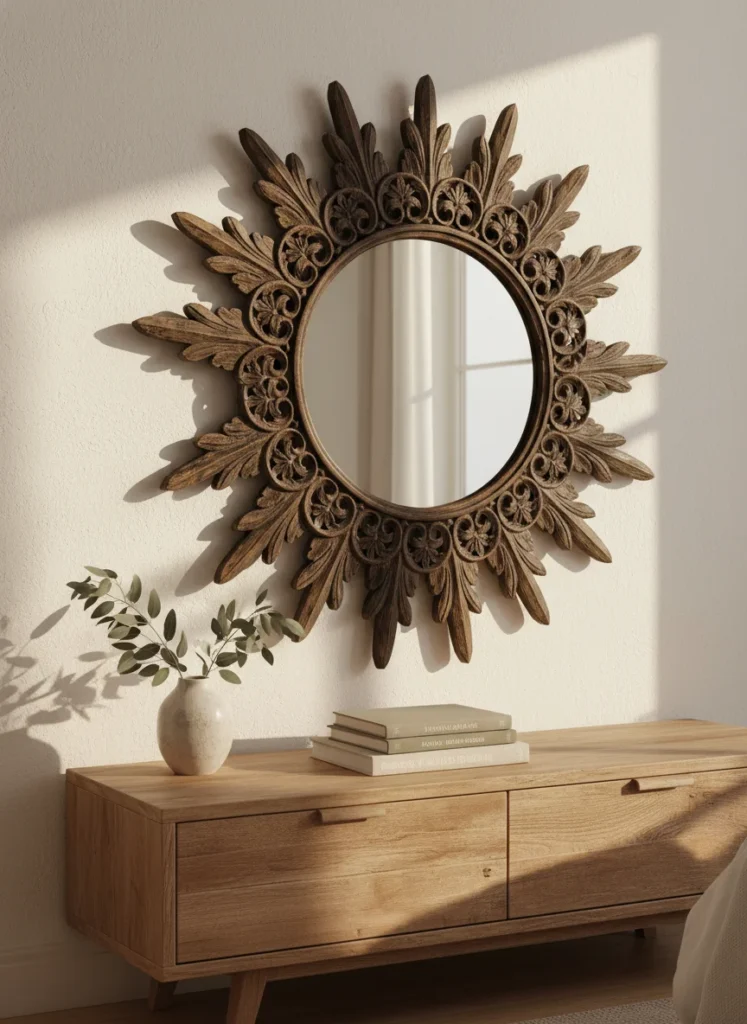
Mirrors are one of the highest-signal items in an Anthropologie bedroom. Not flat rectangles. Not frameless glass. You want carved wood frames, sunburst shapes, arched profiles, or ornate gilded frames with depth and texture. One interesting mirror does more visual work for this aesthetic than an entire gallery of art, because it has both reflective light and sculptural presence.
Thrift stores get these regularly, especially from estate sales. The most common problem is dated gold finishes that read as 1990s rather than collected and timeless. This is an easy fix. Rub ‘n Buff in Antique Gold or European Gold costs about $8 and takes ten minutes to apply. It transforms brassy, cheap-looking gold into something warm and aged. Alternatively, a light coat of matte black or warm bronze spray paint on a carved wood frame gives you a completely different, moody result that works beautifully in a terracotta-and-cream palette.
What to skip: flat rectangular frameless mirrors, anything with a very thin metal frame in chrome or brushed nickel, and mirrors with any crack or chip in the glass itself. Structural issues with frames are usually fixable. Glass problems are not.
3. A Set of Mixed Ceramic Vases in Organic Shapes
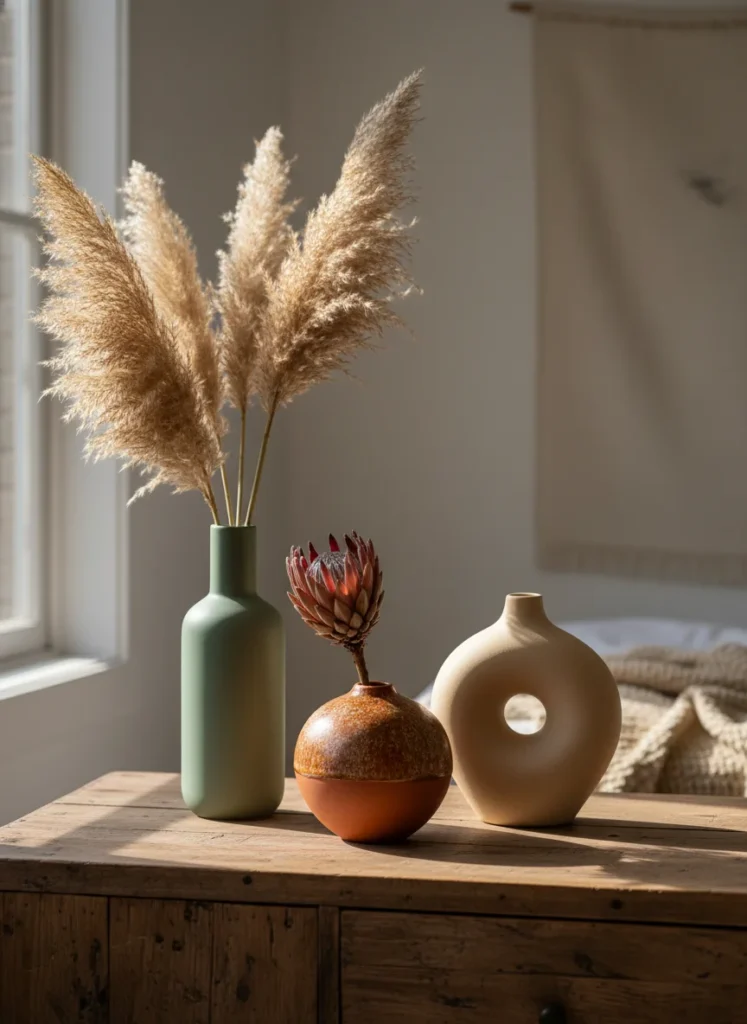
This is where my own thrifting story lives. I found the terracotta ceramic vase that became my signature color anchor at a Goodwill about two years ago. It was $4. Hand-thrown, imperfect, with a warm speckled glaze that I had never seen in any store. That vase is the reason my whole bedroom palette shifted to terracotta and cream. A $4 ceramic changed everything I thought I knew about decorating on a budget.
The Anthropologie vase cluster is one of the most recognizable elements of the aesthetic. Three to five vases in different heights, all with the hand-thrown or organic look, in the same warm color family but not identical. Arrange them in odd numbers and vary the heights dramatically: a tall narrow one, a short squat round one, something medium and asymmetric in between. What you are building is a collected grouping, not a matching set.
What to look for: imperfect shapes, matte or low-sheen glazes, earthy tones. What to skip: perfectly symmetrical mass-produced shapes, high-gloss finishes, and anything with text, patterns, or decorative scenes painted on the surface. If you cannot find enough vases at the thrift store to complete your cluster, a small ceramic bud vase set on Amazon fills the gaps for around $22 to $28 for a set of three.
4. A Velvet or Linen Throw Pillow Cover
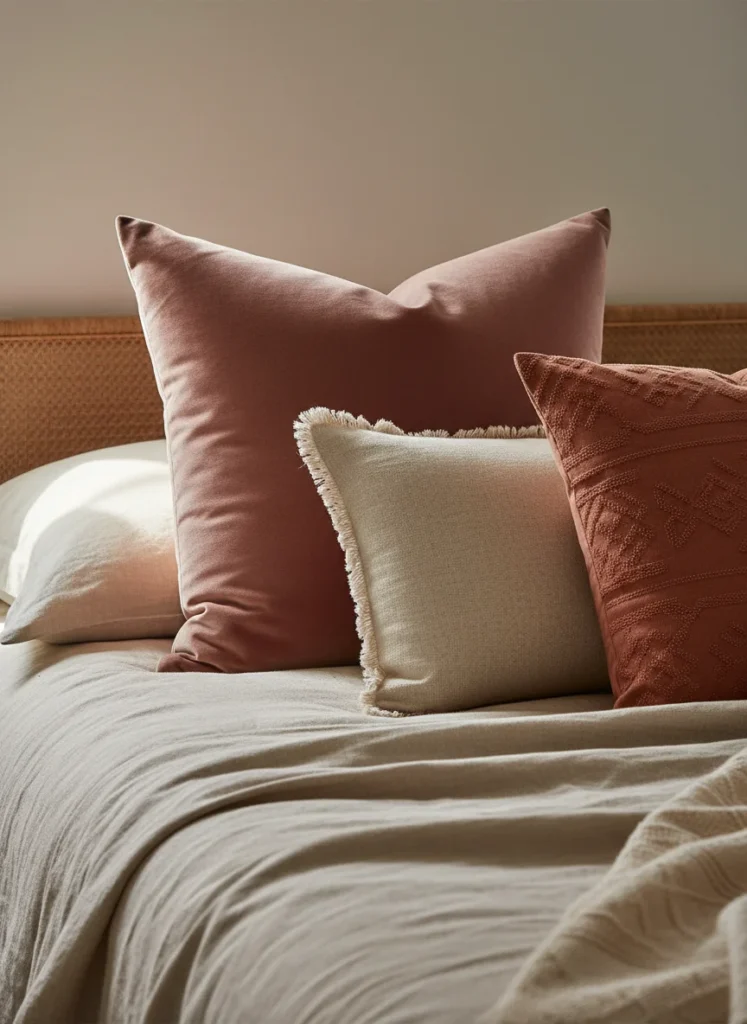
Throw pillows are where a lot of people overspend because the cheap options at regular stores look cheap, and the beautiful options at Anthropologie cost $48 to $78 per cover. Thrift stores are inconsistent here but occasionally extraordinary. The key is knowing what to feel for: weight and texture are everything.
Run your hand across the fabric. A good velvet pillow cover has a dense, even pile with no flat patches or bald spots. A linen cover should feel slightly rough and textured, not smooth like cotton. Down or feather inserts feel heavy and moldable when you squeeze them. Foam inserts are always a downgrade. If you find a quality insert at a thrift store, grab it even without the cover, because a good insert is half the battle.
The mixing strategy is what makes this feel Anthropologie rather than random. Pair a velvet thrift find in dusty rose with a linen lumbar cover with fringe trim from Amazon in natural cream. Add a textured woven cover in ochre. Now you have three pillows from three different sources that read as a curated, layered set. None of them look like they came from the same place, which is exactly right. If you want ideas for refreshing the whole bed wall, decorating above the bed without a headboard covers exactly how to layer pillows and textiles to make the whole space feel considered.
5. A Rattan or Cane Headboard or Accent Piece
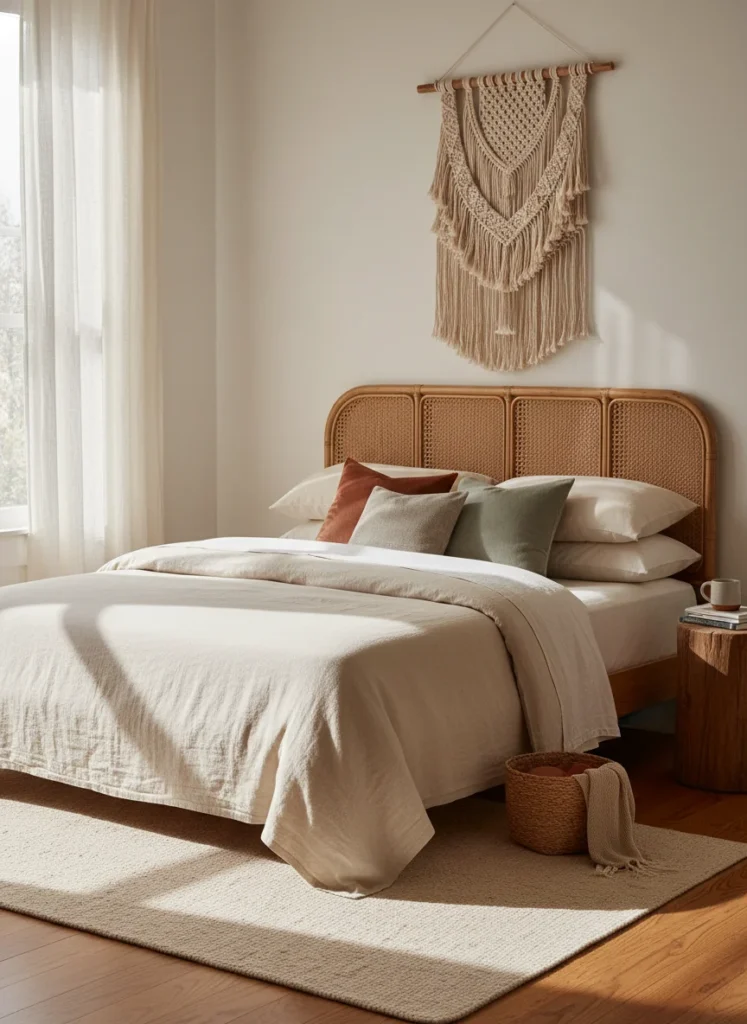
Rattan is one of the hardest affordable finds when you are buying new. A rattan headboard from a boutique brand runs $180 to $400. A rattan headboard from a thrift store runs $15 to $40, and I have seen them go for $8 when a store was overstocked. Rattan is also one of the most identifiable elements of the Anthropologie bedroom aesthetic, so finding it secondhand is a genuine prize.
If you cannot find a rattan headboard, look for any rattan piece: a small shelf, a side table, a plant stand, a decorative tray or basket with a cane weave. Any rattan element brings the warmth and natural texture the aesthetic depends on. The material itself does a lot of the work. Against a warm white or cream wall with linen bedding, even a single rattan accent reads immediately as intentional and considered.
What condition is acceptable: some discoloration and natural aging is fine and actually desirable. Broken strands or structural damage to the frame are not. A few stray cane ends can be trimmed or tucked. For pairing, a rattan-framed accent mirror from Amazon in the $25 to $40 range extends the material story into another part of the room without requiring you to find two rattan pieces at the thrift store.
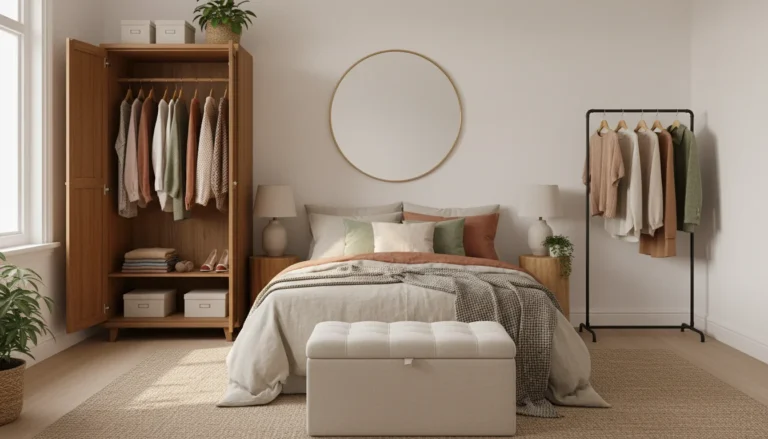
6. A Worn Leather or Faux Leather Ottoman or Bench
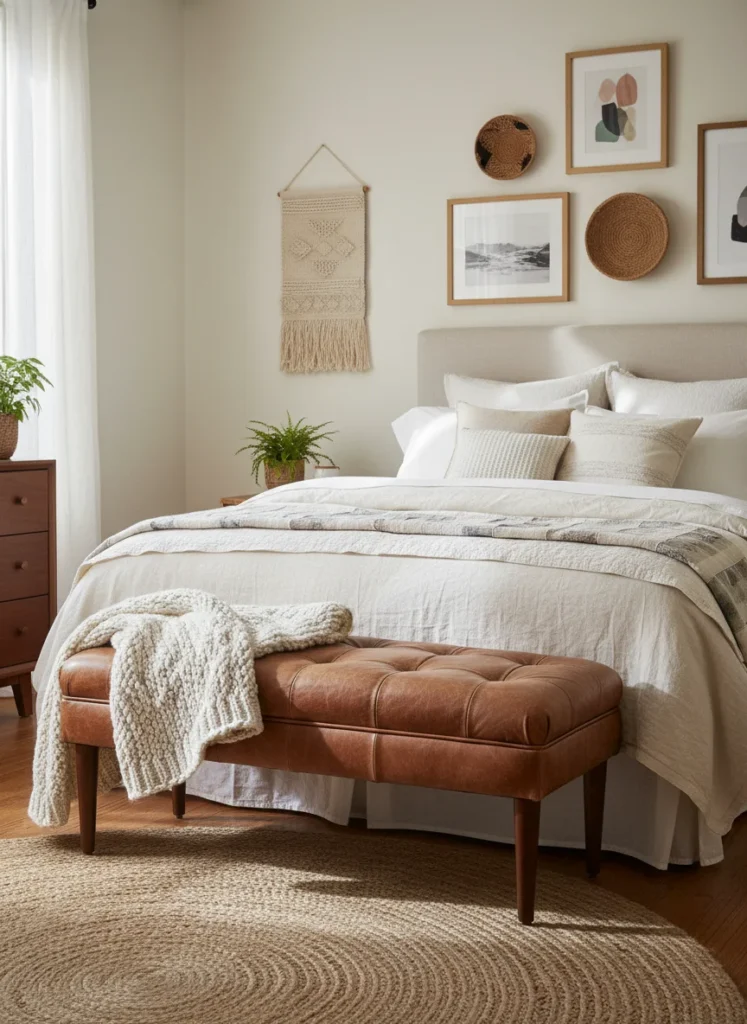
A leather or tufted ottoman at the foot of the bed is one of those details that immediately reads as curated rather than functional. It signals that someone thought about the room as a whole, not just the mattress and the dresser. Anthropologie sells their bench versions for $280 to $500. Thrift stores sell the same look for $20 to $60.
What condition is acceptable: surface wear, light scuffing, some cracking in the leather, even small tears in inconspicuous spots. These marks of wear are not damage in this context. They are exactly what makes a leather bench look collected and real rather than freshly ordered from a catalog. What is not acceptable: structural damage where the legs are broken or wobbling, springs or foam that have completely collapsed, or any smell that will not air out.
Style it simply. A cream chunky knit throw draped loosely over one end of the bench is the only styling you need. It softens the leather, adds texture contrast, and makes the piece feel lived-in rather than staged. For renter-friendly ideas that work around this kind of layered styling without touching the walls or floors, the post on renter-friendly bedroom ideas that need no landlord permission has a full breakdown.
7. A Vintage-Style Alarm Clock or Mantel Clock
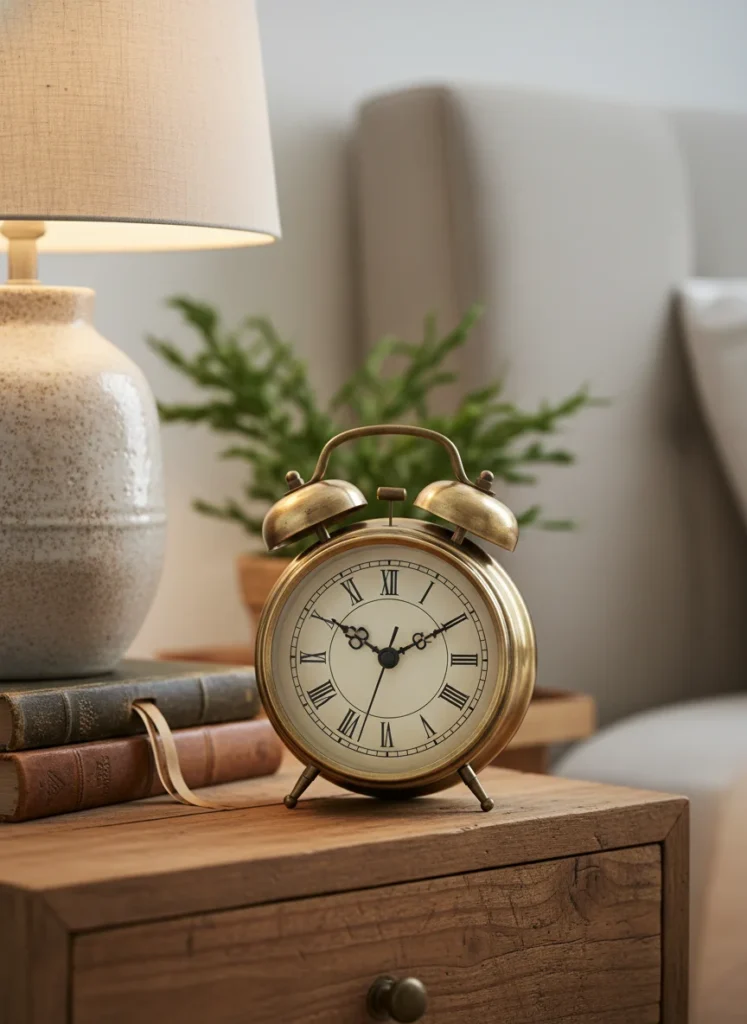
Small items carry a surprising amount of signal in a well-styled room. An analog clock on the nightstand is one of the clearest markers of the Anthropologie aesthetic: it says that someone chose this object specifically, not just out of function but out of a desire for the room to feel like a place. A phone sitting on a nightstand reads as temporary. A small brass mantel clock reads as intentional.
Thrift stores have clocks constantly. You want an analog face, a warm case material like brass, aged gold, dark wood, or ceramic, and a size that fits the nightstand without dominating it. A small round or rectangular clock in the four-to-eight-inch range is ideal. Skip digital clocks entirely, and skip anything with a very modern or industrial aesthetic in chrome or matte black that would read as a different design language.
Check that it works. A non-functioning clock is still a beautiful object, but a working one earns its place on the nightstand every morning. Battery-operated vintage-style movements are easy to replace for a few dollars if the original mechanism is dead. The clock becomes the anchor for your entire nightstand vignette, and once you have it, the rest of the styling around it becomes much easier to see.
8. Interesting Glassware, Decanters, or Tinted Glass Bottles
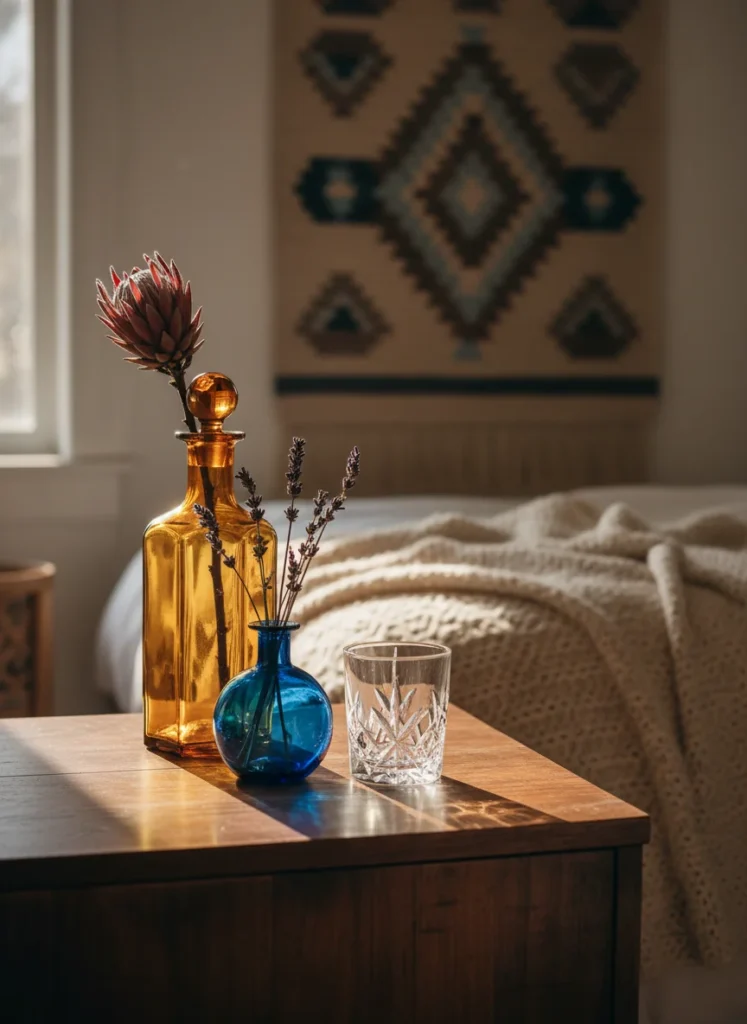
Not for drinking. For styling. This distinction is the entire point of this find. An amber glass decanter with a dried stem inside it, a tinted cobalt glass bottle used as a bud vase, a cut-crystal glass catching afternoon light on the dresser: these are decorative objects that happen to be made of glass, and they are one of the most overlooked thrift store categories there is.
Thrift stores are full of glassware. Most people walk past it because they are thinking about function. You are thinking about color and light. Tinted glass in amber, green, cobalt, and blush catches and bends light in ways that clear glass and ceramic cannot. A small amber decanter with a dried protea stem inside it looks exactly like the $68 styling piece Anthropologie sells. Yours cost $3.
What to look for: interesting shapes, tinted or etched glass, cut crystal with facets that catch light, vintage stoppers, and unusual proportions like a very tall narrow bottle or a short wide decanter. What to avoid: plain clear drinking glasses with no particular shape, anything chipped or cracked, and anything with a label or printed design that reads as promotional rather than decorative. Pair your thrift glass finds with a small bundle of dried pampas grass or dried botanicals from Amazon and you have a styled vignette that looks like it took hours and cost $80.
9. A Woven or Macrame Wall Hanging
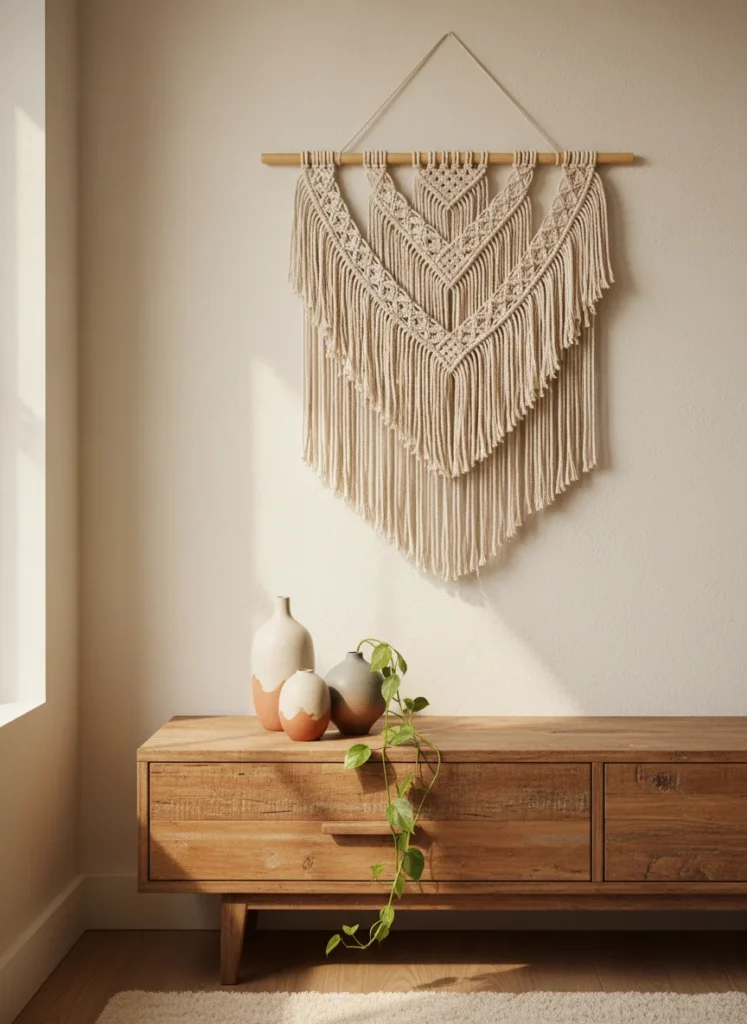
The 1970s boho wave left an enormous inventory of woven wall hangings in thrift stores across the country, and they have never stopped cycling through. Macrame, woven tapestries, fiber art with fringe: these pieces are often priced at $3 to $8 at most Goodwills and Salvation Army locations because the staff do not know what to do with them. You do.
What to look for: natural fibers, which means cotton, jute, wool, or linen. Natural fiber pieces have weight and warmth that acrylic pieces simply do not. Hold the piece and feel the fringe: natural fiber fringe has body and hangs with intention. Acrylic fringe is lightweight and reads as cheap even when it looks fine in photographs. Also look for interesting structure: layers, varying texture within the weave, dimensional elements. A flat woven piece with no texture variation is less interesting than one with raised knots or layered sections.
What to avoid: very large pieces in poor condition with fraying or missing sections, anything with acrylic or polyester fibers, and pieces with very heavy beading that makes them awkward to hang. For hanging without drilling, a set of heavy-duty adhesive picture hanging strips from Amazon handles most macrame pieces up to five pounds cleanly. Pair with the ideas in the post on what to put on bedroom walls instead of pictures to build out the whole wall with intention rather than just placing one piece and calling it done.
10. A Set of Mismatched Frames for a Gallery Wall
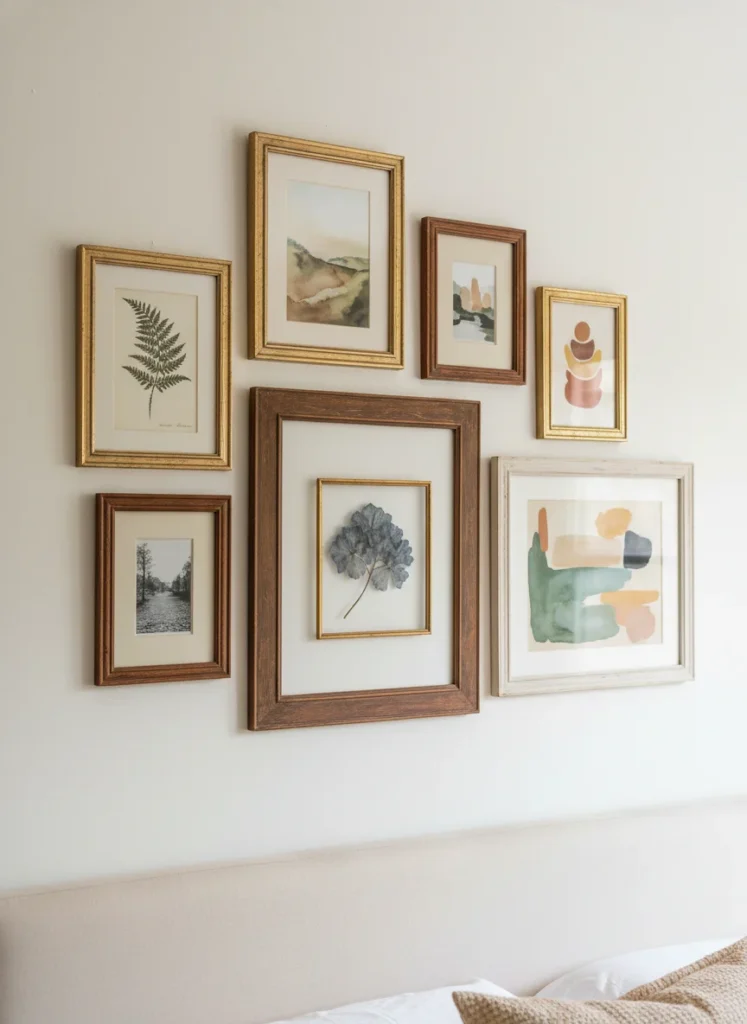
The Anthropologie gallery wall does not use matching frames. That is the entire point. What it does use is frames that share a finish family without being identical: all slightly warm-toned, all with some depth and weight, ranging across antique gold, dark wood, warm brass, and aged cream. The result looks like someone collected these frames across years and different places, which is exactly what you are doing at the thrift store.
Buy frames in bulk when you find them. A thrift store with twelve frames for $1 to $3 each is a major score. Do not worry if they do not match at all when you pick them up. You will unify them. A light coat of the same Rub ‘n Buff in Antique Gold on each frame, or a matching coat of warm white spray paint, brings a disparate group of frames into the same finish family while keeping all their different shapes and sizes. The result is exactly the Anthropologie gallery wall effect: collected but cohesive.
For the art inside the frames, you do not need to buy prints. Free printable art from sources like Unsplash, the Library of Congress digital collection, and vintage botanical illustration archives prints beautifully at home or at a Staples for under $2 per image. A vintage botanical print, a landscape watercolor, a black and white photograph, and two abstract pieces in your palette: that is a five-piece gallery wall for under $20 total. For corner arrangements that extend the gallery concept, the guide on how to decorate a bedroom corner shows exactly how to anchor a gallery arrangement in a three-dimensional space rather than just on a flat wall.
11. A Styling Tray for the Nightstand or Dresser
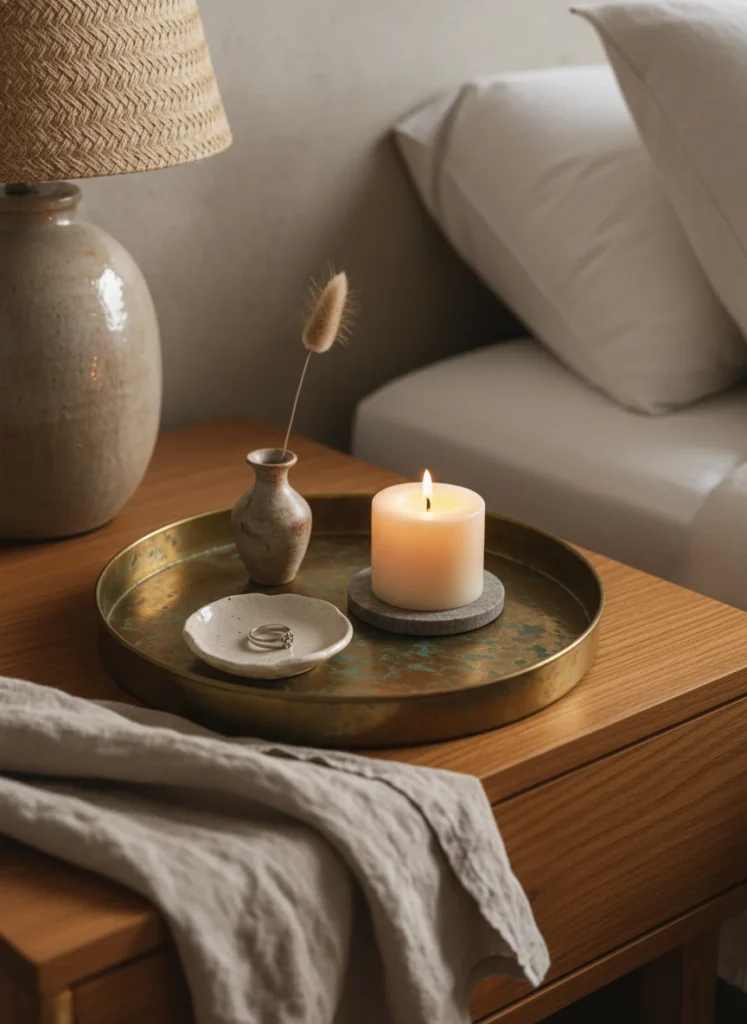
The styling tray is one of the most underrated details in the Anthropologie bedroom aesthetic, and it is the piece that most people never think to look for at a thrift store. A tray does something specific and important: it takes a collection of small, disparate objects and frames them as a single composed vignette. Without the tray, a candle, a ring dish, and a small vase on a nightstand look like clutter. Inside a tray, they look styled.
What to look for at the thrift store: aged brass trays, worn wooden trays with some patina, and ceramic trays in earthy glazes. Rectangle and oval shapes both work. Size matters: a tray for a nightstand should be small enough to leave room for the lamp and a glass of water, roughly eight to twelve inches long. A dresser tray can be larger. What to skip: shiny chrome trays, mirrored trays that read as glam rather than collected, and plastic trays of any kind.
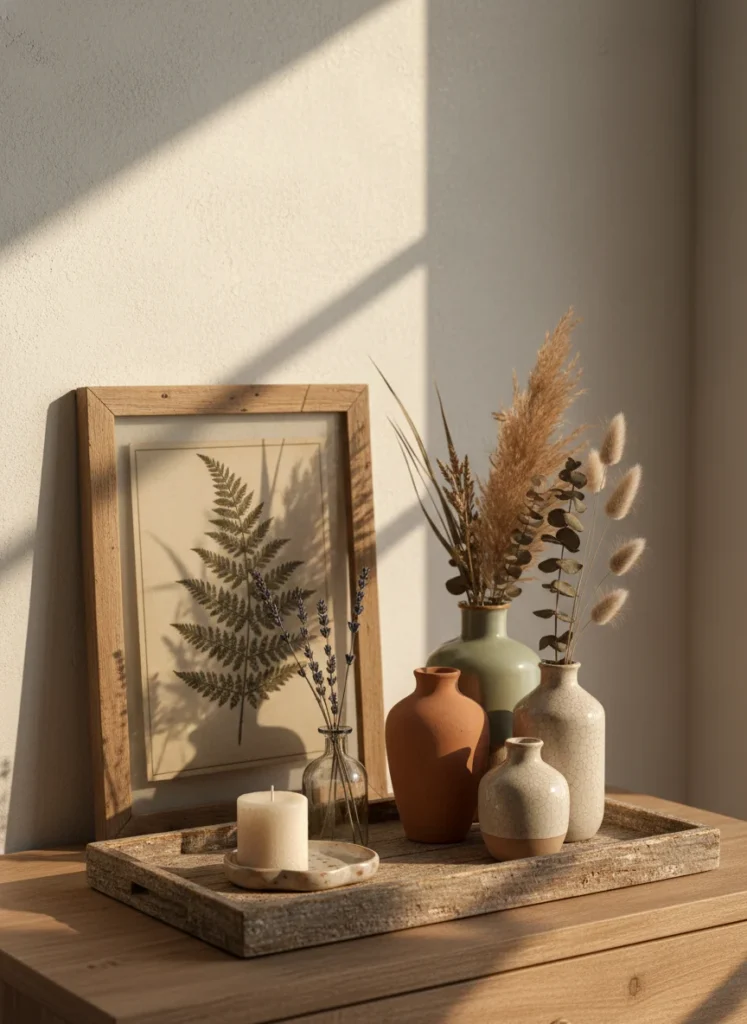
The 1-2-3 tray rule: put one tall element, two medium elements, and one low element inside the tray. One small candlestick or bud vase with a stem. Two objects at a medium height like a ring dish and a small ceramic figure. One low flat object like a folded linen cloth or a few smooth stones. That composition gives the tray visual movement without crowding it. A small aged brass tray from Amazon runs about $18 to $28 if you cannot find one at the thrift store, and it is worth having as an anchor for the dresser even if you thrift everything else on this list.
The Amazon Bridge: What to Buy New When the Thrift Store Falls Short
Thrifting is not an all-or-nothing strategy. Some elements of the Anthropologie look are genuinely hard to find secondhand in good condition, or they require enough quantity that hunting for them piece by piece takes too long. The smartest approach is to thrift the high-signal sculptural items like lamps, mirrors, and vases, then use Amazon to fill in the textiles and accessories that complete the look.
Here is what is worth buying new to pair with your thrift finds:
- Linen bedding in a warm neutral — The bed is the largest surface in the room and the foundation everything else sits against. A washed linen duvet cover in cream or warm white runs $45 to $85 and gives every thrift piece on this list the right backdrop to shine against.
- A linen drum lamp shade — As covered in the lamp section, replacing a dated shade with a simple natural linen drum shade for $18 to $22 transforms any ceramic lamp base from thrift store find to Anthropologie statement.
- Dried botanical stems — A bundle of dried pampas grass or dried botanicals for $12 to $20 fills your thrifted vases and decanters with the exact organic, collected-feeling content they need. No watering required.
- A velvet pillow cover in a signature color — One velvet pillow cover in dusty rose or terracotta for $10 to $14 anchors your pillow arrangement and ties your palette together across everything else in the room.
- Adhesive picture hanging strips — Necessary for hanging the macrame, the gallery wall frames, and anything else you want on the walls without drilling. A pack of heavy-duty adhesive strips costs about $8 and handles the whole list.
- Rub ‘n Buff in Antique Gold — The single most useful product for refreshing thrift store frames, mirror frames, and trays. A tube of Rub ‘n Buff costs around $8 and lasts for an enormous number of projects. It is how you unify a mismatched frame collection and make a dated mirror look intentionally aged instead of accidentally old.
Before we continue, if you’re tired of buying decor that doesn’t look right together, I created something specifically for this…
The Psychology Behind Why This Aesthetic Works
There is a reason the Anthropologie bedroom aesthetic has such a specific emotional effect. It tells a story of a life lived with intention and curiosity. Each piece seems to carry a small history: the lamp from a market in Morocco, the vase from a studio potter, the mirror from a house that is no longer standing. None of this has to be literally true. The visual language just has to suggest it.
This is why matching sets undermine the aesthetic so thoroughly. A matching nightstand lamp and table lamp tell a story of someone who went to a store and bought two of the same thing. Two different lamps that share only a warm ceramic material tell the story of someone who found exactly what they wanted in two different places over time. The second story is more interesting. It makes the room feel more human.
Thrift store shopping is not just a budget strategy for this look. It is actually the most authentic version of the process. You are genuinely collecting. You are finding objects with actual histories in actual places. Your bedroom ends up with the thing Anthropologie has to simulate at great expense: a real collected feeling, because it actually was collected. That is worth something that $180 lamps cannot quite replicate.
If you are starting from scratch with almost no budget at all, the post on decorating a bedroom with no money covers the foundational moves that cost nothing and make the space ready for everything on this list. Start there, then layer these finds in one at a time. The room builds itself over multiple thrift trips, and that gradual accumulation is exactly what makes it feel like Anthropologie in the end.
Go to the thrift store this weekend. Walk past the housewares section slowly. Look at the lamps and ask what they would look like with a linen shade. Look at the frames and ask what they would look like with Rub ‘n Buff. Look at the ceramic pieces and ask what they would look like on your nightstand with a warm bulb. The whole aesthetic is already there. It just needs you to see it.