
This post contains affiliate links. If you buy something through my links, I may earn a small commission at no extra cost to you. I only recommend things I genuinely use or believe in.
A small living room with a dining area is one of the most common layout challenges in apartments and small homes, and the reason most of them feel wrong is simple: two distinct functional zones are sharing one space with no visual or physical cue telling them apart. The dining table sits at one end, the sofa at the other, and the room reads as one long rectangle that serves two purposes badly rather than two well-defined zones that each serve their purpose well. The fix is not a renovation. It is a series of deliberate zoning decisions that the 17 ideas below walk through in specific, applicable detail.
Before we continue, if you’re tired of buying decor that doesn’t look right together, I created something specifically for this…
The Core Problem in a Small Living Room Dining Area Combo
Most small living room dining area combos fail for one of three reasons: the furniture is pushed against the walls in both zones leaving a dead center, there is no visual boundary between the zones so the space reads as one undifferentiated room, or the dining table is too large for the space it occupies and crowds out the living area’s clearance. The 17 ideas below address each of these problems with the specific moves that actually resolve them.
The underlying principle across all of them: two zones require two anchors. Each zone needs one defining element that tells the brain it has arrived somewhere: a rug for the living zone, a pendant light for the dining zone. Once both anchors are in place, every other decision about furniture, storage, and traffic flow becomes easier because the zones have a clear identity.
17 Small Living Room Dining Area Combo Ideas
1. Use Two Different Area Rugs as Zone Anchors
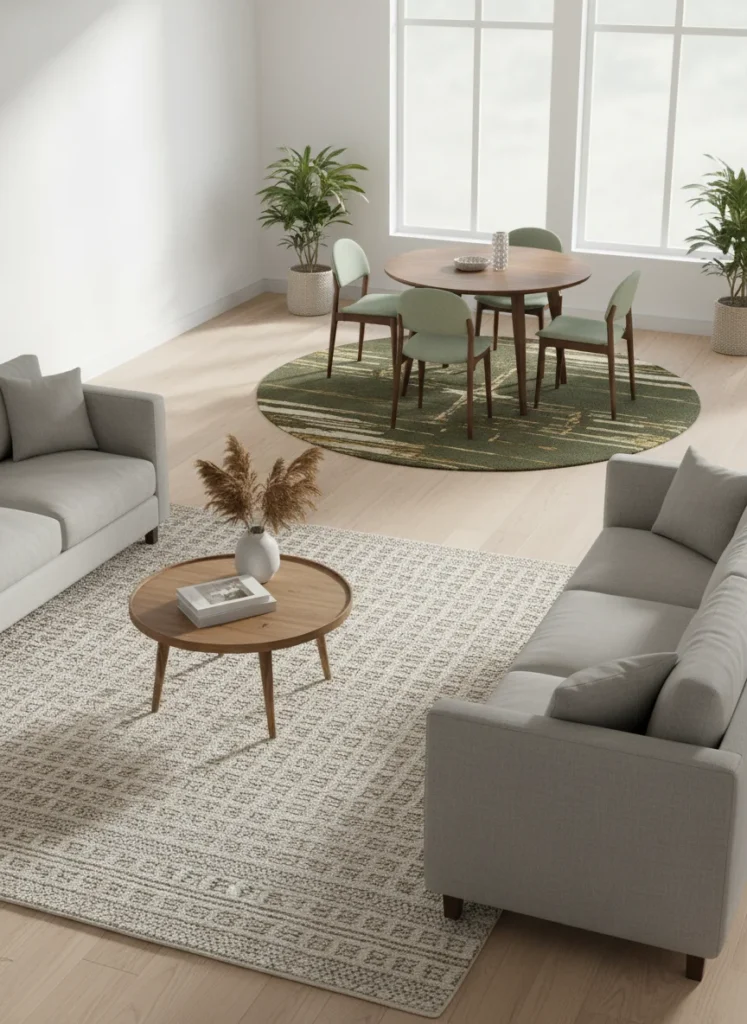
Two rugs are the single most effective tool for creating two distinct zones in a small living room dining area combo. The rug under the living area furniture defines the conversation zone. The rug under the dining table defines the dining zone. The visual boundary between the two rugs is the room’s invisible wall. The brain reads each rug as a distinct zone without needing any physical division between them.
The living area rug should be large enough to anchor the sofa and coffee table with at least the front legs of the sofa sitting on it. An 8×10 is the minimum for most living configurations. The dining rug should extend 18 to 24 inches beyond the dining table on all sides so chairs can be pulled out fully without leaving the rug. For a round table of 48 inches, this means a dining rug of at least 8 feet in diameter. The two rugs should come from the same color family but do not need to match exactly. A jute rug under the living area and a patterned rug in coordinating tones under the dining table is a combination that reads as designed rather than mismatched. Look for a neutral area rug for the living zone anchor and a smaller complementary rug for the dining zone.
2. Hang a Pendant Light Directly Above the Dining Table
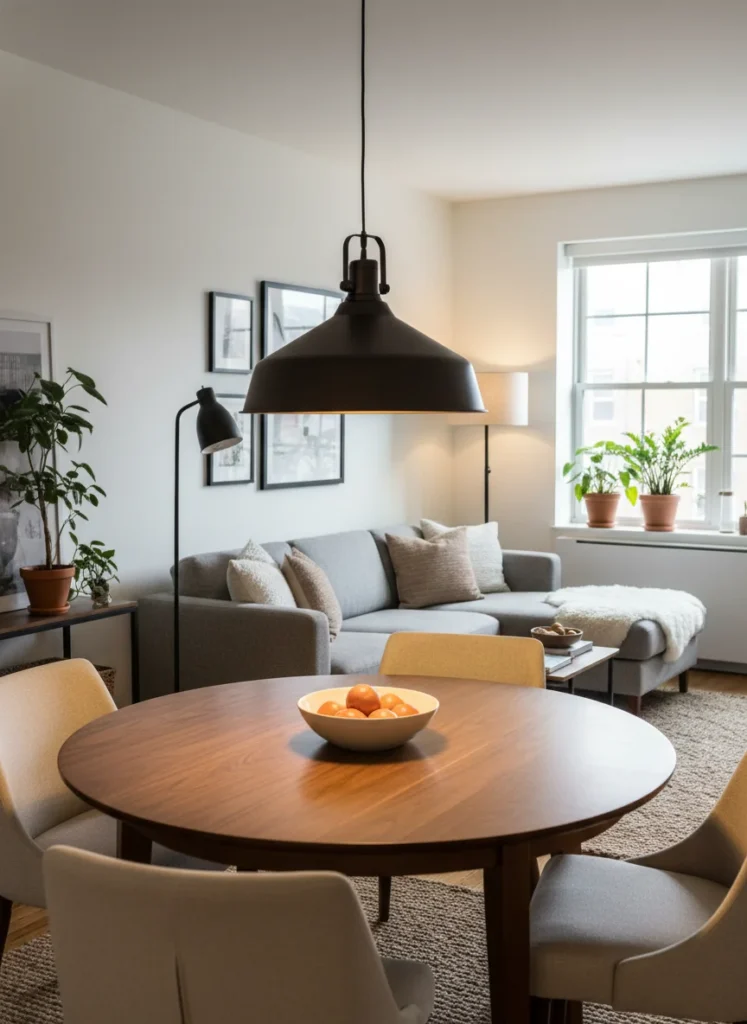
A pendant light centered above the dining table is the most efficient zoning tool in a combined small living room and dining area because it anchors the zone from above, where no furniture can. The pendant creates a defined pool of light above the table that signals a specific functional zone. It also separates the dining area from the living area by establishing a different light plane, which the brain reads as a different space even in a continuous open-plan room.
The pendant should hang so its lowest point is 30 to 34 inches above the table surface, which puts it at eye level when seated and creates the intimate downward light cone that makes dining feel distinct from lounging. A pendant that hangs too high loses its zoning effect because it reads as general room lighting rather than zone-specific lighting. In a rented apartment without hardwired ceiling outlets above the dining table, a plug-in pendant with a ceiling hook and cord cover achieves the same effect. Plug-in pendant lamps on extended cords for rental apartments with cord cover kits run $35 to $70.
3. Float the Sofa With Its Back Facing the Dining Area
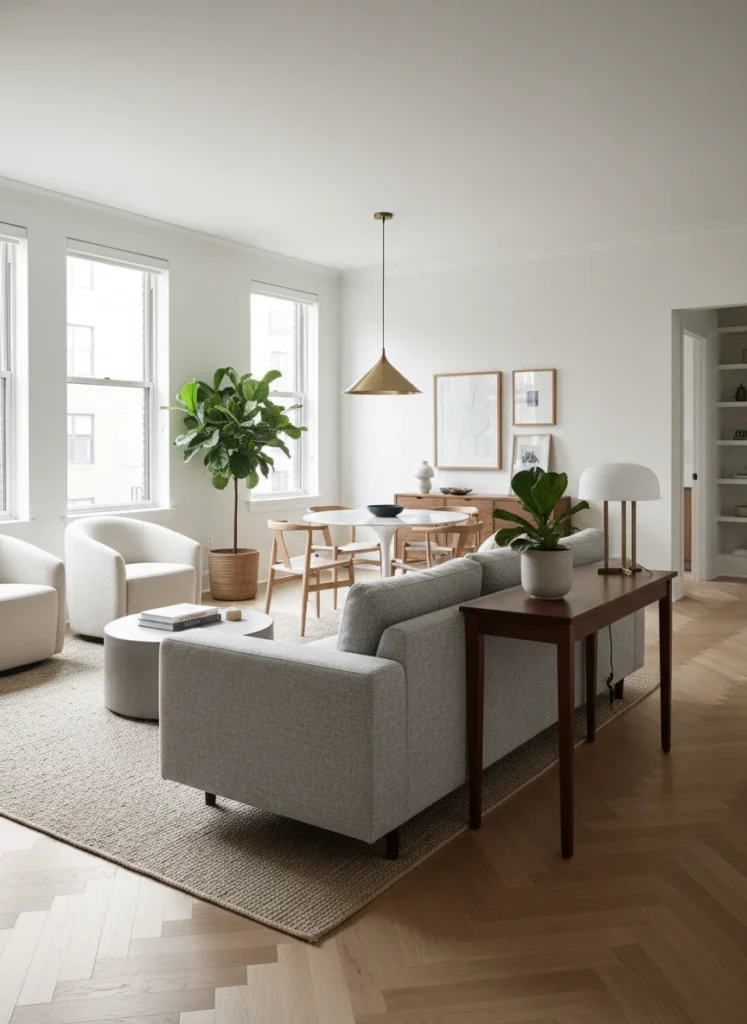
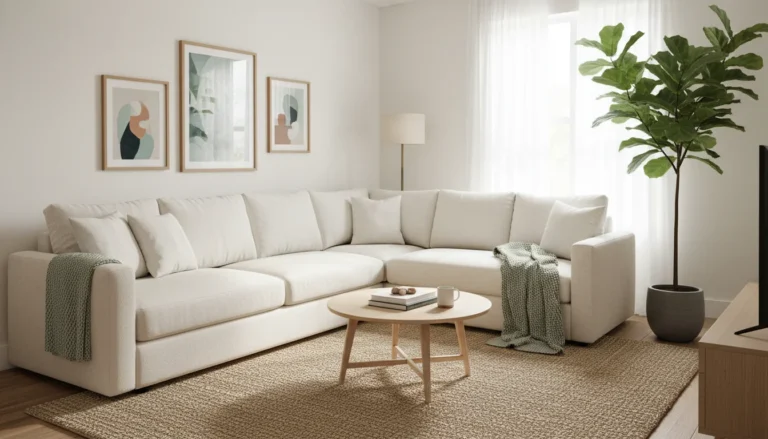
Positioning the sofa so its back faces the dining area is the furniture-level zoning move that does more work than any single piece of decor. The sofa back acts as a low, soft wall between the zones. It creates a clear facing direction for the living area, facing the TV or focal point, while its reverse side implicitly defines where the dining zone begins. The two zones exist on either side of the sofa without any wall between them.
The narrow gap between the sofa back and the dining area is an opportunity: a console table at 10 to 12 inches deep fits in this space, facing the dining zone, and holds a lamp that provides ambient light in the dining area without requiring a separate light fixture. This is the move covered in the small living room layout post on how to arrange a small living room with an awkward layout as one of the foundational designer moves, and it translates directly into the combined living-dining context.
4. Choose a Round Dining Table Over a Rectangular One
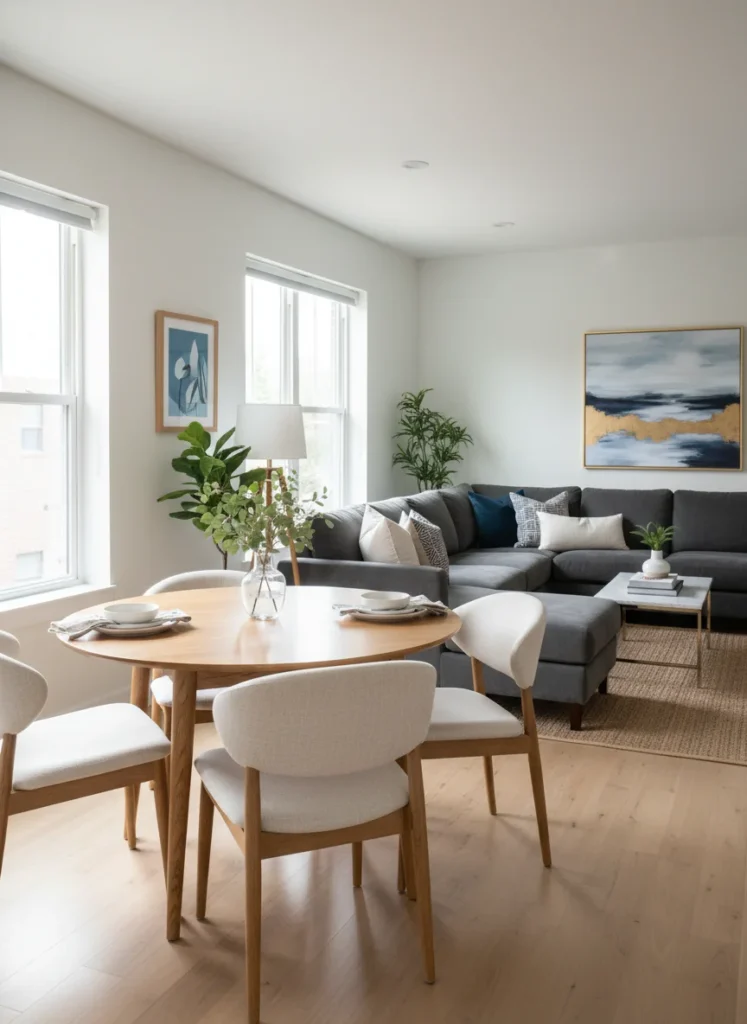
In a small living room dining area combo, a round dining table solves three problems that a rectangular table creates. First, a round table seats four people in less floor space than a rectangular table with the same capacity, because the seats are arranged in a circle rather than along two long sides that require clearance on all four faces. Second, a round table has no corners, which means circulation around it flows naturally from any direction. Third, a round table reads as a different shape from the rectangular sofa and coffee table, which creates a visual distinction between the zones even without a change in color or material.
The sizing rule: a round table for four people should be 42 to 48 inches in diameter. Smaller round tables at 36 inches seat two comfortably or four in a pinch. The dining rug should extend a minimum of 18 inches beyond the table edge on all sides so chairs stay on the rug when pulled out. A round dining table for small spaces in the 42 to 48-inch diameter range is available in most price points from $80 to $250 depending on material.
5. Use an Extendable Dining Table for Maximum Flexibility
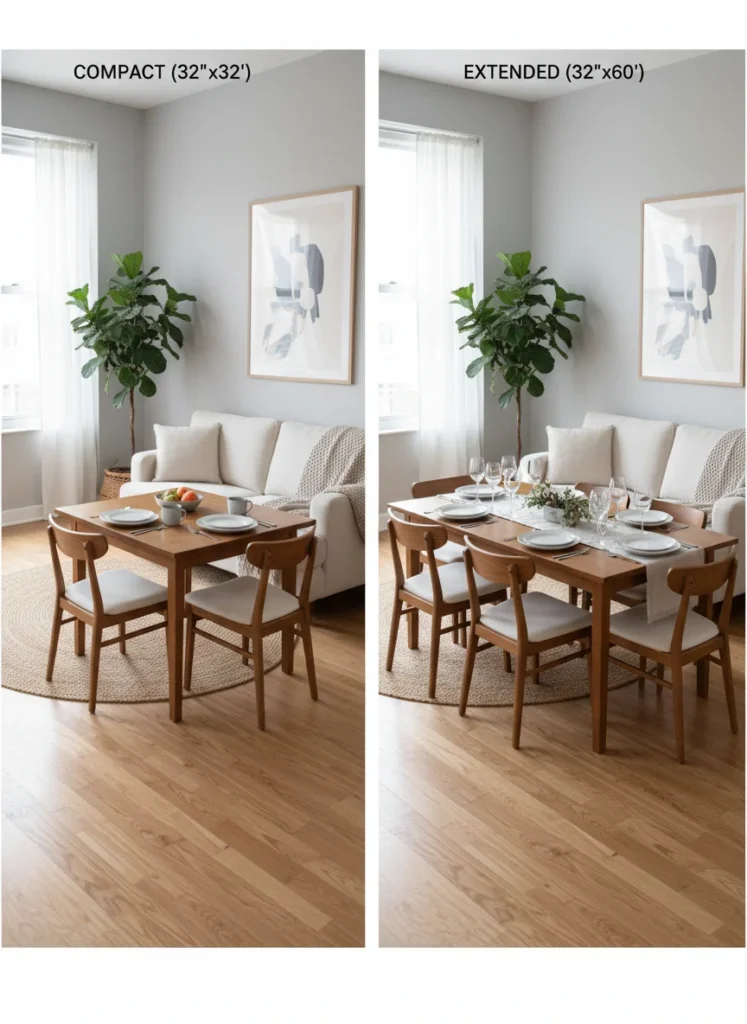
An extendable dining table is the highest-value furniture investment in a small living room dining area combo because it allows the dining zone to shrink in everyday use and expand when you need it. A compact extension table at 32 by 32 inches seats two people daily and takes minimal floor space, leaving more clearance in the combined room for comfortable living zone circulation. Extended to 32 by 60 or 32 by 72 inches for dinner parties, it seats six to eight without requiring a larger table to live in the room permanently.
The leaves for most extendable tables store under the table surface or in a closet. When not in use, the table sits in its compact configuration as a fixed point in the dining zone. When extended, it takes over more of the combined floor space temporarily. This is the specific furniture approach recommended in the studio apartment post on studio apartment ideas for rooms under 400 square feet, where every piece of furniture needs to serve its maximum and minimum function depending on the situation.
6. Create a Color or Material Transition Between the Two Zones
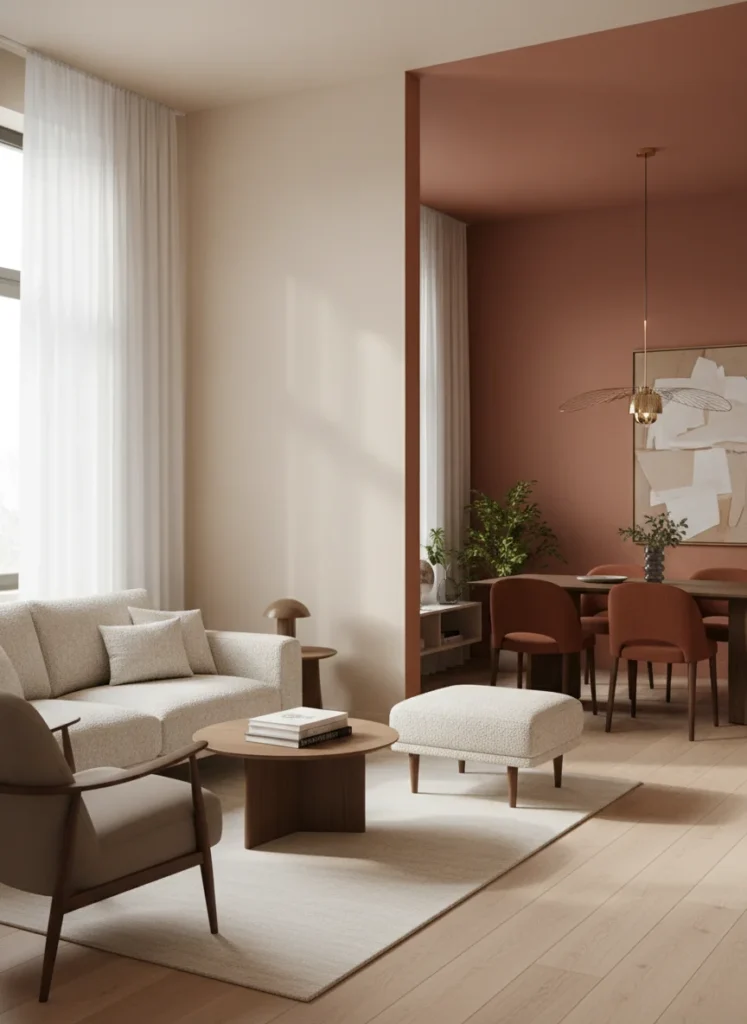
A subtle color shift between the living and dining zones is the paint-level version of zoning in a small living room dining area combo. The two zones do not need dramatically different colors. A living zone in warm white and a dining zone in warm greige, or a living zone in soft sage and a dining zone in deeper dusty green, creates a clear visual signal that the function of the space has changed without making the combined room feel like two rooms painted by different people.
The simplest version of this is a single accent wall in the dining zone, painted in a deeper tone than the living zone walls. The dining pendant lamp hangs in front of this accent wall, the dining table sits in front of it, and the entire dining zone reads as a destination with its own visual identity rather than an extension of the living zone. The transition works because the brain reads background color as a spatial cue that signals a change in zone.
7. Use an Open Bookshelf as a Partial Room Divider
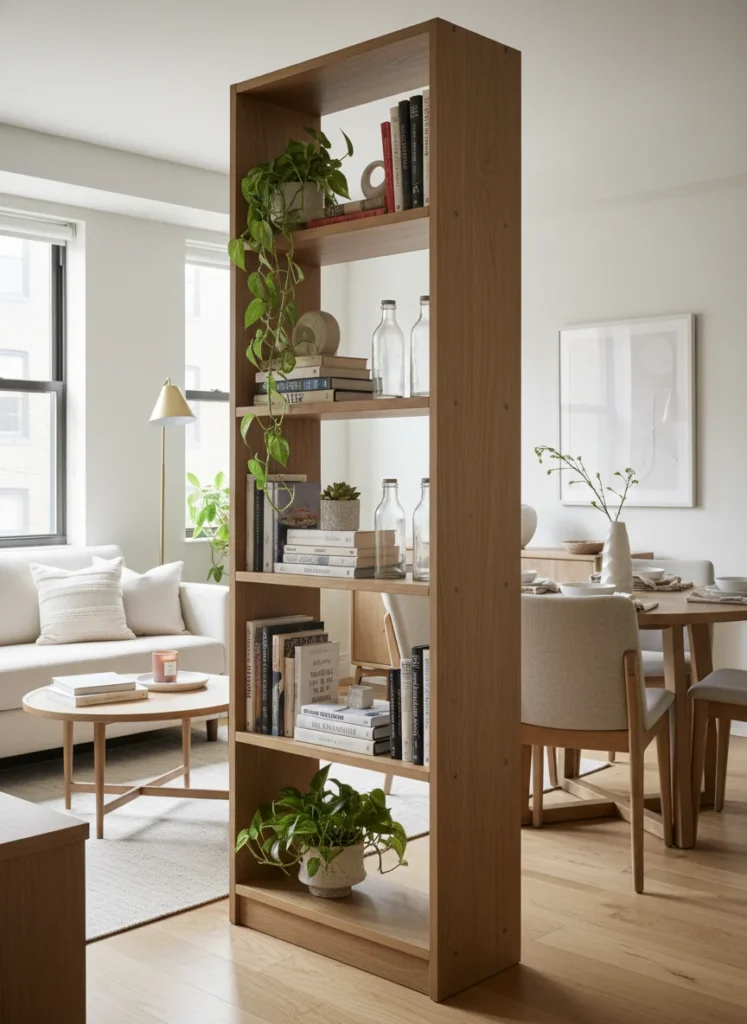
An open bookshelf placed perpendicular to the wall, extending into the room between the living and dining zones, creates a partial division that defines both zones without closing off either one. The shelf is open so light and sightlines pass through it freely. It reads as a boundary from a seated position while allowing the full ceiling height to remain continuous above it, which keeps the combined room feeling like one cohesive space rather than two cramped rooms.
The shelf needs to be at least 48 inches tall to read as a zone divider from a seated position. At 60 to 72 inches, it creates a stronger division while still leaving 12 to 24 inches of open wall above it. The shelf’s position should align with the edge of the dining rug on the living-zone side and the edge of the living area rug on the dining-zone side, reinforcing the zone boundary that the rugs have already established at floor level. A standard bookshelf in this proportion runs $60 to $120.
8. Match the Dining Chairs to the Living Area’s Accent Color
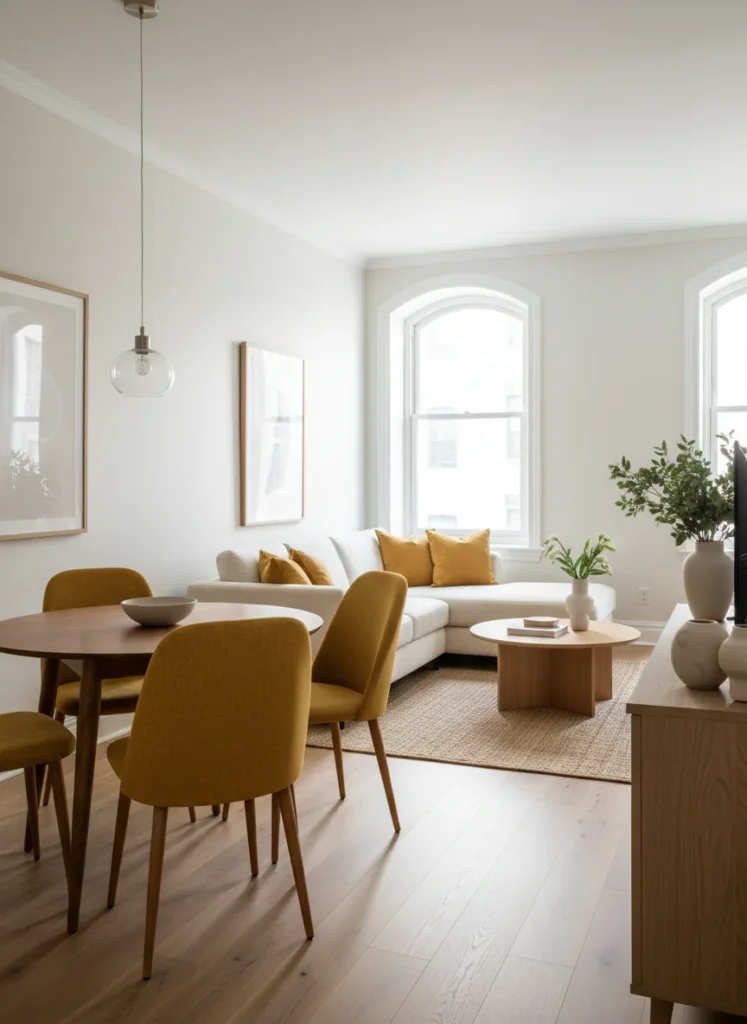
Visual coherence between two zones in a combined small living room dining area is what prevents the room from feeling like two separate design decisions sharing one space. The easiest way to create coherence without making everything match: pull the accent color from one zone into an element in the other. The dining chairs upholstered in the same tone as the sofa throw pillows. The dining table leg color matching the coffee table material. The pendant lamp above the dining table in the same metal finish as the floor lamp in the living zone.
This principle of color threading across zones is what makes professionally designed combined rooms feel like they were planned as one space rather than assembled zone by zone. Each zone retains its distinct identity and function while sharing a visual language that makes the room read as a unified whole. No purchase is required if you have existing accent colors in one zone that can be echoed in the other.
9. Use a Sideboard Along the Shared Wall as Zone Storage for Both Areas
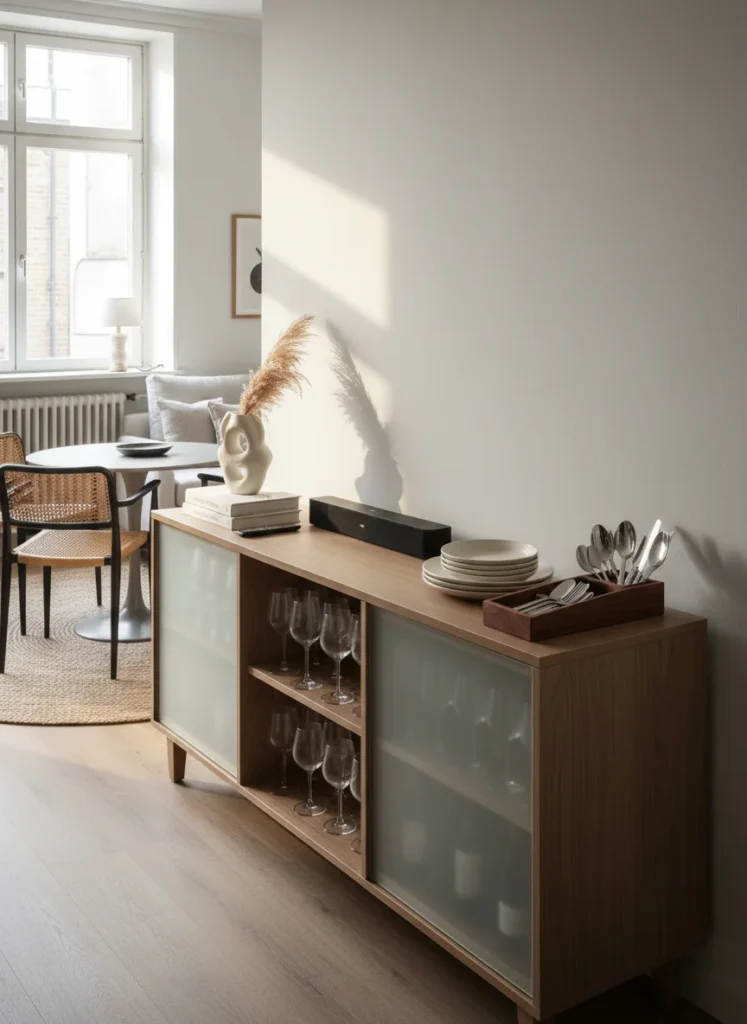
A sideboard placed against the shared wall between the living and dining zones serves both zones simultaneously from one piece of furniture. The dining zone uses it for linens, glassware, and serving pieces stored in the cabinet below. The living zone uses the top surface for a lamp, decor, and media storage if it is adjacent to the TV wall. One piece earns two zone functions without adding a second piece of furniture to the room.
The sideboard depth matters: at 14 to 16 inches deep it sits close to the wall and does not project far into the room’s circulation path. At 18 to 20 inches it starts to compete with the dining table’s clearance in a tight combined room. A slim sideboard in this size range runs $120 to $250. Look for one with closed cabinet storage below and a clear top surface so it reads as furniture rather than a storage unit. A slim sideboard for small combined living and dining rooms in the 14-inch depth range is the right specification.
10. Keep Furniture Legs Visible in Both Zones for Visual Continuity
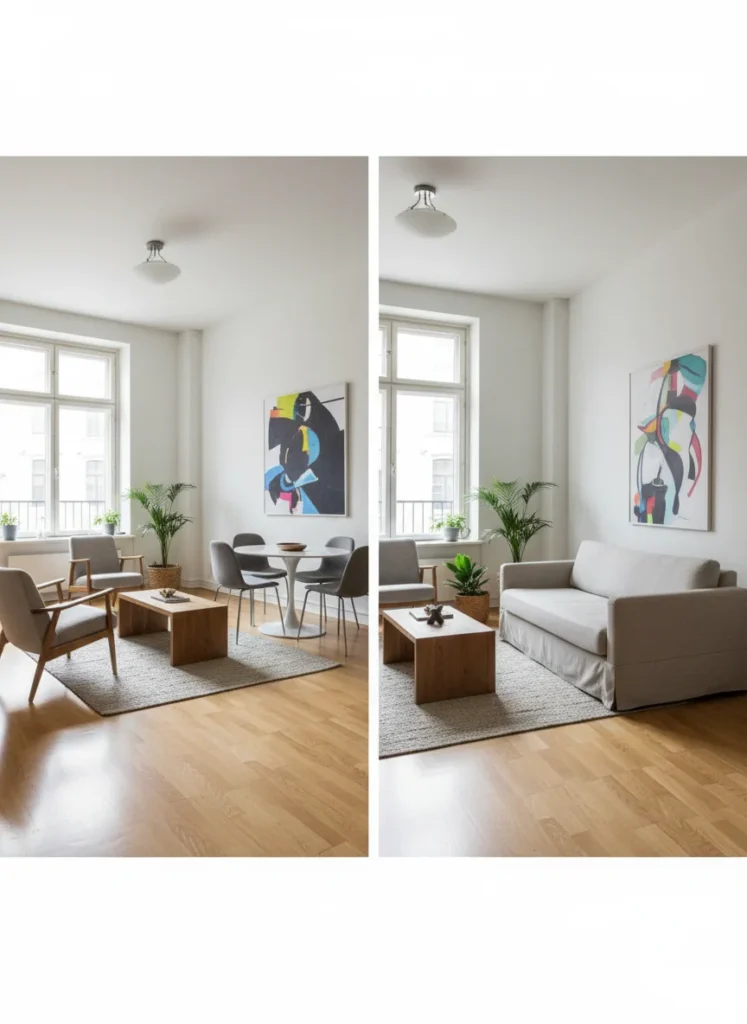
In a small living room dining area combo, furniture with visible legs in both zones creates visual continuity at floor level that makes the combined space feel larger and more open. When the eye can see the floor beneath the sofa, the dining chairs, the coffee table, and the dining table, the floor reads as a continuous surface that connects both zones. When solid-base furniture sits on the floor with no clearance, it creates visual blocks that fragment the room and make it feel smaller than it is.
This is particularly important in the dining zone: dining chair legs that are visible at their full height make the dining table float above the floor in a way that keeps the zone from feeling like a solid block of furniture. Upholstered dining chairs with skirted bases eat the visual floor space in a small dining zone and should be avoided. Metal or wood leg dining chairs at standard leg height of 4 to 6 inches are the right choice for maintaining the open floor plane in a small combined room.
11. Wall-Mount the TV to Free the Living Zone’s Primary Wall
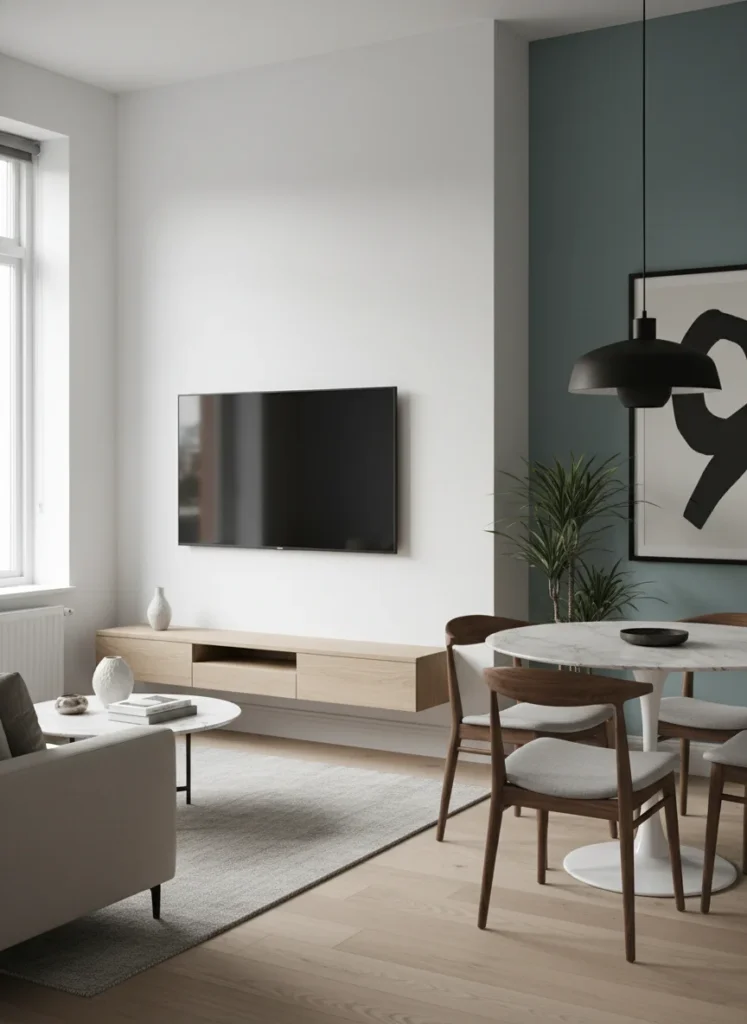
A large entertainment center in a small combined living and dining room takes up the wall space that should be the living zone’s visual anchor and brings significant furniture mass to a room that already has a dining table, chairs, and sofa competing for space. Wall-mounting the TV with a slim floating console below it clears the living zone wall from floor to TV height, which makes the room read as more open and makes the combined space feel less crowded despite containing the same number of functional pieces.
The clearance below a wall-mounted TV and above the floor, typically 18 to 24 inches, can be filled by a floating console that holds media components without touching the floor. The visible floor beneath the console reads as the floor extension of the living zone, which connects the two zones at floor level rather than dividing them with a solid block of furniture. This is one of the layout principles covered in the post on how to arrange a small living room with an awkward layout and it applies with equal force in combined room contexts.
12. Use Curtains to Create a Temporary Dining Room When Needed
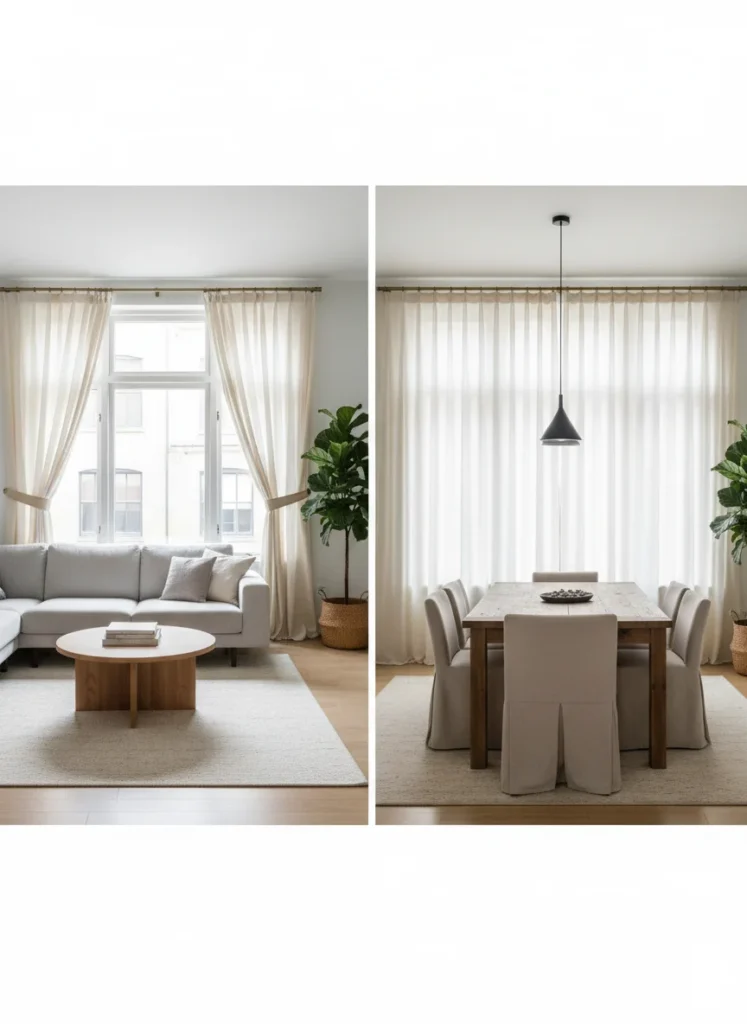
A ceiling-mounted curtain track with linen panels running between the living and dining zones is the most flexible zone divider available in a rented combined space. When open, the curtain panels stack to the side and the room reads as one continuous space with good light and sightlines. When closed, they create a soft partition that gives the dining area its own identity, muffles the kitchen sounds from the dining zone, and makes dinner parties feel like they are happening in a defined room rather than a corner of the living room.
Ceiling-mounted curtain tracks for room division install with small ceiling-mounted brackets and run on a smooth glide system. The track can follow any line across the ceiling, not just a straight line parallel to one wall. Sheer linen panels allow light to pass through while creating a visual boundary. Full opaque panels create more complete separation. A ceiling track system with panels for an 8 to 10-foot opening runs $60 to $120. This is also the approach used for creating zones in studio apartments, covered in detail in the post on studio apartment ideas for rooms under 400 square feet.
13. Scale the Dining Table to the Actual Number of People You Feed Daily
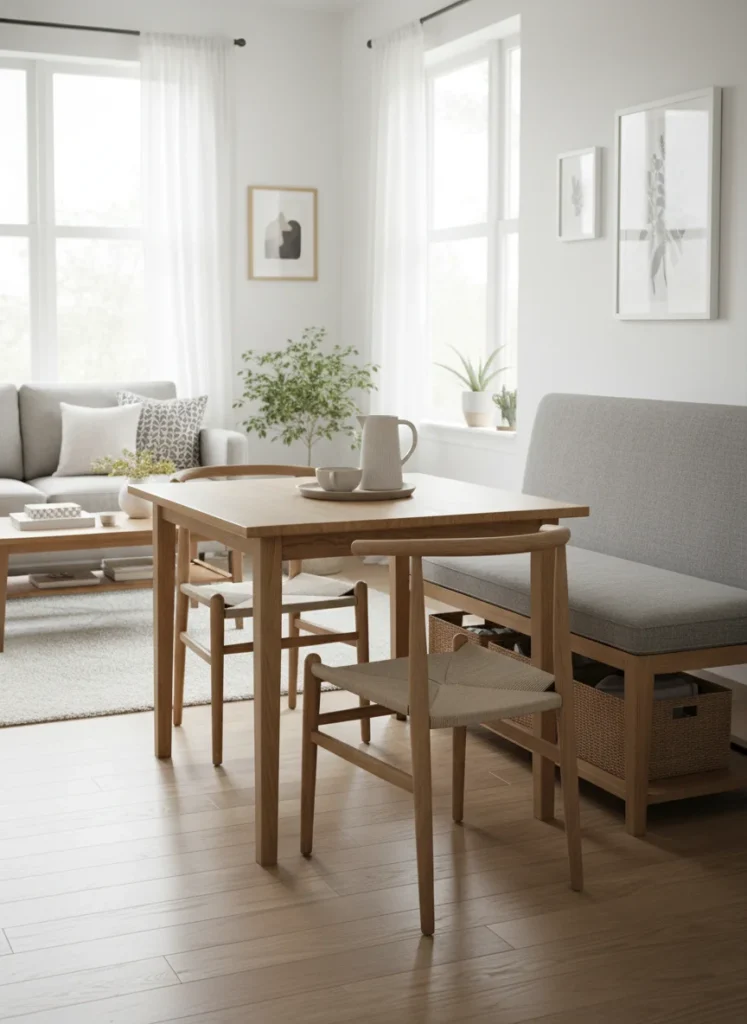
The single most common mistake in small living room dining area combos is a dining table sized for the maximum number of people you might ever host rather than the number you feed on an average Tuesday. A table for six in a room that holds two people daily means four chairs worth of space is occupied 95 percent of the time by nothing. Scaling the table to your daily use, two or four people depending on your household, and adding a storage bench or wall-mounted folding extension for guests when needed frees significant floor space in the dining zone every single day.
A correctly sized daily dining table at 32 by 32 inches for two, or 36 by 60 inches for four, with a storage bench against one wall for overflow seating, gives the combined room appropriate daily clearance while maintaining the option for larger gatherings without a permanently oversized furniture footprint. The storage bench provides seating for two additional guests and stores dining linens, extra place settings, or anything else the dining zone needs to hold.
14. Place Plants at Zone Boundaries as Living Dividers
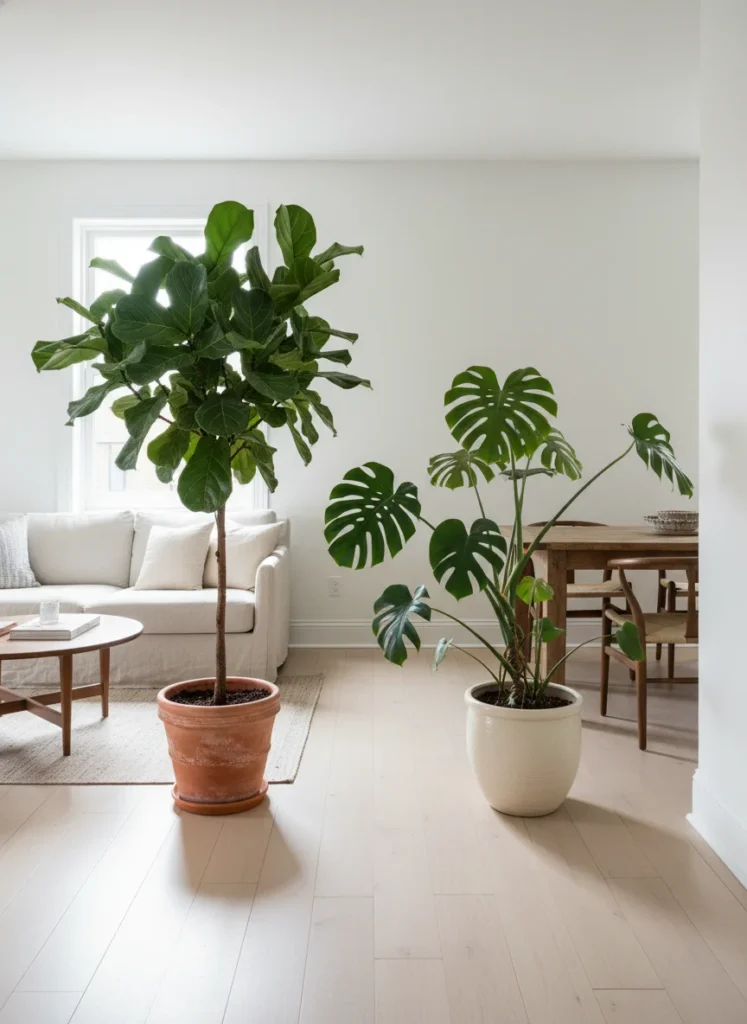
Two large plants positioned at the zone boundary, one on each side of the path between the living and dining areas, create an organic zone marker that reads as intentional design rather than a functional division. A fiddle leaf fig on one side and a large monstera on the other frame the threshold between zones without blocking it. The eye reads the pair of plants as a soft gate, a signal that the zone has changed, while the plants themselves add life and visual richness to the zone boundary that no piece of furniture can replicate.
The plants need to be large, floor-standing specimens in statement pots, not small shelf plants. A plant that reaches 4 to 5 feet in height reads as architectural. A small plant on a stand reads as decor. The architectural plant is the one that can function as a zone marker. Fiddle leaf figs, monsteras, large snake plants, and bird of paradise plants all work well for this purpose because they have strong vertical forms that define space without spreading horizontally into the circulation path.
15. Use a Banquette or Built-In Bench Along One Wall of the Dining Zone
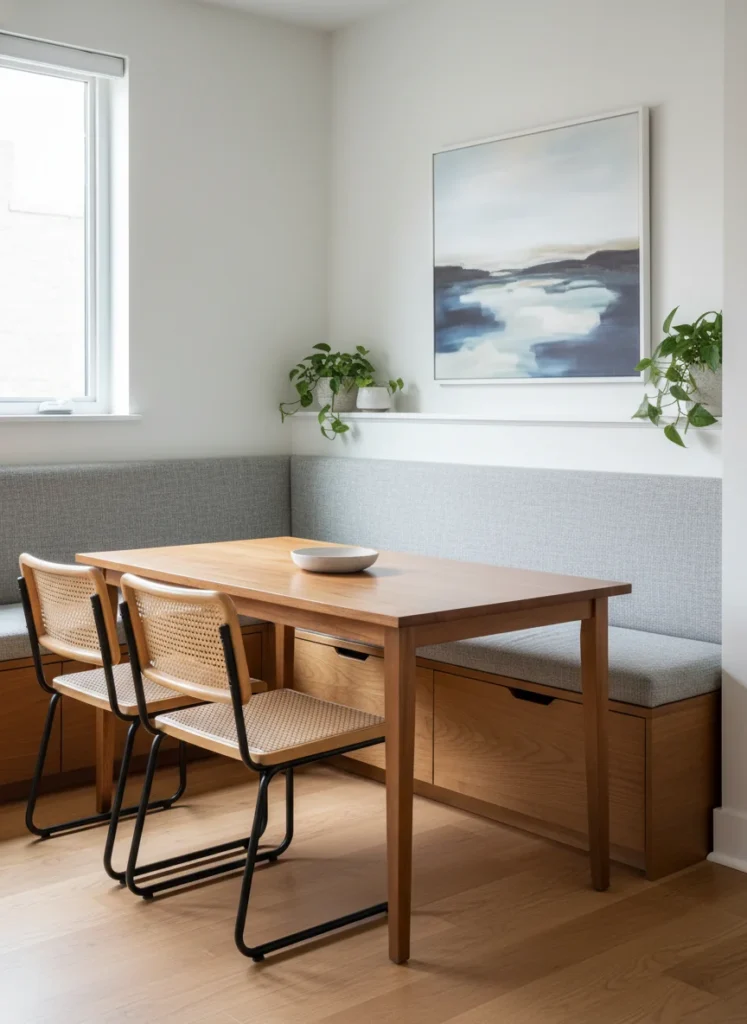
A wall-mounted banquette bench along the dining zone wall is the highest space efficiency move in a small living room dining area combo because the bench sitters slide in rather than pulling chairs out, which eliminates the 18 to 24-inch chair clearance requirement on that side of the table. In a small combined room, recovering 18 to 24 inches of floor space on one side of the dining table is significant: it allows the table to sit closer to the wall, which gives more clearance to the living zone and the circulation path between zones.
A basic built-in banquette bench with a hinged top for storage runs $80 to $200 in materials and a half day to build from a simple box construction with a foam cushion top. The storage beneath the seat, typically 12 to 15 inches of depth, holds dining items, extra linens, or seasonal pieces that would otherwise require additional furniture. The seat cushion can be upholstered in the room’s accent color, which serves the zone-coherence goal of threading one color across both spaces.
16. Ensure 36 Inches of Clearance Around Every Piece of Dining Furniture
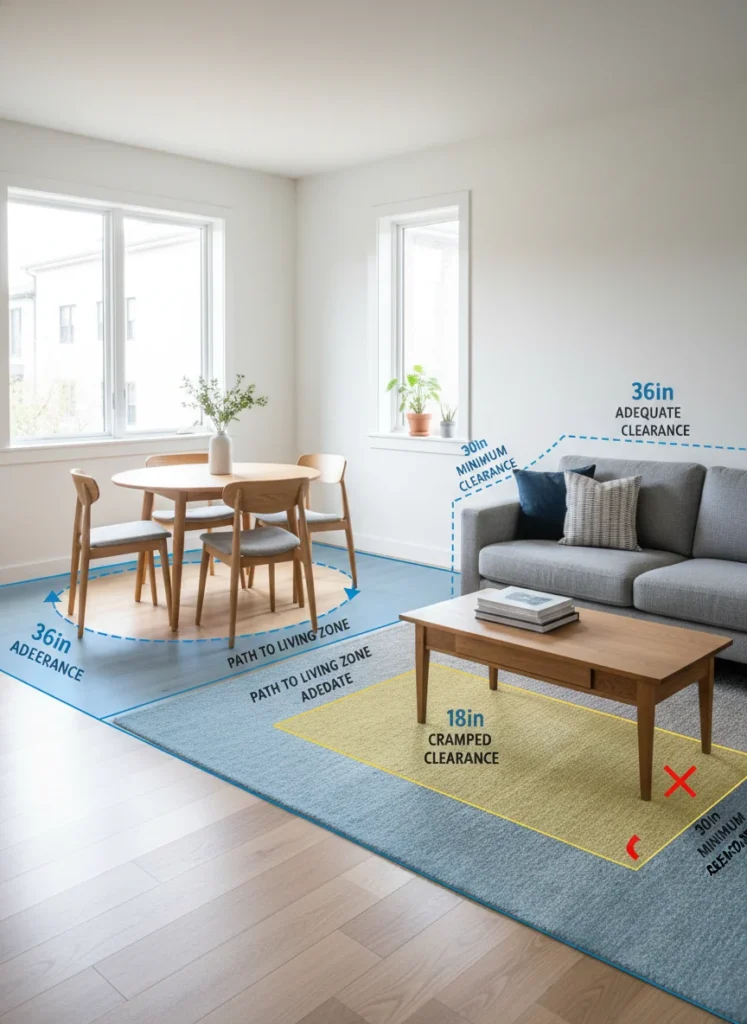
The most common reason a small living room dining area combo feels cramped is not that the room is too small. It is that the dining table and chairs take up more floor space than the clearance allows after the living zone furniture is placed. The minimum functional clearance around a dining table is 36 inches on the traffic side and 24 inches on the wall side. Less than 36 inches on the side where people pull out chairs means the chair movement competes with circulation, which makes the dining zone feel physically uncomfortable regardless of how well styled it is.
Measure this before placing any furniture. Tape the dining table footprint plus 36-inch clearance zones on the floor and assess whether the remaining space is adequate for the living zone. If it is not, the dining table needs to be smaller, not the living zone. The living zone clearance requirements are fixed by comfort: a minimum of 18 inches between the sofa and the coffee table, and 36 inches of clear path around the perimeter of the seating area. These numbers do not compress. The dining table is the variable.
17. Use Consistent Lighting Temperature Across Both Zones
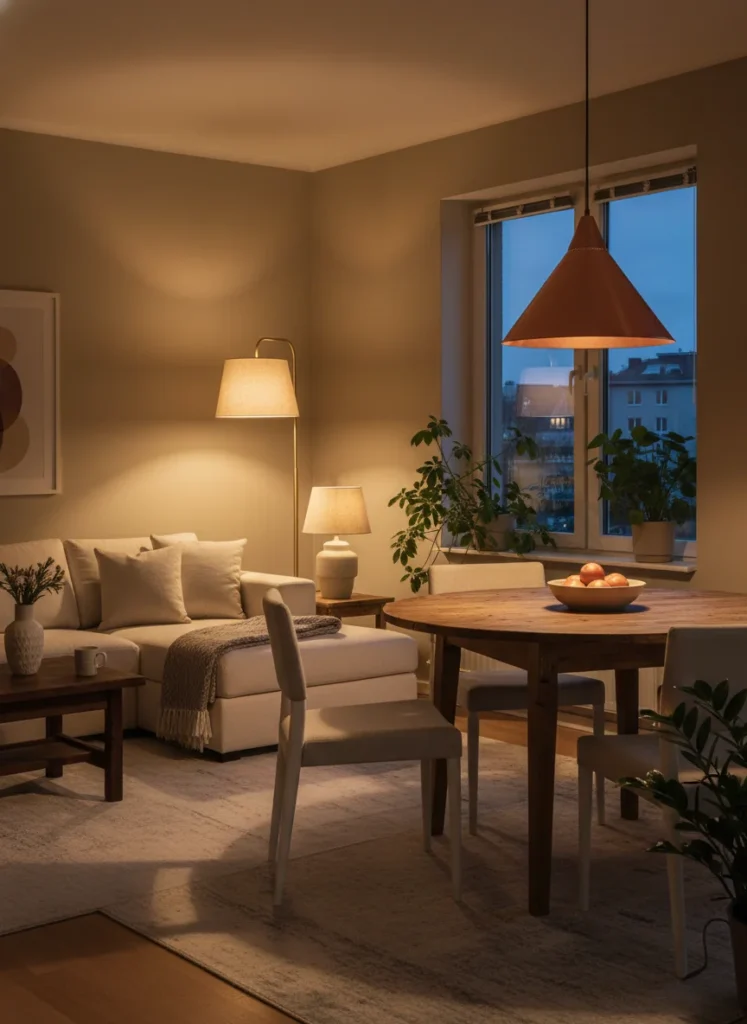
Zones that use different lighting color temperatures, a warm 2700K floor lamp in the living area and a cool 4000K overhead in the dining area, feel like different rooms because the brain processes color temperature as a strong environmental cue. Using the same color temperature across both zones, 2700K warm white in all light sources, is the lighting-level coherence move that makes the two zones read as part of one designed space.
This does not mean identical light fixtures. The living zone can use a floor lamp and a table lamp. The dining zone uses a pendant lamp above the table. Both use 2700K bulbs. The zones have different lighting setups that serve their different functions, but the quality of the light in both zones belongs to the same warm family. This is the lighting principle behind the combined room feeling designed and intentional rather than assembled zone by zone. For more on layered lighting in open-plan and small spaces, the principles in the post on small living room ideas when there is no natural light apply directly to the evening lighting setup in a combined living and dining room.
The Priority Order for Making Both Zones Work
If you are starting from scratch or rearranging an existing combined room, work in this sequence: measure the clearances first, place the dining zone rug and anchor it with the table and chairs within the required clearances, then place the living zone rug and float the sofa with its back to the dining zone. Add the pendant above the dining table and a floor lamp or pair of table lamps in the living zone. Then address the zone boundary with a plant, a bookshelf, or simply the sofa back. Every other decision, the sideboard, the accent wall, the curtain divider, improves the room but is not required for it to function well. The rug placement, the clearances, the pendant light, and the floating sofa position are the moves that determine whether the room works or does not. Everything else is refinement.