

This post contains affiliate links. If you buy something through my links, I may earn a small commission at no extra cost to you. I only recommend things I genuinely use or believe in.
A small bedroom that looks messy does not need more storage. It needs a system. Those are not the same thing. More storage without a system means more places for things to pile up invisibly until the bin overflows and the surface clutter returns. A real organization system does one thing: it makes it easier to put things away than to leave them out. When that is true, the room stays organized without constant effort. When it is not, no amount of baskets will fix it.
The 17 ideas below are the specific, actionable tricks that actually keep a small bedroom organized long-term. Not the generic “declutter first” advice that starts every article about this topic. The real moves: where to put what, what to buy, and what to stop doing that is making the mess worse than it needs to be.
💡 Before you start decorating, see how your room could look with AI.
🏡 See Your Room Before You Spend a Dollar
Still wondering if that new furniture, paint color, or decor style will actually look good in your space?
- Upload a photo of your room and let AI instantly generate beautiful design ideas.
- Explore different interior styles, furniture layouts, and color combinations before you spend a single dollar.
The Organizing Mindset That Changes Everything
Most small bedroom organization advice treats the problem as a storage problem. The real problem is a decision problem. Every item that ends up on the floor, the chair, or the nightstand is there because putting it away required a decision that was slightly harder than leaving it down. The solution is to make the right choice the easy choice: a hook where the robe gets dropped, a tray where the jewelry lands, a designated bin where the laundry goes. These are not aesthetic upgrades. They are friction-reduction systems.
Once the friction is reduced, the room starts to look intentionally minimal because it genuinely is: everything has a place, and the places are easy to use. The minimal look is the byproduct of a system that works, not a style choice you maintain through constant effort.
17 Small Bedroom Organization Tricks That Actually Work
1. Give Every Surface a Three-Item Maximum
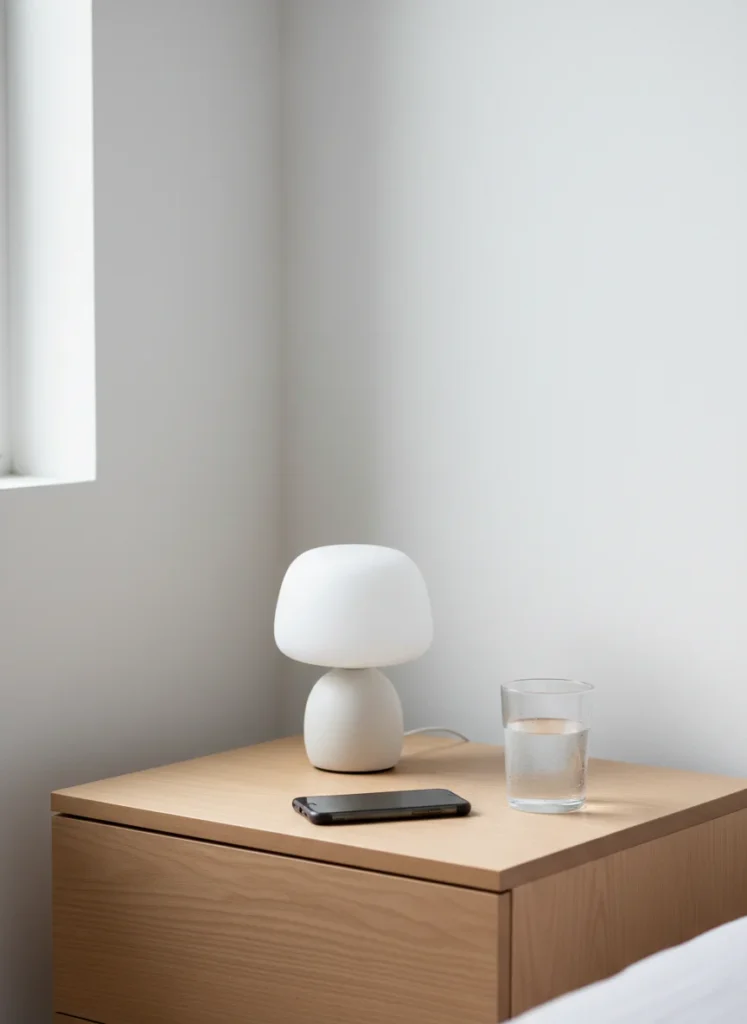
The nightstand, the dresser top, and the windowsill are the surfaces that become clutter magnets in almost every small bedroom. The problem is not that people put things on them. The problem is that there is no rule about what belongs there. A three-item maximum per surface is a rule that requires no willpower to follow because it is binary: three items or fewer, or it is time to put something away.
The three items on the nightstand might be: lamp, phone, glass of water. The three items on the dresser top: tray, perfume bottle, one small plant. The rule forces a decision every time something new arrives on a surface, which is the decision-friction that most organization systems try to eliminate. When the surface limit is clear, the choice to put the new thing away becomes the default, not a conscious effort. This is the simplest and highest-impact habit in keeping a small bedroom organized without thinking about it.
2. Use Slim Velvet Hangers to Gain 30 Percent More Closet Space
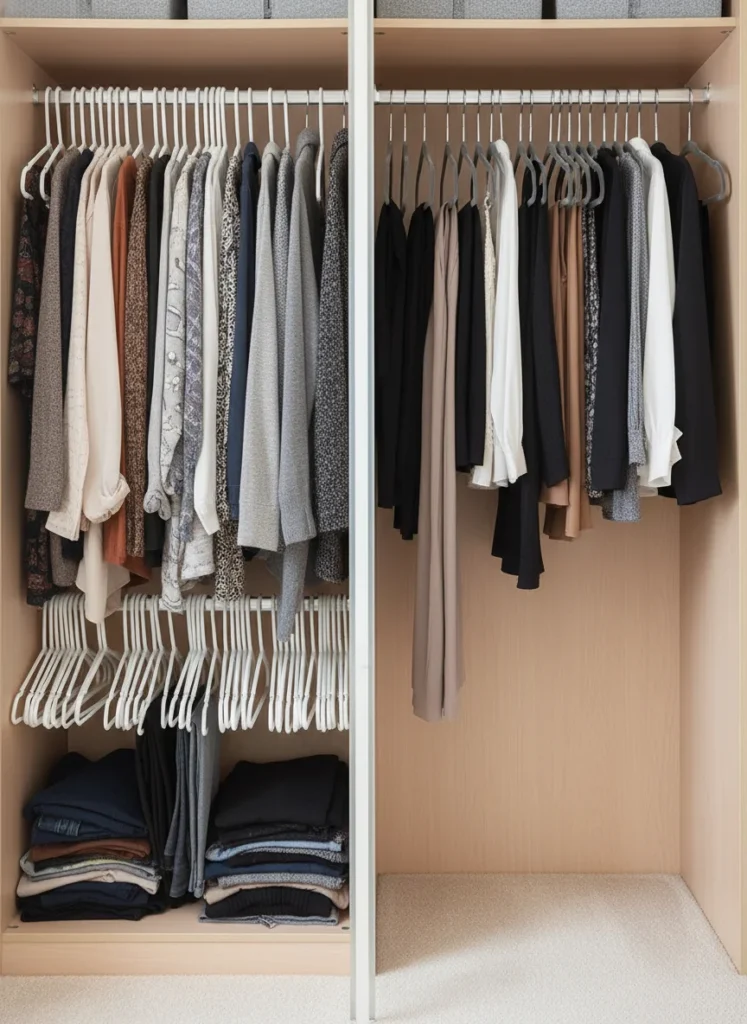
Plastic hangers are 2 to 3 inches thick at the shoulder. Slim velvet hangers are under an inch. Replacing every plastic hanger in a closet with slim velvet alternatives adds roughly 25 to 35 percent more hanging capacity to the same rod length, which for many small bedroom closets means the difference between cramped and actually functional. The velvet surface also grips fabric so clothes do not slip and pile on the floor, which is a separate problem that plastic hangers create.
A set of 50 slim velvet hangers runs $12 to $18 on Amazon. This is the highest return-per-dollar investment in closet organization, and it takes 20 minutes to complete. The closet immediately looks more organized after the swap even if nothing else changes, because the rod reads as airy rather than packed. Slim velvet hangers in a neutral tone are the first purchase to make in any small bedroom organization project.
3. Install an Over-the-Door Organizer on the Bedroom Door

The inside of the bedroom door is prime real estate that almost every small bedroom leaves empty. An over-door organizer with pockets holds scarves, belts, small bags, charging cables, jewelry, or any of the small items that typically live on the dresser top or nightstand surface and create visual clutter. Because it is behind the door, it is invisible from the room when the door is open, which means the storage reads as clean even if the organizer itself is full.
The best over-door organizers for bedrooms have deep pockets rather than clear vinyl ones, which read as more intentional and less storage-unit. A fabric over-door organizer with deep pockets runs $15 to $28. This is one of the moves from the no-closet-bedroom approach, which I covered in the post on small bedroom ideas with no closet, where door and wall storage become the primary organization systems.
4. Put Flat Rolling Bins Under the Bed for Seasonal Storage
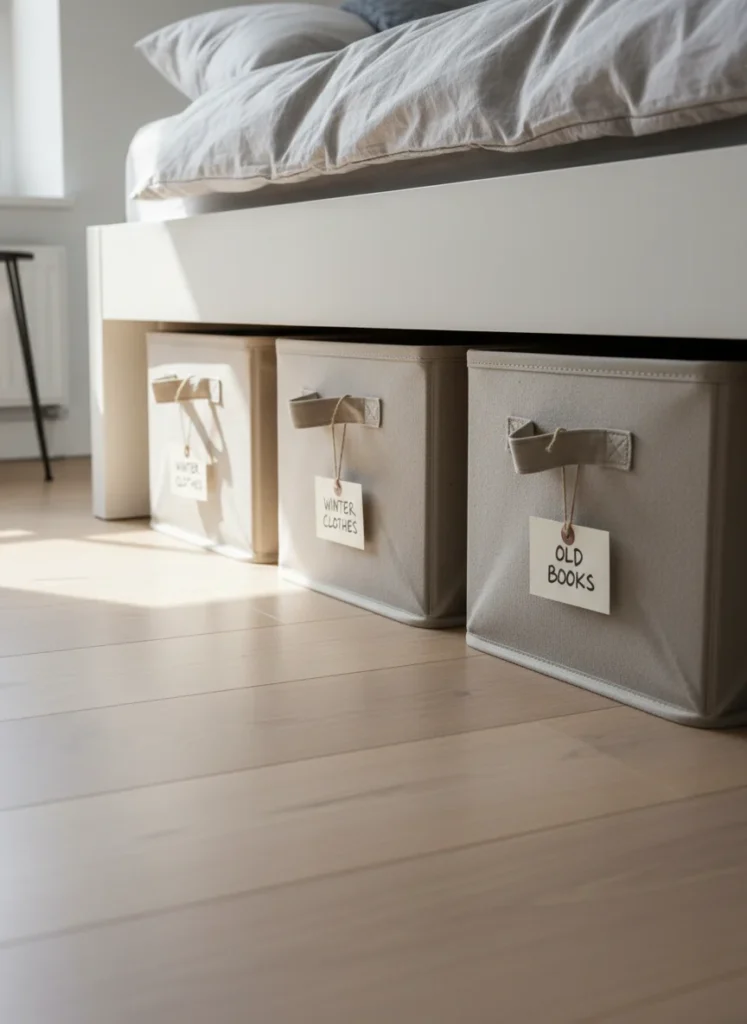
Under-bed storage is the most underused square footage in a small bedroom, and the reason most people do not use it effectively is that they buy the wrong containers. Tall storage bins require a high bed frame. Deep lidded boxes are hard to access. Flat, rolling fabric bins that slide in and out easily are the only under-bed storage solution that gets used consistently because they do not require effort to access.
Dedicate the under-bed zone to seasonal items: winter clothing in summer, summer clothing in winter, extra bedding, or shoes for the current season. Labeling the bins takes 30 seconds and saves 5 minutes of searching every time you need something. The post on small bedroom ideas with a full bed covers the specific bed frame height requirements and the riser option for beds with less than 6 inches of clearance. Look for flat rolling under-bed storage containers in neutral fabric in the $18 to $35 range for a set of two.
5. Use Drawer Dividers for Every Dresser Drawer
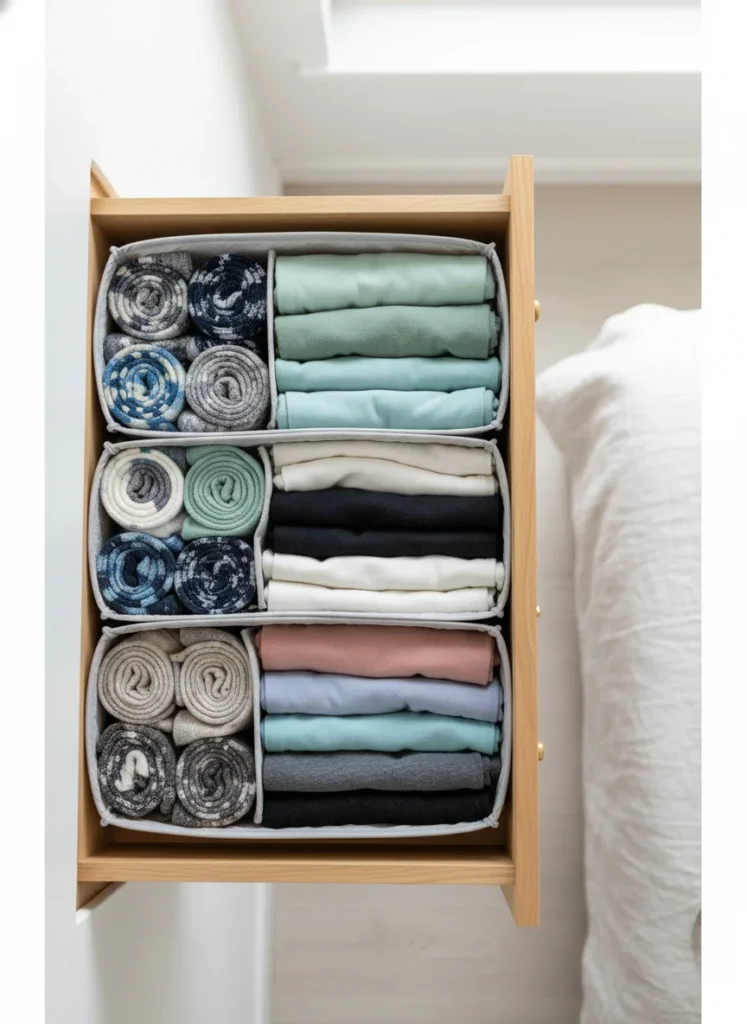
An undivided dresser drawer becomes a junk drawer within two weeks regardless of how carefully you initially fold and sort. The items shift, mix, and become impossible to find without emptying the drawer. Drawer dividers fix this by giving each category of item its own physical zone. Socks do not mix with underwear. T-shirts stay upright rather than falling sideways. The system maintains itself because the dividers provide the structure that loose items cannot maintain on their own.
The most flexible dividers are adjustable bamboo or expandable plastic dividers that resize to fit any drawer width. Adjustable bamboo drawer dividers run $12 to $20 for a set of six and fit most standard dresser drawers. Pair with the vertical folding method, where items are folded into small rectangles and stood upright rather than stacked, so you can see every item in the drawer at a glance without disturbing the ones below.
6. Add a Wall Hook Rail Beside or Behind the Door
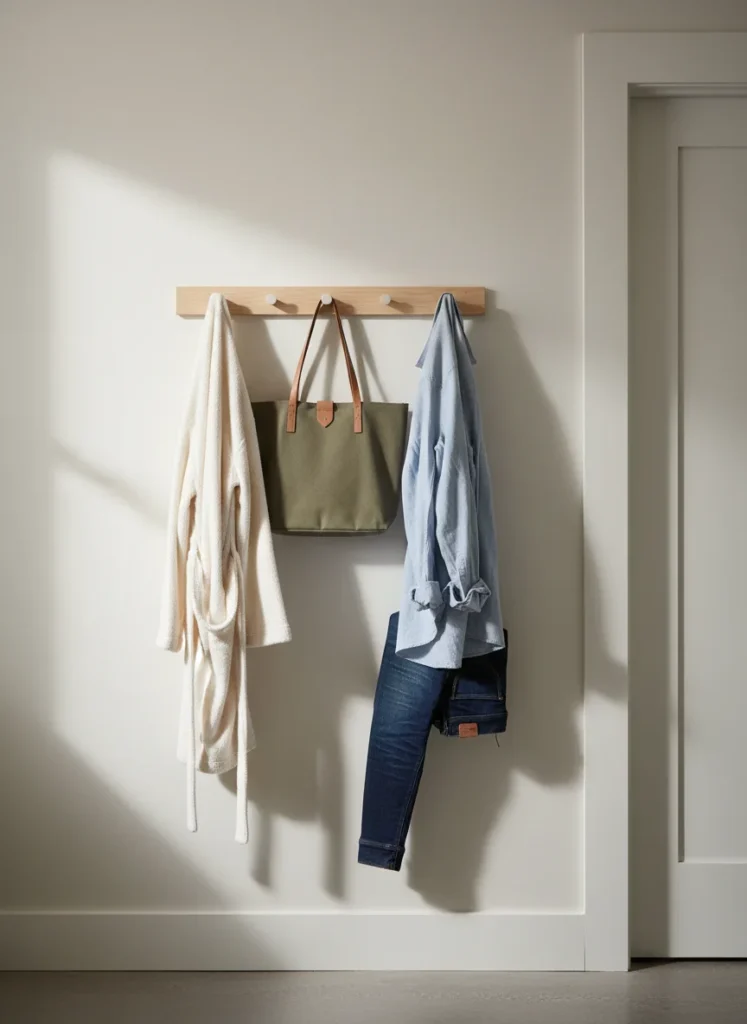
The floor at the foot of the bed and the chair in the corner are where clothes go when they are not clean enough to put back in the closet but not dirty enough for the laundry basket. This is the purgatory zone of small bedroom organization and it creates more visible clutter than almost anything else. A wall-mounted hook rail beside or behind the door solves this by giving the purgatory items a designated home that is off the floor and off every surface.
Four to five hooks is enough. One for the robe, one for the current day’s outfit, one for the bag or tote, one for the “might wear again” item. The hooks should be at a height that is natural to reach without thinking, roughly 60 to 66 inches from the floor. A wall hook rail in wood or matte black metal runs $15 to $30 and installs in 15 minutes. This is the move that most directly eliminates the floor and chair pile problem rather than just relocating it.
7. Fold Clothes Vertically in Drawers
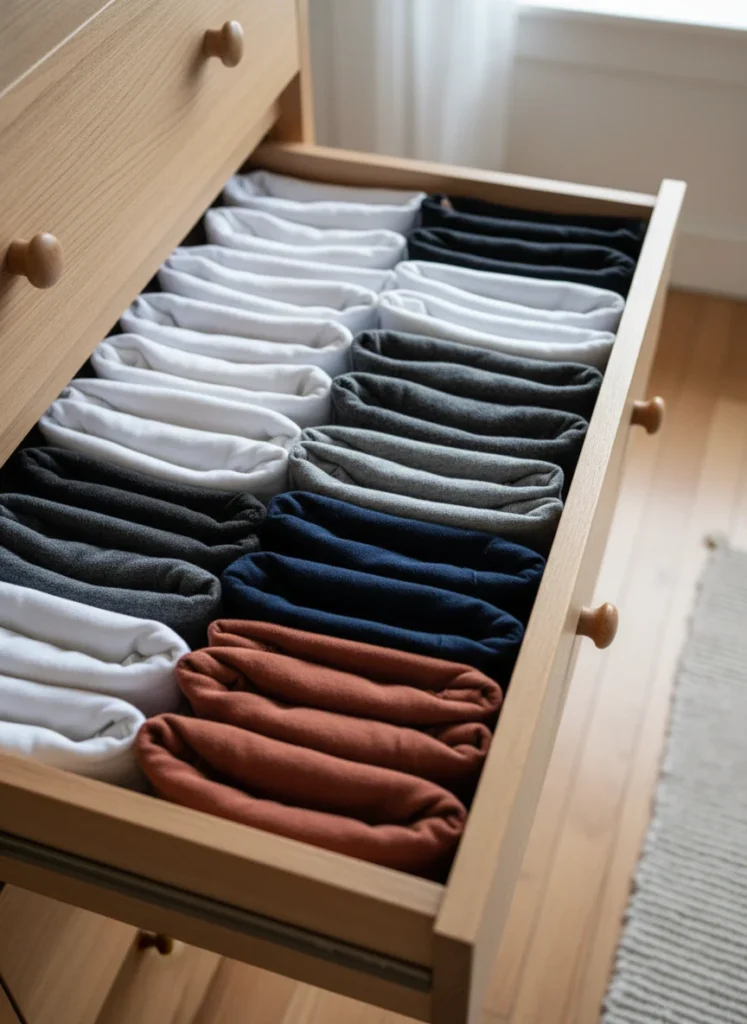
The stacking method of folding, where each item is laid flat on top of the one below, means you can only see the top item in the stack and accessing anything beneath it disturbs the whole pile. The vertical folding method, often called the KonMari method or file folding, folds each item into a small rectangle and stands it upright so that every item in the drawer is visible at once from above, like files in a filing cabinet. It sounds minor. The difference in how long a drawer stays organized is significant.
Vertical folding works for t-shirts, jeans, shorts, and most tops. It does not work well for thick knits or structured items. Once you fold this way it is genuinely hard to go back to stacking because the access to every item without disturbing the arrangement is immediately more functional. No purchase required. This is a system change, not a storage product.
8. Use a Tray to Contain Every Surface Collection
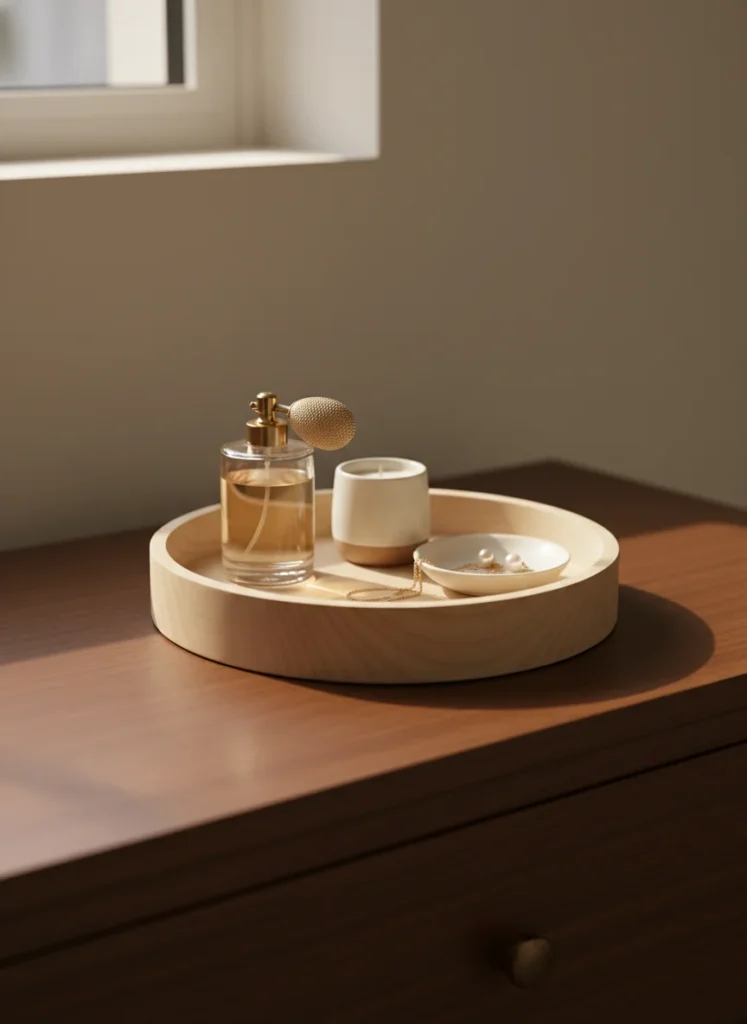
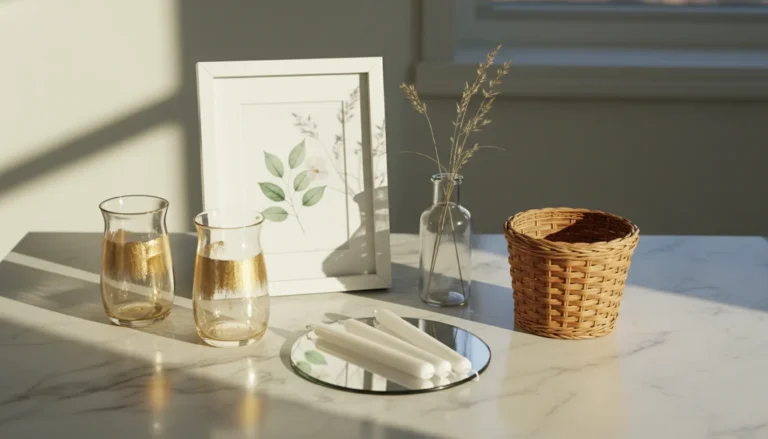
A tray is a visual boundary. Items inside a tray read as a curated collection. The same items scattered across a surface read as mess. The tray does not add storage, it adds visual containment, which is a different but equally important function in a small bedroom that is trying to look intentionally organized.
One tray per surface is the rule. The dresser gets a tray for jewelry, perfume, and small objects. The nightstand gets a tray for the phone, a candle, and a glass. Nothing else belongs on the surface outside the tray. When the tray gets full, something comes out rather than something being added to the surface beside it. A small round wood or ceramic tray for bedroom surfaces runs $10 to $22. The visual impact on how organized the room looks is immediate.
9. Mount Floating Shelves Instead of Adding Furniture
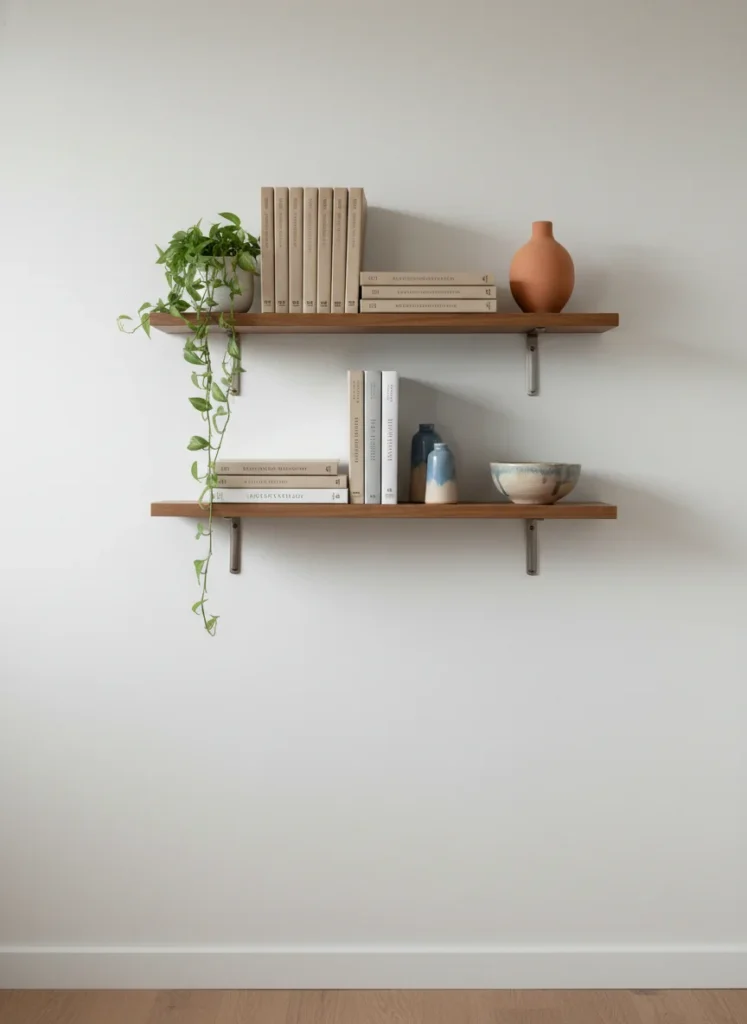
Every piece of floor furniture in a small bedroom competes with the clearance you need to move around the room. Floating shelves add storage capacity without taking a single square inch of floor space. Two floating shelves on one wall hold more than a small bookcase and leave the floor beneath them completely clear, which makes the room read as larger even if the total volume of objects in the room is the same.
Style shelves with intentional negative space: not full, not empty, but about 60 to 70 percent occupied with items that have a reason to be there. Books, plants, a ceramic or two, and one functional item like a small basket for charging cables. Anything that would otherwise live on a surface goes on the shelf instead. The shelf creates the surface the room was missing without adding furniture to the floor plan. A set of two floating shelves in natural wood runs $20 to $40 and installs in under 30 minutes.
10. Do a Five-Minute Reset Every Night Before Bed
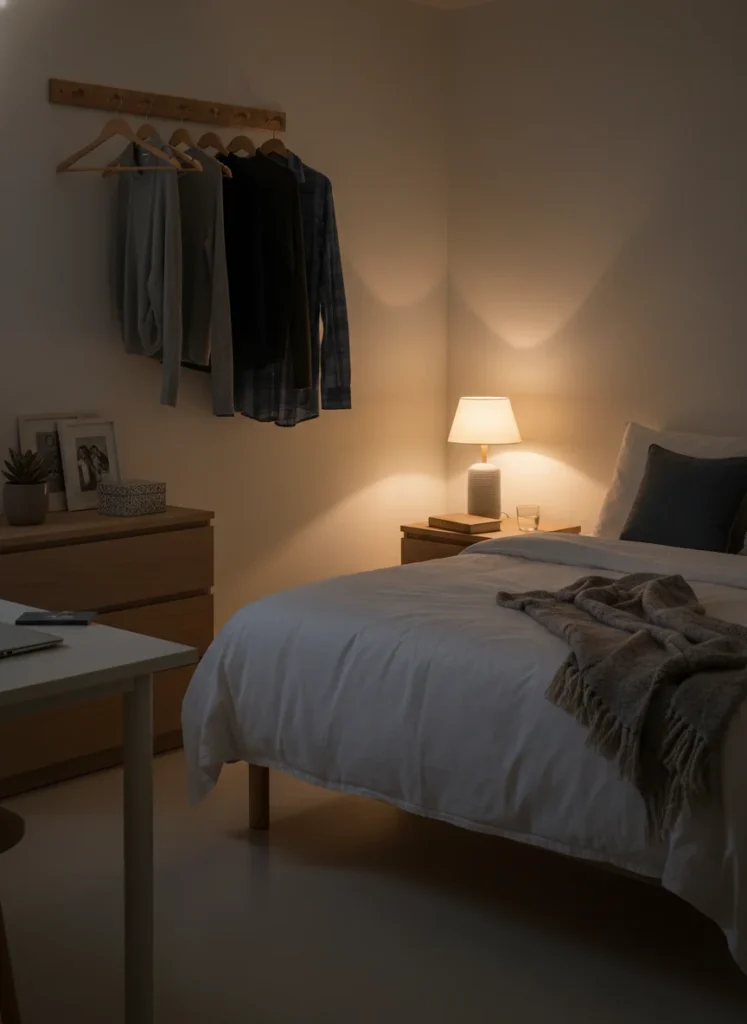
Organization systems only work if they are used, and the five-minute nightly reset is the habit that makes the system automatic. Before sleeping, spend five minutes putting today’s misplaced items where they belong: the outfit to the hook or the hamper, the glass to the kitchen, the random items from the nightstand back to their trays. Five minutes is the specific amount of time that feels acceptable even when you are tired, which is why it sticks when longer routines do not.
The reset works because it prevents accumulation. One day’s worth of misplaced items takes five minutes to put away. Three days’ worth takes 20 minutes and generates enough resistance that it does not happen. The daily reset prevents the tipping point where the effort of organizing feels too large to start. No products required. This is the habit that makes every other system on this list sustainable.
11. Use a Dedicated Laundry Basket With a Lid
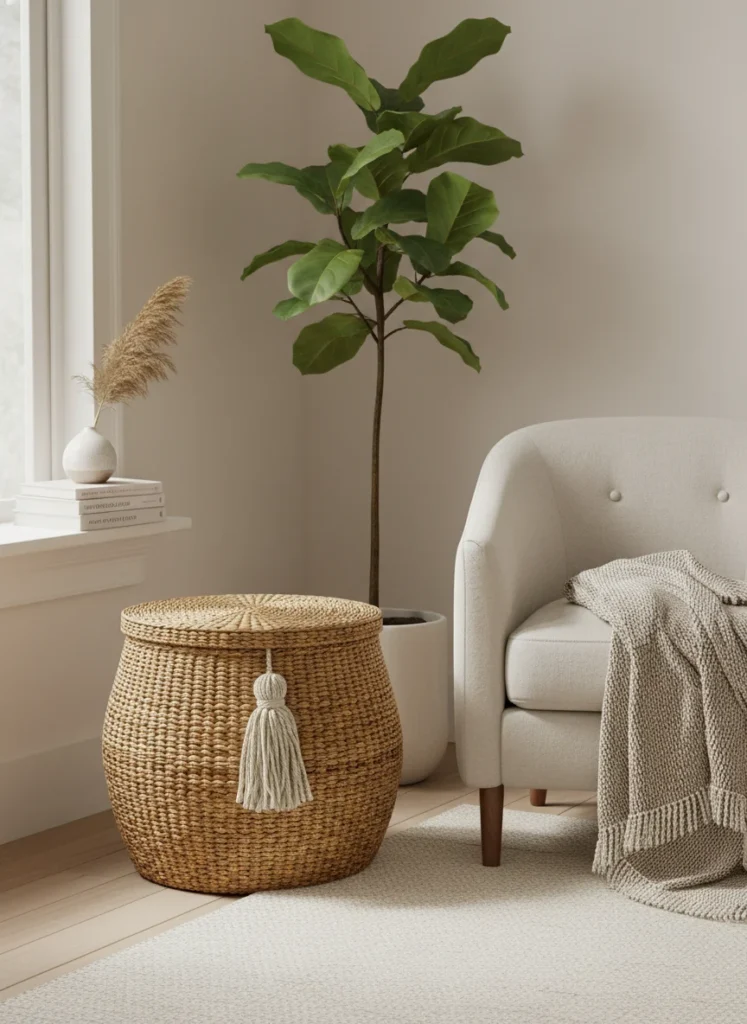
An open laundry basket in a small bedroom is a permanent visual reminder of mess even when the room is otherwise organized. A lidded basket converts the laundry storage from visible disorder to a piece of room decor. The basket also signals that dirty laundry has a specific destination, which reduces the likelihood of clothes landing on the floor or the chair instead.
A woven seagrass or rattan laundry basket with a fitted lid looks like an intentional design choice in a bedroom rather than a utility item. It reads similarly to the baskets used in the coastal grandmother bedroom, the japandi bedroom, and the quiet luxury bedroom, which means it works across a wide range of aesthetics. A lidded woven laundry basket in a natural material runs $25 to $55.
12. Keep One “Catch-All” Basket That Gets Emptied Weekly
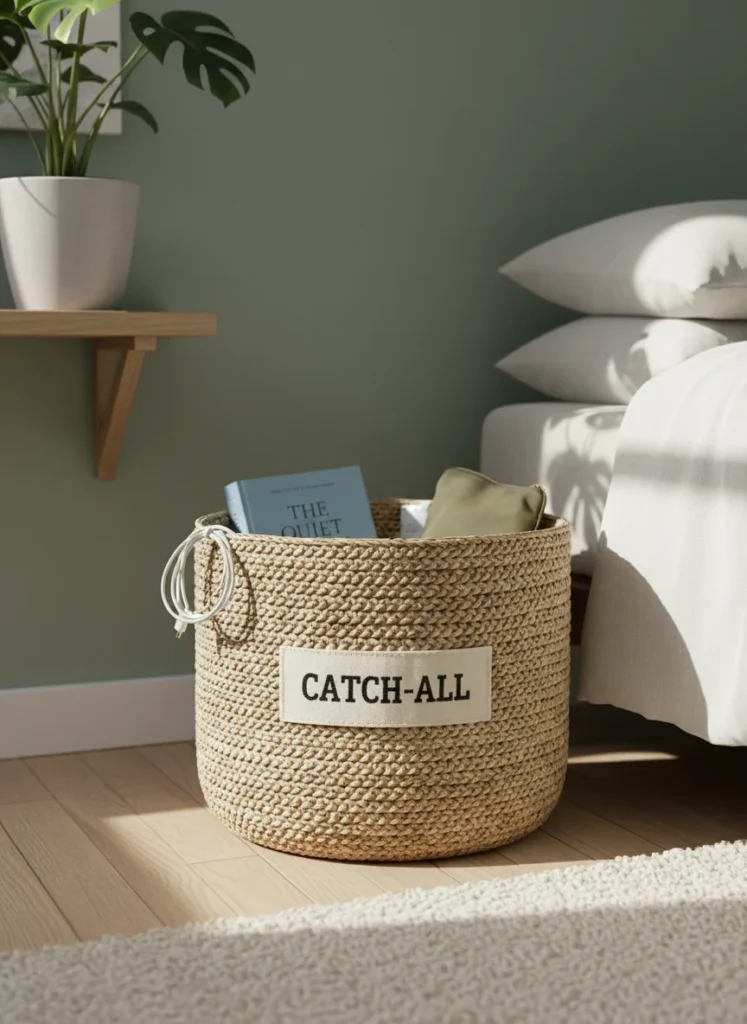
Every small bedroom needs a sanctioned landing zone for items that do not yet have a permanent home or that are in temporary transit. Without a designated spot, these items land on every surface. With one designated basket, they land in one place and the rest of the room stays clear. The catch-all basket works because it accepts the reality that not everything has a perfect home every day, while still containing the visual clutter to one location.
The rule: the basket gets emptied and items returned to their homes once a week. If the basket is consistently full before the week ends, that signals that certain items need permanent homes that they currently lack. The basket is a diagnostic tool as much as a storage solution. A medium woven basket in a neutral natural tone, $15 to $25, works perfectly and reads as intentional bedroom decor rather than overflow storage.
13. Move the Dresser Into the Closet to Free the Bedroom Floor
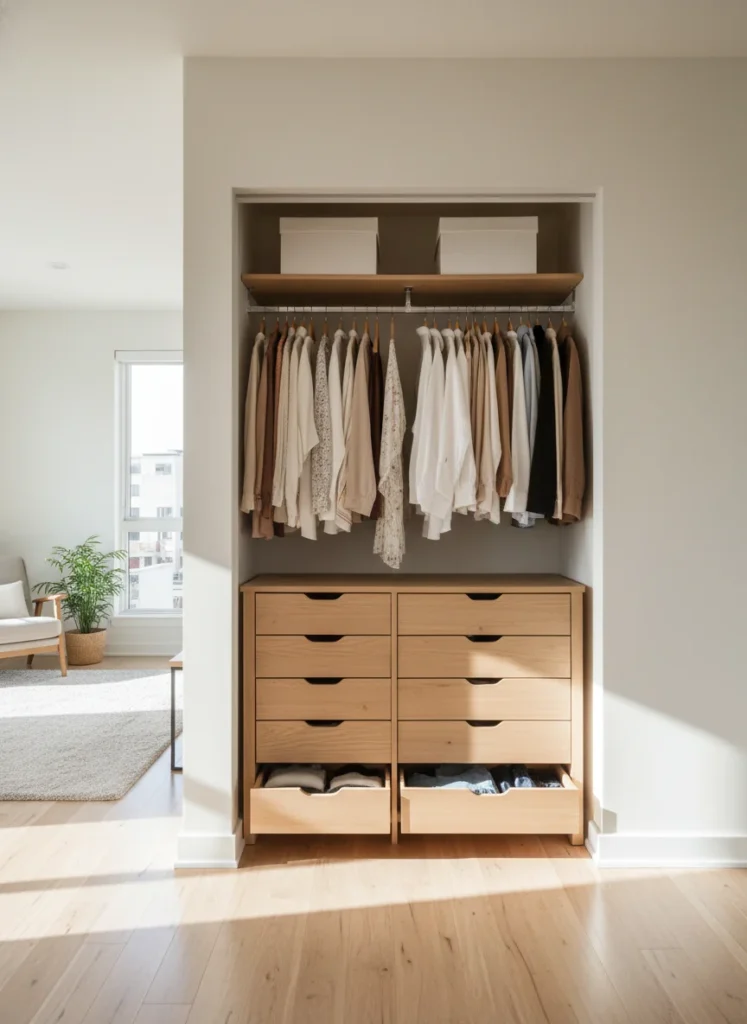
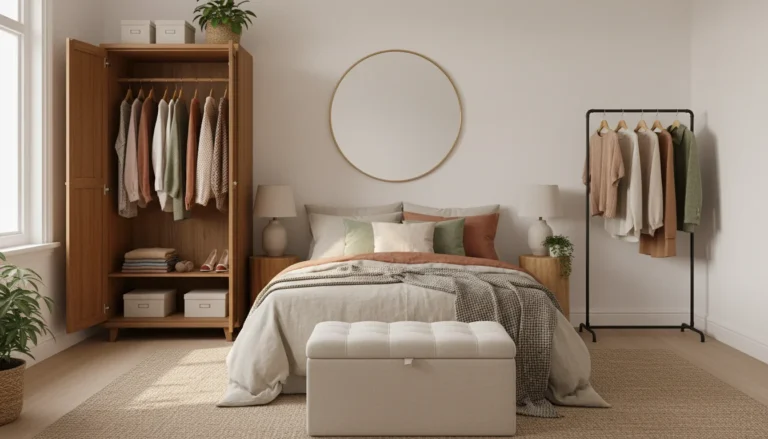
A dresser inside the closet sounds counterintuitive until you experience a bedroom without a dresser on the floor. A standard dresser is 30 to 36 inches wide and 18 inches deep, which is 4.5 to 5.4 square feet of floor space in a bedroom that may be 100 to 120 square feet total. Moving the dresser inside the closet, where it replaces or fits below the hanging clothes section, reclaims that floor space for the bedroom and makes the room read as significantly more open.
This works if the closet is at least 24 inches deep and the dresser is slim enough to fit inside it. Many standard 4-drawer dressers at 18 inches deep fit inside a standard 24-inch closet with 6 inches of door clearance. The closet now holds all clothing in both hung and folded form, and the bedroom floor has no clothing storage furniture at all. This is the move covered in the post on small bedroom ideas with a full bed as one of the highest-impact layout changes for tight rooms.
14. Label Storage Bins to Eliminate Search Clutter
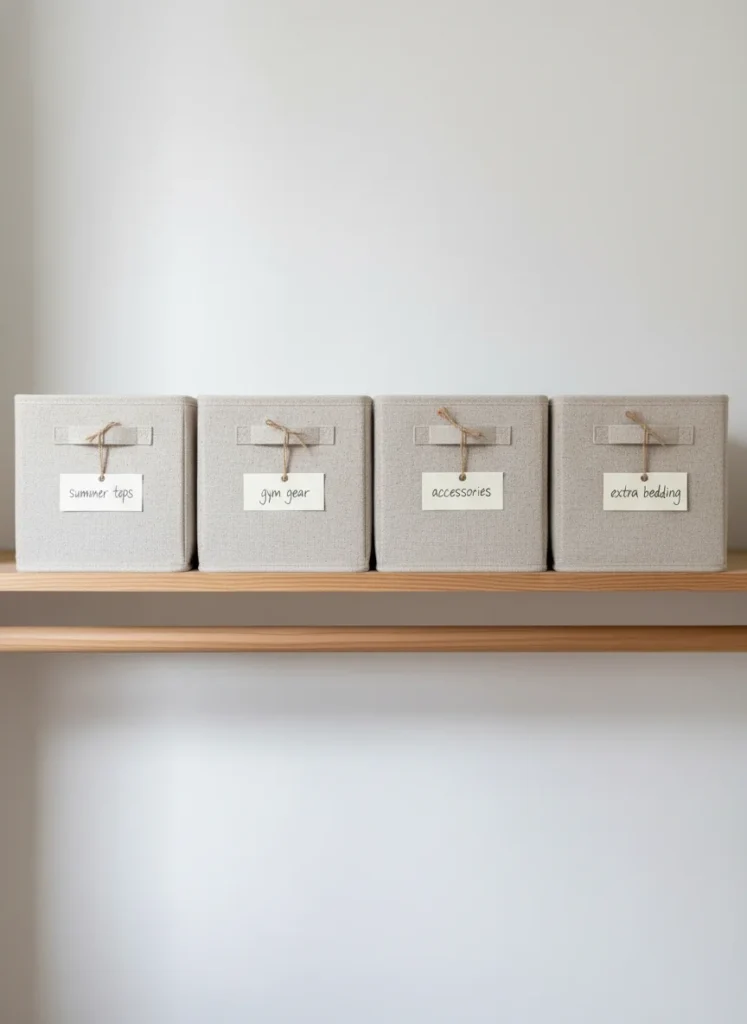
Unlabeled storage bins create a specific type of organizational failure: you put items in them quickly but cannot find them easily, which leads to emptying the wrong bin, leaving items out rather than searching, and eventually the bin becoming a general clutter repository. Labels eliminate this friction entirely. When every bin has a name, every item has exactly one possible destination, and finding anything takes seconds instead of minutes.
Labels do not need to be elaborate. A small piece of masking tape with a handwritten category name works as well as any printed label system. For visible bins on open shelves, a small rectangular tag attached with twine reads more finished. The habit of labeling costs nothing and is the difference between a storage system that works indefinitely and one that devolves into chaos within a few weeks.
15. Use Peel-and-Stick Hooks for Cables and Small Accessories
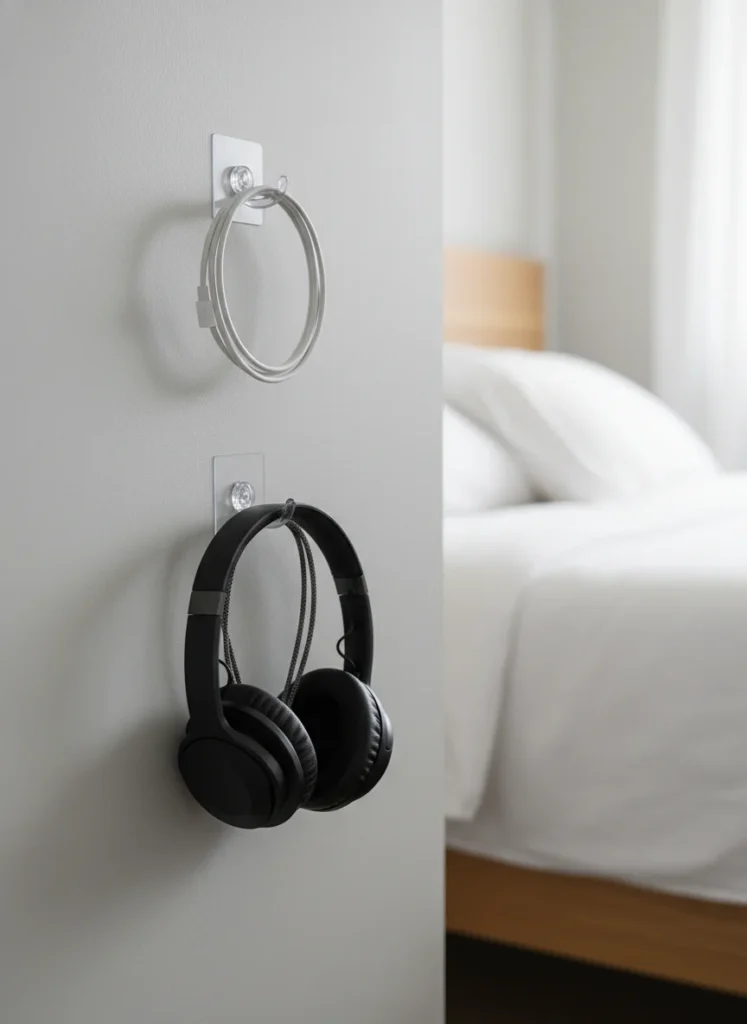
Charging cables, headphone cords, and other cables are among the most persistent surface clutter items in a small bedroom because they serve a daily function but have no good permanent home in most rooms. A peel-and-stick adhesive hook on the wall behind the nightstand or on the side of the desk holds the cable in an accessible position off every surface without drilling and without purchasing any permanent fixture.
Command strips and adhesive hooks in the appropriate weight rating for the items they will hold are renter-friendly and remove cleanly. A pack of peel-and-stick adhesive hooks for small items costs $6 to $12 for a pack of 20 and solves the cable-surface problem in about five minutes.
16. Adopt the One-In, One-Out Rule for Everything That Enters the Bedroom
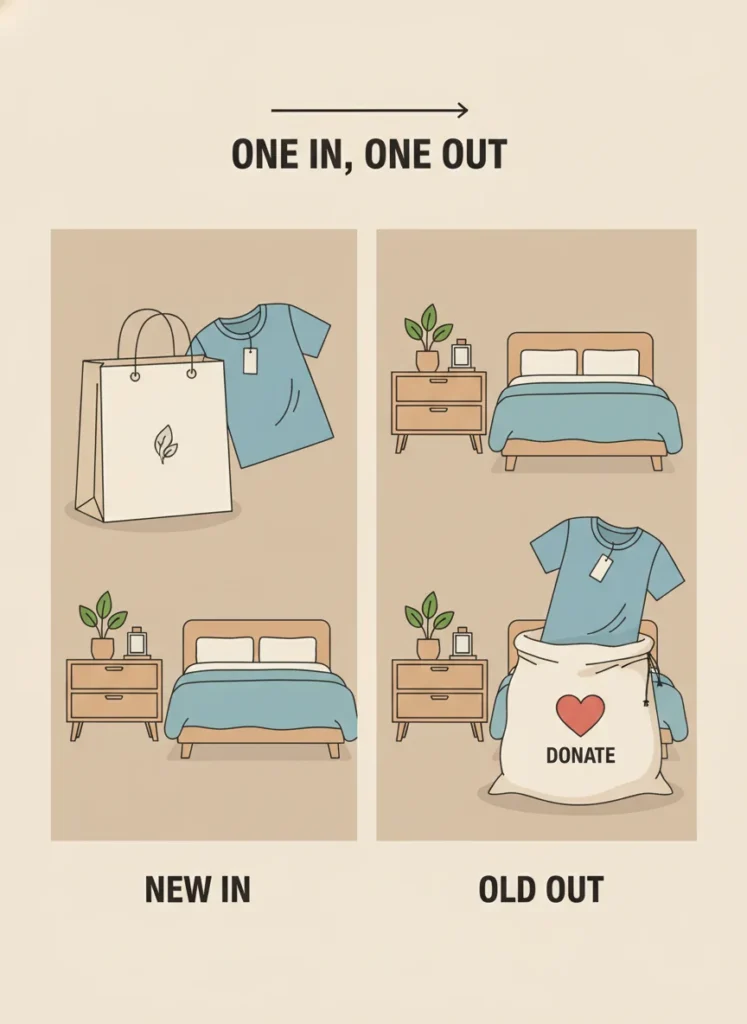
The single most effective long-term organizational rule for a small bedroom is also the simplest: for every new item that enters the room, one existing item leaves. A new shirt goes in the drawer, an old shirt goes to the donation bag. A new book goes on the shelf, an old book goes to the give-away pile. The room’s capacity stays constant regardless of how many new things arrive.
This rule requires a donation bag to be permanently accessible, either in the closet or beside the dresser. The moment you apply the one-in rule and need an item to go out, the bag needs to be immediately accessible or the rule fails. A simple cotton tote bag in the closet corner is enough. When it fills, it leaves. The room never grows beyond its organizational capacity because the capacity is actively maintained rather than passively hoped for.
17. Make the Bed Every Single Morning
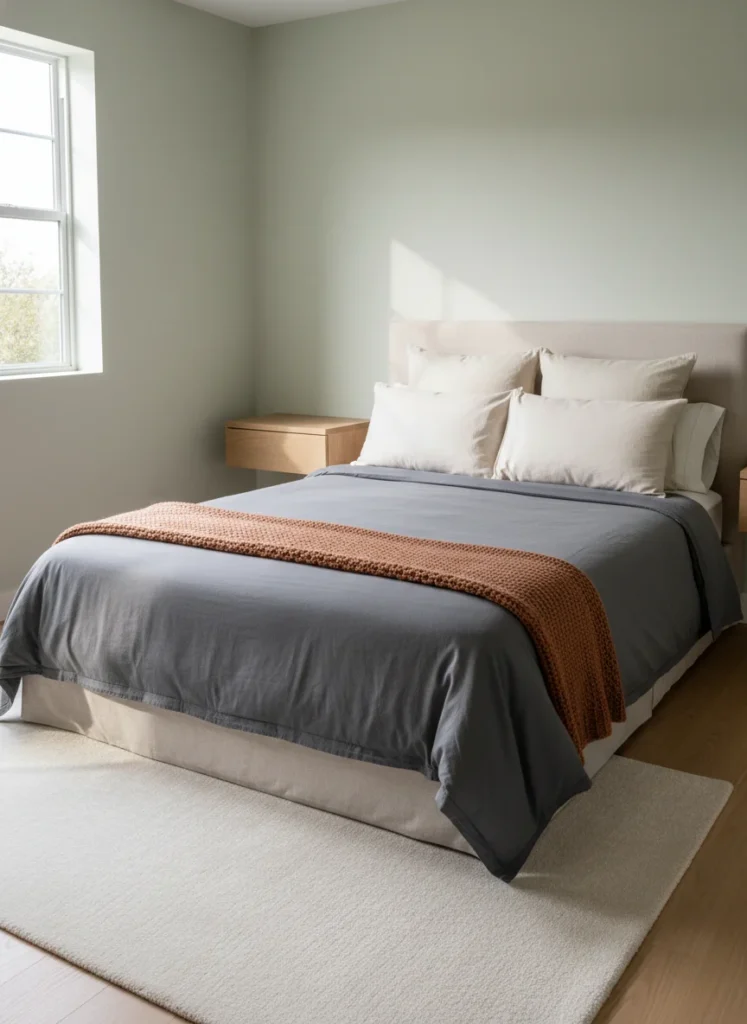
Making the bed is the one organizational action with the highest visual return in a small bedroom. An unmade bed in a small room reads as the entire room being messy because the bed is the largest visual element. A made bed in the same room reads as organized even if every other surface still needs attention. It is the visual anchor that sets the tone for how the room reads at a glance.
This does not require a hotel-quality styling session. Pulling the duvet flat and setting the pillows takes under 90 seconds. The visual impact lasts all day. If the bedding makes it hard to make quickly, that is a sign the bedding system is too complicated: too many decorative pillows that need to be removed and replaced, or a duvet that is too heavy to smooth quickly. Simplify the bedding to make the 90-second make possible every morning without exception. More on the bedding strategy that pairs with a minimal bedroom is in the post on quiet luxury bedroom ideas on a budget, where the bed styling philosophy aligns perfectly with the intentionally minimal look.
Before we continue, if you’re tired of buying decor that doesn’t look right together, I created something specifically for this…
The System That Keeps a Small Bedroom Organized for Good
The 17 tricks above work together as a layered system: the physical storage solutions reduce friction, the surface rules prevent accumulation, the daily habits maintain the baseline, and the one-in one-out rule prevents the slow growth of clutter over time. No single trick is the answer. The combination is what makes the small bedroom look intentionally minimal rather than accidentally organized on good days and chaotic on the rest.
Start with the three that apply most directly to your specific problem. If the floor is the issue: hook rail and laundry basket with a lid. If the surfaces are the problem: three-item maximum and trays. If the closet is the bottleneck: slim velvet hangers and the dresser relocation. Build from there. The system compounds as each piece reinforces the others, and within a few weeks the room starts maintaining itself with minimal daily input.